Mastering Adverbs of Time: The Ultimate Student Guide
Every term, during parent-teacher conferences or while grading essays for secondary English certifications like the Cambridge IGCSE, Oxford AQA, or Edexcel exams, a familiar problem pops up. Brilliant stories or analytical essays come across my desk, but they read like a scattered timeline. Students write sentences like, “We went to the museum and we looked at artifacts and we went home.” The sequence is completely lost. The reader is left wondering: Did this happen simultaneously? Did one event trigger the other? This comprehensive article provides clear frameworks for mastering adverbs of time to unlock a higher band of technical narrative performance.
Why Is Mastering Adverbs of Time the Secret to Better Writing?
According to standard linguistic curriculum metrics, an adverb of time: is defined as a word or phrase that modifies a verb, adjective, or sentence by specifying precisely when, for how long, or how frequently an action occurs within a temporal framework.
The core issue in secondary writing is chronological confusion. The solution isn’t adding flashy adjectives or complex metaphors. The fix is mastering adverbs of time. These simple words act like traffic controllers for your sentences. They tell the reader exactly when something happened (yesterday, now, later), how long it lasted (for three hours, all day), and how often it repeats (weekly, never).
When you learn to position these words correctly, your sentences transition from choppy, isolated thoughts into a smooth, cinematic flow. For instance, notice how adding a few temporal markers completely changes the pacing of a short story:
- Without temporal markers: The bell rang. The students packed their bags. The teacher smiled.
- With temporal markers: Suddenly, the bell rang. Immediately, the students packed their bags while the teacher smiled wearily.
By dedicating time to mastering adverbs of time, you give your reader a clear map of your narrative or argument, ensuring they never get lost in your timeline. When reviewing digital essays on Google Docs or Microsoft Word, I find that essays utilizing a rich diversity of these modifiers consistently score higher in the structural coherence bands used by exam graders. Through mastering adverbs of time, you avoid the monotonous trap of using “then” at the start of every single sentence. It is a transformational skill that changes how you express complex thoughts. Let’s look at how mastering adverbs of time can be broken down into practical steps that you can apply to your next major writing assignment.
What Are the Core Categories of Time Adverbs?
According to standard grammar classification frameworks, a specific point adverb of time: is defined as a linguistic modifier that establishes a concrete, non-negotiable temporal anchor for an action, answering the direct question “when” within a chronological sequence.
When grading essay submissions across platforms like Turnitin or Canvas, I often notice secondary students using the exact same four words over and over again: then, after, next, and soon. While these words are grammatically correct, relying on them too heavily makes your writing feel repetitive. To truly elevate your work, you need to understand that temporal modifiers fall into three distinct functional categories.
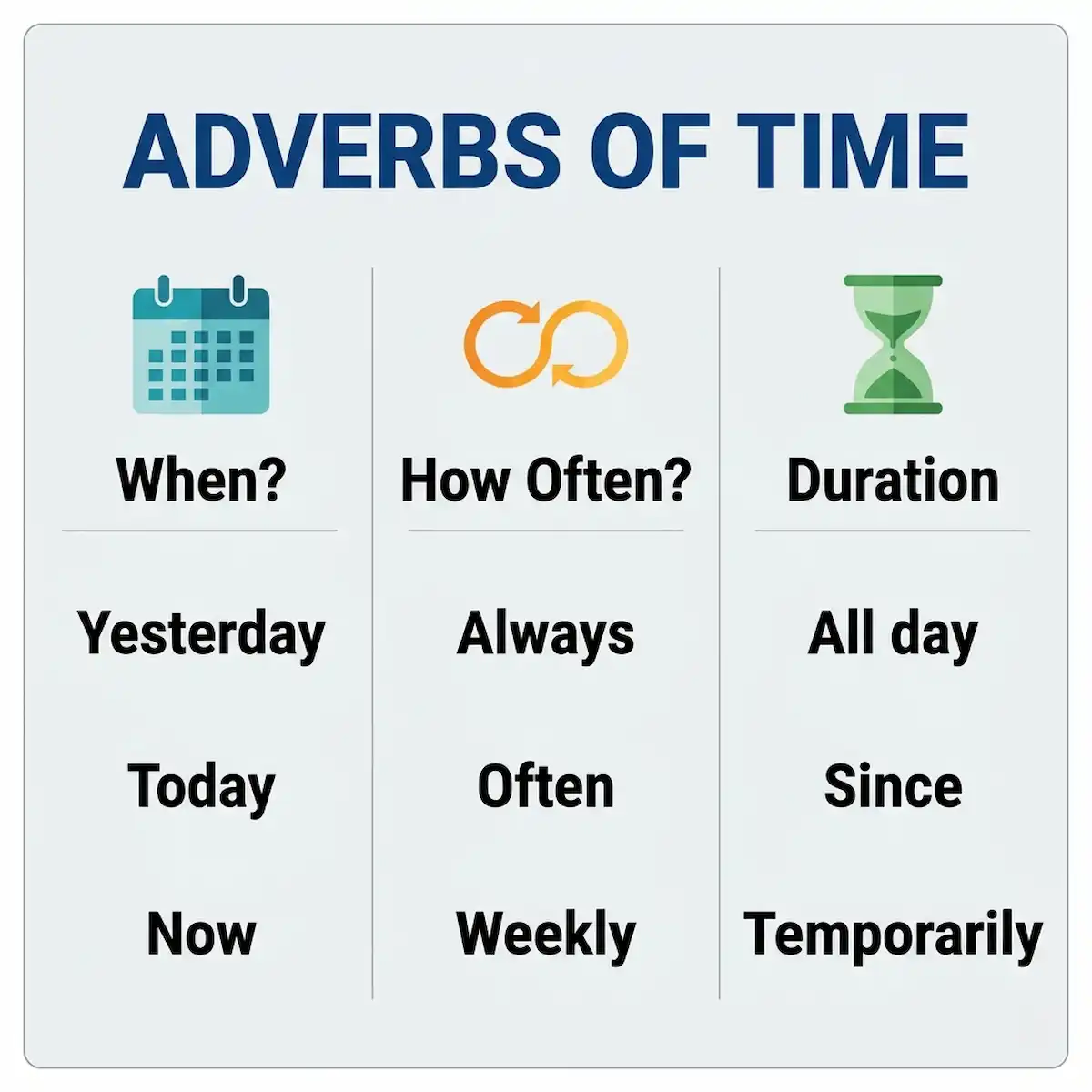
By mastering adverbs of time, you learn to identify these categories and select the exact word your sentence needs. The first category answers the question When? (Specific Point in Time). These words anchor your action to a precise moment on the calendar or clock. The second category answers How long? (Duration). These tell your reader the lifespan of an action. The final category answers How often? (Frequency). These explain the repetition rate of an event.
To help you see the differences clearly, let’s look at how these three categories function side by side:
| Category Type | Core Grammatical Function | Primary Question Answered | High-Impact Academic Examples |
| Specific Point | Anchors an action to a precise moment | When? | Yesterday, today, tomorrow, tonight, now, then, recently, later, immediately |
| Duration | Defines the lifespan or boundary of an action | How long? | All day, for an hour, since Tuesday, temporarily, permanently, overnight |
| Frequency | Establishes the repetition rate of an event | How often? | Always, usually, normally, often, sometimes, rarely, seldom, never, annually |
Think of these categories as different tools in a toolkit. You wouldn’t use a hammer when you need a tape measure, and you shouldn’t use a frequency adverb when your sentence needs a precise anchor point. In my years teaching secondary English, I’ve seen that mastering adverbs of time helps students move past basic vocabulary. Instead of writing, “We did our homework later,” a student who is focused on mastering adverbs of time will write, “We completed our chemistry module subsequently.” This slight shift changes how an examiner views your writing profile.
When you practice mastering adverbs of time, you start to see these categories naturally as you read classic literature or news articles on websites like BBC Learning English or The New York Times. You begin to notice that professional writers rely on a deliberate balance of all three categories to keep their text moving smoothly. Let’s explore how mastering adverbs of time gives you full control over these categories in your own essays.
How Do You Correctly Position Point-in-Time Adverbs?
According to pedagogical syntax guidelines, a point-in-time modifier: is defined as a chronological marker placed at the absolute beginning or conclusion of a clause to establish structural focus, narrative pacing, or emphasis within a text.
The placement of these words can drastically change the tone and rhythm of your sentences. A common mistake I see in student portfolios on platforms like Seesaw or Google Classroom is putting point-in-time modifiers right in the middle of a clause, which disrupts the natural flow of the sentence. For example, writing “The class tomorrow will visit the lab” sounds awkward and unnatural.
Through mastering adverbs of time, you learn how to avoid these clumsy phrasing traps. To fix this, you generally have two reliable options: place the modifier at the very end of the sentence for a neutral, natural tone, or place it at the very beginning to build drama or emphasize the timeline.
Here is a quick look at how changing the position of these words alters the focus of your writing:
| Adverb Placement | Sentences Example | Stylistic Impact & Student Writing Use Case |
| End of Sentence | We will submit our final history projects tomorrow. | Standard, objective placement. Use this for general academic writing and standard essays. |
| Beginning of Sentence | Tomorrow, we will submit our final history projects. | High emphasis. Use this when the timeline itself is the most important part of your argument. |
| Incorrect / Avoid | We will tomorrow submit our final history projects. | Awkward middle placement. Disrupts the verb phrase and makes the text hard to read. |
If you want to make your writing flow naturally, try reading your sentences out loud. If your voice trips over a word like yesterday or now in the middle of a phrase, try moving it to the very end or the very beginning. This simple habit is a major part of mastering adverbs of time. When working on creative writing pieces for your portfolio, mastering adverbs of time allows you to play with suspense. Consider starting a paragraph with “Suddenly” or “Instantly” to pull your reader straight into the action.
On the other hand, in an analytical history essay evaluating major treaties, mastering adverbs of time means placing dates and points-in-time cleanly at the ends of clauses to keep the focus on your historical analysis. By mastering adverbs of time, you also avoid confusing your reader when describing complex, multi-stage events. If you are writing a lab report for your biology class, mastering adverbs of time ensures that steps are clearly separated, preventing your reader from mixing up the sequence of your actions.
How Do Duration Adverbs Map Out an Action’s Lifespan?
According to advanced syntax structures, an adverb of duration is defined as a temporal element that quantifies the continuity, boundary, or lifespan of a verb’s action, measuring the total time elapsed from start to finish.
When grading argumentative essays, I regularly see arguments lose their impact because the timeline is too vague. A student might write, “The ice caps melted and the sea levels rose.” Without a clear timeframe, the reader doesn’t know if this happened over a weekend or several decades. This is why mastering adverbs of time is so crucial for clear, academic communication.
By mastering adverbs of time that show duration, you bring immediate clarity to your writing. These words often rely on prepositions like for and since to build their structure. For measures a specific block of time, while since points directly back to a clear starting point.
Let’s look at how these duration markers establish clear boundaries for your reader:
| Duration Modifier | Sentence Construction | Analytical Value for Academic Essay Projects |
| For + Time Block | The experiment ran for six hours without interruption. | Quantifies exact duration, showing the scope and scale of an event or study. |
| Since + Point | The local community has tracked pollution since 2018. | Establishes a historical baseline, linking a past starting point directly to the present. |
| Boundary Adverbs | The school campus will be temporarily closed for repairs. | Explains the nature of the timeframe, distinguishing between short-term and permanent states. |
Using duration adverbs effectively takes the guesswork out of your writing, allowing your reader to understand exactly how much time an action takes. In my grammar workshops, I emphasize that mastering adverbs of time involves knowing when to choose a duration marker over a point-in-time marker to give your arguments more weight. For example, when preparing for an English speech competition using platforms like NoRedInk or Quill.org, mastering adverbs of time can help you highlight the urgency of an issue. Saying an issue has persisted “for generations” sounds much more powerful than saying it happened “in the past.”
Ultimately, mastering adverbs of time allows you to paint a precise picture of time for your audience. Whether you are describing a quick science experiment or a centuries-old historical trend, mastering adverbs of time gives you the tools to make your timelines explicit and impactful. Remember that mastering adverbs of time is an active focus during your proofreading stages.
Where Should Adverbs of Frequency Fit Into Your Sentences?
According to descriptive English grammar standards, an adverb of frequency: is defined as a modifier that indicates the mathematical or relative regularity with which an action occurs, ranging from absolute certainty to complete non-occurrence.
Positioning frequency adverbs can be tricky because their placement depends entirely on the types of verbs you are using. In my classes, this is where students lose the most marks on grammar quizzes. They often write sentences like, “I always am on time,” instead of the correct form, “I am always on time.” Mastering adverbs of time means getting these structural rules down until they become second nature.
To get this right every time, remember this simple rule: if your sentence uses the verb to be (am, is, are, was, were), place the frequency adverb after the verb. For almost all other main verbs, place the frequency adverb before the verb.
Here is a breakdown of how this rule works in practice:
| Verb Type Involved | Correct Structural Placement | Exemplary Sentence Structure for Students |
| To Be Verbs | After the primary verb | The student council leaders are usually present at meetings. |
| Action Verbs | Before the primary verb | Our peer tutors frequently help classmates after school hours. |
| Auxiliary Verbs | Between helper and main verb | The research team has never missed a laboratory deadline. |
Mastering adverbs of time makes your writing sound natural and polished, helping you avoid the awkward phrasing that often distracts readers. When practicing on digital learning apps like Duolingo or IXL Learning, you will see that native speakers follow these placement rules automatically. As you focus on mastering adverbs of time, you will also notice that frequency words can change the entire tone of an argument.
In persuasive essays, using absolute words like “always” or “never” can make an argument easy to challenge. Part of mastering adverbs of time is learning to use softer frequency markers like “frequently,” “generally,” or “seldom” to build a more balanced, nuanced position. By mastering adverbs of time, you gain complete control over how often an action appears to happen. This is incredibly helpful when writing lab reports or describing behavioral trends in social studies, where accuracy is everything. Let’s look closer at how mastering adverbs of time can help you combine these modifiers smoothly within a single sentence.
What Happens When You Combine Multiple Adverbs of Time?
According to standard syntactic sequencing rules, a multi-adverb temporal sequence: is defined as a structured arrangement where modifiers are organized in a strict order of “how long,” “how often,” and “when” to maintain clarity.
What do you do when a sentence needs to tell your reader where, how long, how often, and when an event happened all at once? If you stack these modifiers randomly, your sentence quickly turns into a confusing jumble. For example: “The band practiced last night for two hours weekly at school.” It’s completely disorganized, and it’s a common issue I see when grading drafts.
To keep your writing clear, native English speakers follow a natural, unspoken order: 1. For how long, 2. How often, 3. When. Mastering adverbs of time is the key to managing this sequence without making your sentences feel forced or clunky.
Let’s look at how to organize multiple temporal details into a clean, easy-to-read sentence:
| Sequence Priority | Step 1: How Long? (Duration) | Step 2: How Often? (Frequency) | Step 3: When? (Specific Point) |
| Sentence Structure | The track team ran for an hour | every single day | last semester. |
| Strategic Goal | Measures the individual session length | Shows how often the session repeated | Anchors the entire routine to a clear timeframe |
When you arrange your sentences this way, you can share a lot of detailed information without overwhelming your reader. Mastering adverbs of time helps you build complex sentences that still feel light and easy to follow. During peer-review sessions in my classroom, I often have students highlight different types of modifiers in distinct colors using highlighter pens. This visual exercise shows how mastering adverbs of time keeps sentences balanced. If a sentence has three time words clustered together at the very end, it can feel heavy.
Part of mastering adverbs of time is learning to move the “when” element to the front of the sentence to balance things out: “Last semester, the track team ran for an hour every single day.” By mastering adverbs of time, you build the confidence to write longer, more sophisticated sentences. You no longer have to break your thoughts down into short, choppy sentences just to avoid grammar mistakes. Instead, mastering adverbs of time gives you the freedom to weave detailed timelines together seamlessly.
How Do Subtle Shifts in Temporal Words Change Your Tone?
According to sociolinguistic stylistic frameworks, a temporal tone shift: is defined as the deliberate selection of nuanced time modifiers to transition a text from casual, informal speech to formal, academic discourse.
Choosing the right word isn’t just about grammar; it’s also about setting the right tone for your audience. In casual text messages on WhatsApp or Discord, we often use vague words like later, soon, or in a bit. But if you use those same words in an analytical essay, your writing can lose its authority. Mastering adverbs of time is about knowing which words fit formal writing and which ones belong in casual conversation.
For instance, look at how changing a single time word elevates a sentence from a casual comment to a professional statement:
- Informal: We need to fix the science lab equipment soon.
- Formal: We need to fix the science lab equipment immediately.
Let’s compare informal time markers with their formal, academic counterparts to see this in action:
| Casual/Informal Marker | Academic Alternative | Impact on Essay Writing and Narrative Voice |
| Soon | In due course / Shortly | Changes a vague prediction into a professional, measured expectation. |
| Now | Currently / At present | Moves away from a conversational tone to sound like a precise, objective observation. |
| Again and again | Repeatedly / Consistently | Replaces conversational repetition with a focused, analytical description. |
By choosing more precise alternatives, you instantly give your writing a more polished, academic tone. In my experience grading secondary English papers, students who focus on mastering adverbs of time always stand out because their writing sounds mature and deliberate. When working with formal grading metrics on tools like Turnitin, vocabulary precision is a key factor in earning top marks. Mastering adverbs of time ensures you don’t default to casual speech patterns out of habit.
Instead, mastering adverbs of time allows you to choose words that match the expectations of examiners and teachers. Ultimately, mastering adverbs of time helps you control how your reader perceives your voice. Whether you are writing a persuasive speech, a historical analysis, or a creative story, mastering adverbs of time gives you the stylistic flexibility to adjust your tone perfectly for any audience. Focus on mastering adverbs of time every time you write a new draft to reinforce these high-scoring habits.
Practice Makes Perfect
Here is a PDF worksheet you can download to practice adverbs of time. The answers are on a separate page.
Frequently Asked Questions About Time Modifiers
According to secondary English curriculum guidelines, an adverbial study guide: is defined as an educational framework designed to answer common student questions and fix frequent grammatical errors in writing.
Can a word like ‘yesterday’ act as both a noun and an adverb?
Yes. It depends entirely on how it functions in your sentence. If it is the subject of the sentence, it is a noun (“Yesterday was a wonderful day”). If it modifies an action by telling you when it happened, it is an adverb (“We completed our team project yesterday”). Mastering adverbs of time requires learning to look at how a word functions in context rather than just labeling it in isolation.
What is the main difference between ‘yet’ and ‘already’?
We generally use already to talk about something that happened sooner than expected (“We have already finished the biology quiz”). We use yet to talk about something that hasn’t happened but is expected to happen soon, typically in negative sentences or questions (“The school bus has not arrived yet”). Mastering adverbs of time helps you use these words correctly to clarify expectations for your reader.
Why shouldn’t I place a frequency adverb at the start of a sentence?
While some frequency adverbs like sometimes or usually work perfectly fine at the beginning of a sentence (“Sometimes we study in the library”), others like always, seldom, or never sound very awkward there. Placing them right before the main verb is always the safest bet for clear writing. Mastering adverbs of time means recognizing these subtle stylistic preferences.
How do time adverbs help transition between paragraphs?
Time adverbs are excellent tools for building smooth transitions. Instead of starting a new paragraph with a jarring change, using transitional phrases like subsequently, simultaneously, or previously helps guide your reader smoothly from one point in your timeline to the next. Mastering adverbs of time allows you to connect your paragraphs logically, making your entire essay feel cohesive and well-structured.
Final Checklist for Your Next Essay Assignment
To make sure your writing is as clear and polished as possible, keep this quick checklist handy for your next assignment. Remember that mastering adverbs of time is a gradual process that improves with intentional practice:
- Are your specific point-in-time adverbs placed neatly at the very beginning or the very end of your sentences?
- Did you place your frequency adverbs after ‘to be’ verbs and before action verbs?
- When using multiple time words, did you follow the natural order: How long, How often, When?
- Did you swap out casual words like soon or later for stronger, academic choices like immediately or currently?
By mastering adverbs of time, you give your writing a clear, professional rhythm that keeps your reader engaged from start to finish. Happy writing!
Additional Helpful Information
- Learn about adverbs of frequency – Present Tense Time Expressions – Adverbs of Frequency