Prepositions of Time: In, On, At — How to Stop Guessing When Things Happen
If you sit in my secondary English classroom on a rainy Tuesday morning, you will see smart intermediate students who can write a sharp thesis statement freeze up over a three-letter word. Someone will hand in a paragraph saying, “We have a history test in Friday at 8:30,” or “School starts on September.” Even students who score well on reading comprehension trip over prepositions of time in on at because their first language often maps time differently than English does.
One of my favorite classroom moments happened a couple of years ago with a Grade 10 student named Sokha. She had studied verb tenses all week and nailed past continuous and present perfect on a quiz. Yet in her weekend journal, she wrote that her family visited relatives “at Sunday morning” and got back “on the night.” When I circled both prepositions in red pen, she sighed and asked, “Why does English make small words do so much work?”
She had a fair point. Unlike tenses, which follow tidy conjugation patterns, prepositions of time in on at feel idiomatic at first. Once you see how English zooms in from broad stretches of time to exact moments on the clock, though, the system makes much more sense. According to the Cambridge Dictionary grammar guide to at, on, and in, these prepositions group time expressions by scale and use, alongside a handful of fixed phrases you simply pick up through exposure.
Why Intermediate Learners Mix Up In, On, and At
In secondary school, intermediate learners sit at an awkward crossroads. You already know basic vocabulary for days, months, seasons, and hours, so nobody treats you like a beginner. At the same time, real-world writing—book reports, emails, lab schedules, exam essays—punishes careless small words.
Most mistakes happen for three practical reasons:
- Translating word-for-word from another language. Many languages use one general preposition for “at/on/in” or attach time markers directly to nouns. Copying that structure into English creates instant friction.
- Treating every time word the same way. A month, a calendar date, a day of the week, and a clock time are different units of time. English assigns a different preposition depending on which unit you name.
- Forgetting when to drop the preposition completely. Words like next, last, this, and every already anchor the time expression, so adding in, on, or at in front of them is a classic trap.
From a teaching and publishing perspective, clarity on small grammar points also matters outside the classroom. Search engines and AI answer systems pull direct, unambiguous definitions and structured comparisons when students or readers ask how a rule works. A clean chart paired with realistic examples beats vague advice every time.
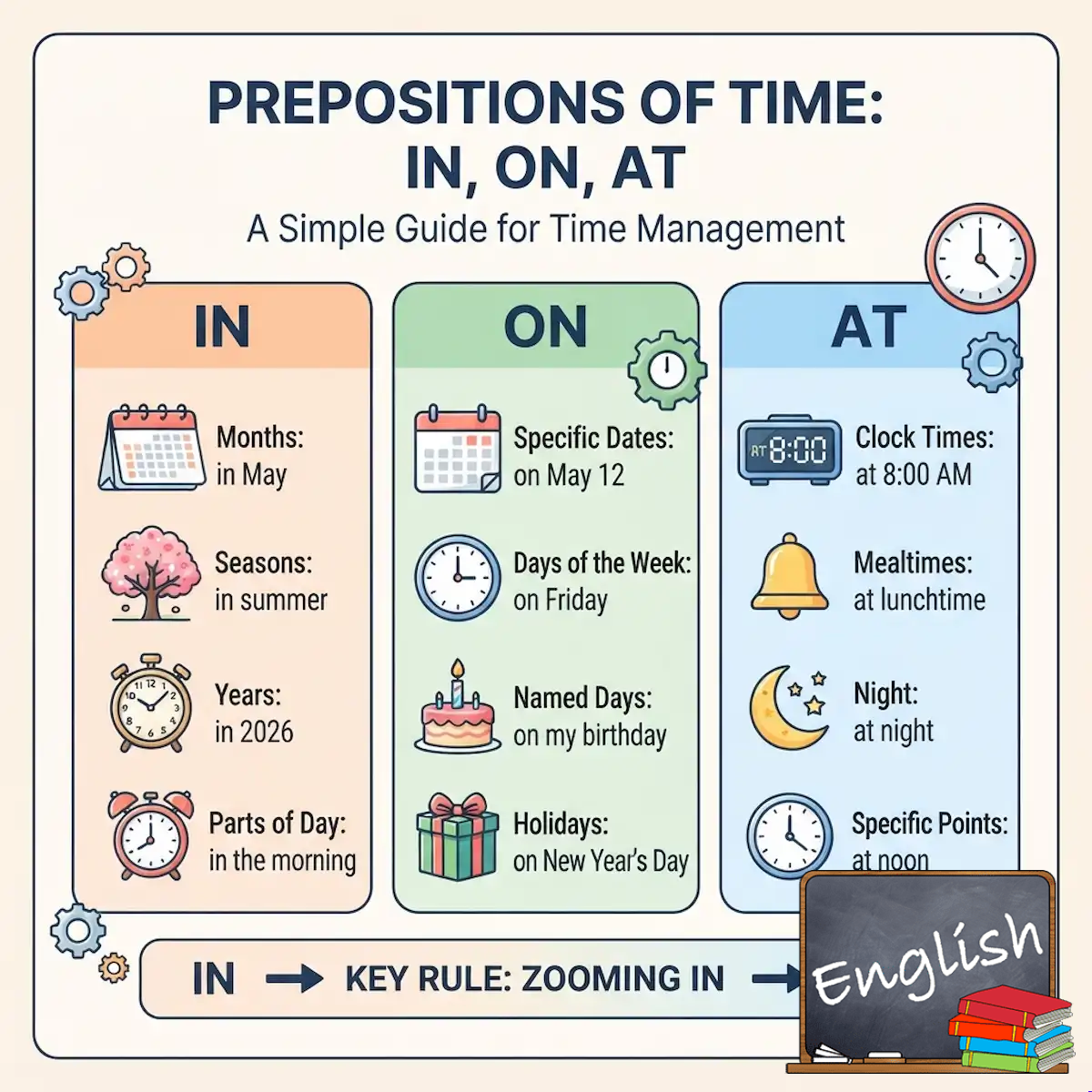
The Big Picture: A Scale-and-Rule Chart for In, On, and At
Think of time in English like a camera lens zooming in:
- In zooms out to wider periods: centuries, decades, years, seasons, months, and general parts of the day (like in the morning).
- On focuses on a specific day or calendar date: Mondays, Fridays, birthdays, holidays with the word “day,” and exact dates.
- At pinpoints a specific spot on the clock or a fixed point in the daily routine: at 7:15, at noon, at midnight, at night.
Here is a reference chart you can keep in your notebook when reviewing prepositions of time in on at:
| Preposition | Time Scale / Category | Typical Examples | Classroom Watch-Out |
| in | Months, seasons, years, decades, centuries | in May, in summer, in 2026, in the 1990s, in the 21st century | Do not use in before a full calendar date (on May 12, not in May 12). |
| in | Most parts of the day | in the morning, in the afternoon, in the evening | Watch out for at night and at noon / at midnight. |
| on | Days of the week and named days | on Monday, on Friday, on my birthday, on New Year’s Day | Days always take on, even if you add a part of the day (on Tuesday morning). |
| on | Specific calendar dates | on July 4, on October 19, 2025, on the 2nd of March | Never use in or at right before a specific date. |
| at | Exact clock times | at 8:00 a.m., at half past three, at 11:45 p.m. | Use at for the hour/minute mark, not in or on. |
| at | Specific points in the day / routines | at noon, at midnight, at night, at lunchtime, at bedtime | In the night can appear when referring to a specific night event. |
Clock Times: Pinpointing the Exact Moment with At
Whenever you look at a digital display or an analog clock face and read out a time, reach for at. Whether the time is on the hour, a quarter past, or a messy 4:37 p.m., at locks onto that exact point in time.
In my secondary classes, I tell students to picture a laser pointer hitting one exact tick mark on a clock. That single point is at.
Examples of Clock Times in Sentences
- “The school bus leaves at 6:45 a.m., so don’t sleep through your alarm.”
- “Our science lab starts at 1:15 in the afternoon.”
- “The library closes at eight o’clock on weekdays.”
- “I usually finish my homework at around nine, right before dinner.”
- “The train arrives at 17:30 if there are no delays on the line.”
Related Time Points and Mealtimes
Closely related to clock times are fixed points in the day—noon, midnight, night—and routine breaks or mealtimes like breakfast, lunch, dinner, and break time. As noted in the British Council LearnEnglish guide to prepositions of time, learners frequently use at for clock times, mealtimes, and night.
- “We eat lunch at noon when we have a full schedule.”
- “The streetlights flick on at dusk and stay lit all night.”
- “Nobody in our house is awake at midnight on a school night.”
- “Can we talk at break time instead of during the lecture?”
Teacher’s Tip: Students often ask why we say in the morning, in the afternoon, and in the evening, yet switch to at night. Treat at night as a set chunk for nighttime in general. If you specify a particular night or add a description, on or in can step in: “I woke up in the night” (during a specific night) or “It happened on a cold December night”.
Days of the Week: Locking In Specific Days with On
Once you move from clock minutes up to a full twenty-four-hour day, on takes over. That covers every day of the week—Monday through Sunday—plus special named days such as birthdays, graduation day, or holiday days.
A common slip-up in secondary essays happens when a student writes a day plus a time of day. Suppose your English literature quiz is on Thursday morning. Which word wins: on for Thursday or in for the morning? In English, the larger unit named first—the day—governs the preposition: on Thursday morning.
Examples with Days of the Week and Named Days
- “We have basketball practice on Mondays and Wednesdays.”
- “Our drama club meets on Friday after the final bell.”
- “She always bakes a lemon cake on her birthday.”
- “The school is closed on National Day, so enjoy the rest.”
- “I can’t make it on Saturday afternoon because I’m volunteering.”
Chart: Days of the Week and Part-of-Day Combinations
| Phrase | Correct Preposition | Why It Works | Example Sentence |
| Friday | on | Single day of the week | “The book report is due on Friday.” |
| Sunday morning | on | Named day takes priority over part of day | “We clean out our lockers on Sunday morning.” |
| the morning (alone) | in | General part of the day without a named day | “I think more clearly in the morning.” |
| my birthday | on | Specific named day | “They gave me a dictionary on my birthday.” |
| New Year’s Day | on | Holiday phrase ending in “Day” | “Fireworks went off on New Year’s Day.” |
Dates: Exact Calendar Spots Also Use On
Dates work on the exact same principle as days of the week: a specific calendar date takes on. Whether you write a date in month-day order (March 15), day-month order (15 March), or ordinal form (the fifteenth of March), the preposition stays on.
I still remember grading a set of mock exam letters where half the class wrote “in 14 February” because February is a month. Once you see the date 14, you have narrowed the month down to one specific day—so on is the right choice.
Examples with Calendar Dates
- “School registration opens on August 10.”
- “The history museum is hosting a special talk on 22 November.”
- “Our final exams begin on the third of June.”
- “He moved to this town on October 1, 2023.”
- “Please submit your permission slip on or before May 5.”
Notice that even if you include the year at the end of a full date (on October 1, 2023), the preposition at the start is still on because you are pointing to a specific date. If you mention only the year (in 2023), you zoom back out and use in.
Months: Zooming Out to Longer Blocks with In
Months are wider stretches of time—twenty-eight to thirty-one days long—so English uses in. When an event happens sometime during a month without a specific date attached, in is your go-to preposition.
Examples with Months
- “Rainy season usually picks up in June and July here.”
- “Our school musical is rehearsed in October and performed in November.”
- “I was born in April, right around spring break.”
- “Tourism slows down a bit in September when classes start up.”
- “We planted tomato seedlings in January and watched them grow.”
Quick Contrast: Month Alone vs. Month + Date
- “The festival is in May.” (General month → in)
- “The festival opens on May 18.” (Specific date → on)
That contrast shows up constantly on grammar tests and in real-life scheduling. Whenever you add a number for the day, switch from in to on.
Seasons: Grouping Weather and Cycles with In
Seasons—spring, summer, autumn (or fall), and winter—are broad three-month cycles of the year. Just like months and years, seasons take in.
In British and international English, you will see both in spring and in the spring, in summer and in the summer. Both are standard; omitting or keeping the doesn’t change the preposition in.
Examples with Seasons
- “Cherry blossoms bloom in spring in many northern cities.”
- “Days feel longer and warmer in summer.”
- “Leaves turn amber and dry out in autumn.”
- “Students bundle up in heavy sweaters in winter.”
- “We go camping in the dry season whenever the trails are firm.”
If you attach a specific date or day inside a season—such as on the first day of summer—the preposition shifts to on because you are naming a specific day rather than the season as a whole.
Putting Clock Times, Days, Dates, Months, and Seasons Side by Side
When intermediate students master prepositions of time in on at separately, the next step is combining them in one sentence or reading a schedule that mixes all five categories. The British Council guide to understanding English prepositions points out that learners do best when they ask whether a time reference is general or specific rather than guessing from memory.
Here is a side-by-side comparison chart covering clock times, days, dates, months, and seasons:
| Category | Preposition | Example 1 | Example 2 |
| Clock time | at | “Class begins at 7:30 a.m.” | “The movie ends at 10:15 p.m.” |
| Day | on | “We play volleyball on Thursday.” | “Library books are due on Friday.” |
| Date | on | “The term starts on September 1.” | “Her birthday falls on December 19.” |
| Month | in | “Exams take place in November.” | “We traveled to the coast in August.” |
| Season | in | “The river rises in rainy season.” | “Many birds migrate south in autumn.” |
Look at how smoothly a single sentence can stack multiple time expressions from largest to smallest:
“Our school science fair began in October, opened to parents on November 14, and wrapped up at 4:00 p.m. after the awards.”
Notice the progression: in October (month) → on November 14 (specific date) → at 4:00 p.m. (exact clock time).
Extra Traps Every Intermediate Student Should Know
Once you have the core rules for prepositions of time in on at down, four extra details separate confident speakers from hesitant ones.
1. Zero Preposition with Next, Last, This, and Every
Do not put in, on, or at before time phrases that start with next, last, this, or every.
- Wrong: We have a quiz on next Friday.
- Right: We have a quiz next Friday.
- Wrong: I visited my cousins in last summer.
- Right: I visited my cousins last summer.
- Wrong: She practices piano at every evening.
- Right: She practices piano every evening.
The same goes for today, tonight, tomorrow, and yesterday—you say “I’ll see you tomorrow morning,” not “at tomorrow morning.”
2. At the Weekend vs. On the Weekend
In British and Commonwealth English, speakers usually say at the weekend or at weekends. In American English, on the weekend or on weekends is very common. Neither is “wrong” in everyday conversation, though staying consistent within a single piece of writing or exam response is smart practice.
3. In Time vs. On Time
Students often confuse these two phrases because both contain time:
- On time means punctually—at the scheduled hour or minute (“The bus arrived on time at 7:00″).
- In time means early enough before a deadline or event (“We made it to the station in time to buy tickets before departure”).
4. Future Duration with In
You also use in to say how far in the future something will happen after a period of time, such as “in two weeks” or “in a few minutes”: “Our grades come out in three days.”
Classroom Practice: Test Yourself Before Moving On
Try completing these eight sentences using in, on, at, or — (no preposition needed). Cover the answer key below while you work.
- The bell rings _____ 12:30 for lunch.
- Our school trip is scheduled _____ March 24.
- Typhoon winds are strongest _____ late summer and early autumn here.
- I forgot to bring my notebook _____ this morning.
- She always feels wide awake _____ night and sleepy _____ the morning.
- The new semester begins _____ February.
- We usually play football _____ Saturday afternoon.
- They are moving to a new house _____ next month.
Answer Key and Quick Explanations
- at — Exact clock time (
12:30). - on — Specific calendar date (
March 24). - in — Seasons (
late summerandearly autumn). - — (no preposition) — Starts with
this(this morning). - at / in — Fixed nighttime phrase (
at night) paired with a general part of the day (in the morning). - in — Month (
February). - on — Named day (
Saturday afternoon). - — (no preposition) — Starts with
next(next month).
When Sokha came back to class a week after that journal correction, she looked at her draft before turning it in and muttered, “Monday morning is on, September is in, 8:00 is at.” She didn’t get every single tricky exception right on the first try—nobody does—but she stopped guessing blindly. Treat these rules as a working map, check your drafts for time words before you hit submit, and let real reading and conversation do the rest.
Practice Makes Perfect
Here is a PDF worksheet you can download to practice Prespositions of Time – The answers are on a separate page
Additional Helpful Information
- Learn more about prepositions of place – Learn English Prepositions of Place – ‘In,’ ‘On,’ and ‘At’