Learning the Balance of Rude vs Polite English
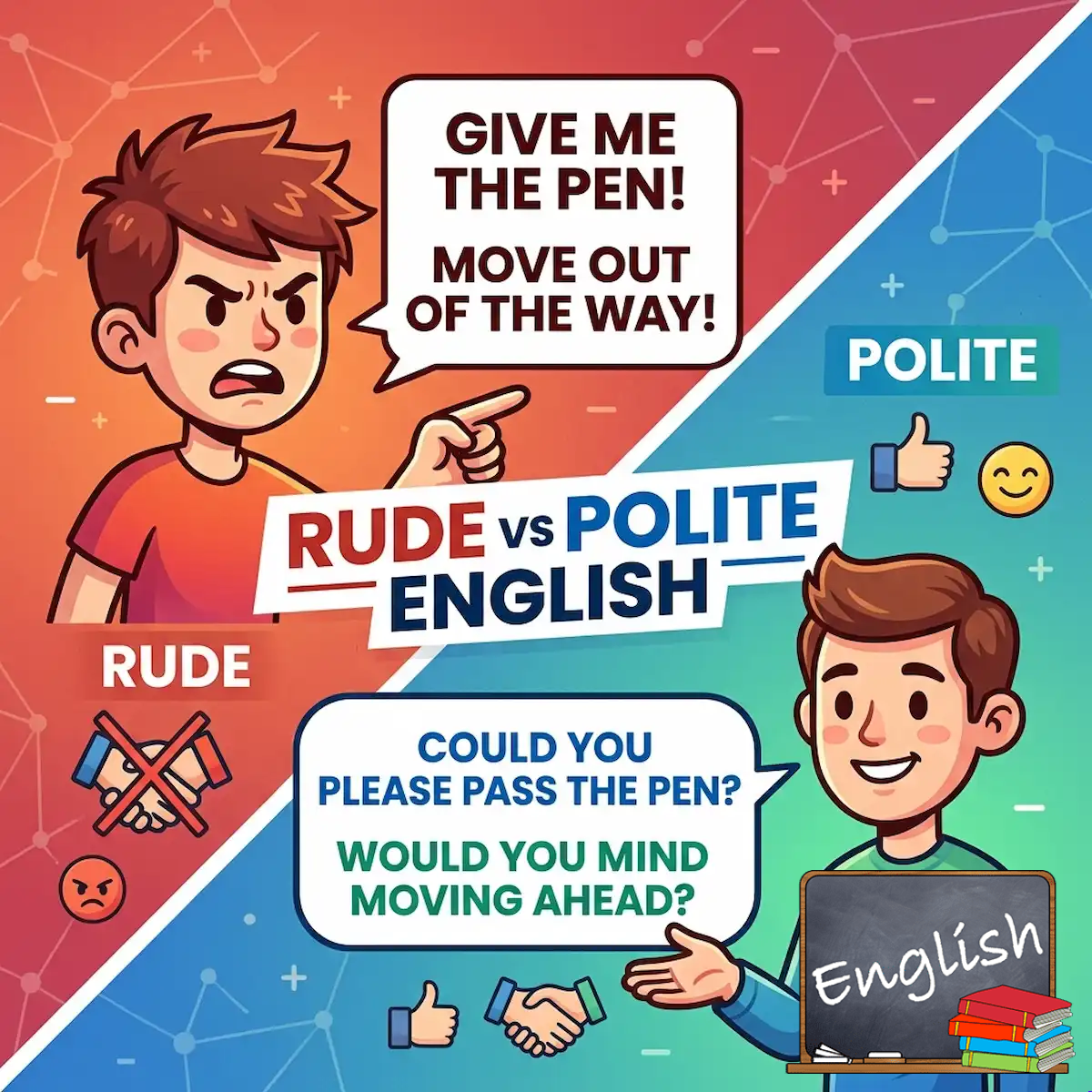
Walk into any secondary school classroom, and you will hear a massive mix of language. You might shout, “Give me a pen!” to your best mate, and they will toss one across the desk without a second thought. But if you turn around and say that exact same sentence to your teacher, a supervisor, or an interviewer during a weekend job interview, the room will go completely silent. As an English teacher, I see this happen every single week. Students often do not mean to be disrespectful; they simply translate directly from their native language or use “text-speak” logic in real life. In the English-speaking world, navigating the line between Rude vs Polite English is a critical skill because the boundary between being direct and being offensive is razor-thin. Learning to balance Rude vs Polite English ensures your communication stays respectful.
Why Direct Expressions Can Sound Aggressive
In many modern languages, if you want something, you ask for it directly. If you say the literal translation of “I want a sandwich” or “Move out of the way” in several European or Asian languages, it is perfectly standard. English does not work that way. In English culture, directness is frequently viewed as aggressive or demanding, which is why understanding the mechanics of Rude vs Polite English matters so much. To avoid sounding aggressive, native speakers rely heavily on a grammatical concept called hedging—which means adding softening words, modal verbs, and indirect phrasing to lower the impact of a statement.
When analyzing Rude vs Polite English dynamics, politeness boils down to two main ideas: showing the listener that you value and respect them, and softening what you say so you do not sound overly forceful or demanding. This aligns directly with the core linguistic concepts covered in the Cambridge Dictionary Politeness Grammar Guide, which outlines how native speakers modify structures to show respect. When you ignore these structural principles, you unintentionally slip into common Rude vs Polite English pitfalls.
The Golden Rules of Softening Your Tone
Before we look at our master list of 50 examples, let’s look at the four core tools you can use to navigate Rude vs Polite English successfully. Transforming blunt statements into respectful ones requires a few simple adjustments:
- Ditch the Imperatives: Avoid starting sentences with action verbs (Sit, Give, Tell, Stop). This sounds like a command, which instantly pushes a conversation into the territory of Rude vs Polite English friction.
- Deploy Modal Verbs: Use past-tense modals like could, would, should, and might. They create a psychological distance that makes requests feel optional and respectful.
- The “I’m Afraid” Buffer: When delivering bad news or a disagreement, preface it with “I’m afraid…” or “To be honest…” to cushion the blow.
- Use Continuous Tenses: Changing “I want to ask you something” to “I was wondering if I could ask you something” instantly reduces the pressure on the listener.
Mastering these tools helps you control your tone so you never have to worry about the negative side of the Rude vs Polite English spectrum.
50 Real-World Examples of Rude vs Polite English
Here are 50 concrete, everyday expressions broken down by category. Pay attention to how the polite versions use more words to achieve a softer, more diplomatic tone.
1. Making Everyday Requests
When you need something from someone else, your choice of words determines how willing they will be to help you out. Shifting your requests away from direct commands is the easiest way to master Rude vs Polite English in daily life.
| # | Rude / Too Direct | Polite Alternative | Why It Matters |
| 1 | Give me that book. | Could you pass me that book, please? | Changes a command into a modal question. |
| 2 | I want a glass of water. | I would like a glass of water, please. | “I want” sounds childish and demanding. |
| 3 | Open the window. | Would you mind opening the window? | “Would you mind” requires a gerund (-ing verb). |
| 4 | Tell me the time. | Excuse me, do you happen to have the time? | “Do you happen to” acknowledges you are interrupting. |
| 5 | Send me the homework link. | I was wondering if you could send me the homework link? | Past continuous frames it as a gentle thought. |
| 6 | Leave me alone. | I’m sorry, but I really need to focus right now. | Explains why you need space instead of rejecting them. |
| 7 | Give me your phone. | May I use your phone for a quick second? | “May I” officially asks for permission. |
| 8 | Turn off the music. | Could we possibly turn the music down a bit? | “We” makes it a shared decision rather than an order. |
| 9 | Help me with this box. | Could you give me a hand with this box, if you don’t mind? | Adds an escape clause for the other person. |
| 10 | Come here. | Can you step over here for a moment, please? | Softens a harsh summons into an accessible invite. |
2. Disagreeing with Opinions
You do not have to agree with everyone, but stating your disagreement poorly can instantly start an argument in class or online. Managing disagreements is a huge part of understanding Rude vs Polite English.
| # | Rude / Too Direct | Polite Alternative | Why It Matters |
| 11 | You are completely wrong. | I see what you mean, but I have a slightly different view. | Validates their perspective before offering yours. |
| 12 | That is a terrible idea. | I’m not sure that is the best approach for this project. | Avoids strong negative adjectives like “terrible.” |
| 13 | No way! | I am afraid I cannot agree with that point. | Formalizes the rejection to remove emotional heat. |
| 14 | Your presentation was bad. | I think some parts of the presentation could be improved. | Focuses on constructive future growth, not past failure. |
| 15 | That makes no sense. | Could you clarify that? I didn’t quite follow your logic. | Puts the blame on your understanding rather than their clarity. |
| 16 | I hate this book. | I’m not overly fond of this particular novel, to be honest. | Replaces the emotional verb “hate” with a mitigated preference. |
| 17 | Your answer is incorrect. | Actually, let’s double-check that answer together. | Converts a blunt correction into a collaborative effort. |
| 18 | Who cares about that? | That’s an interesting point, though it might not apply here. | Respects their contribution while refocusing the topic. |
| 19 | That is stupid. | I can understand your perspective, but have you considered…? | Defuses an insult by introducing an alternative option. |
| 20 | Change your mind. | Perhaps we could look at this from another angle? | Suggests a joint shift in perspective rather than demanding submission. |
3. Handling Mistakes and Problems
Blaming someone directly makes them defensive. In the study of Rude vs Polite English, shifting the focus from the person to the situation using strategic passive voice is an essential strategy.
| # | Rude / Too Direct | Polite Alternative | Why It Matters |
| 21 | You broke the computer. | It looks like there is an issue with the computer system. | Focuses on the state of the object, not the person who did it. |
| 22 | You didn’t explain this well. | I didn’t quite catch that last part—could you repeat it? | Takes the responsibility onto yourself as the listener. |
| 23 | You are late. | We were hoping to start a few minutes ago. | References the schedule instead of attacking their punctuality. |
| 24 | You forgot to email me. | Just following up, as I haven’t received the email yet. | A gentle reminder that assumes the best intentions. |
| 25 | You messed up our project score. | It seems like we had a misunderstanding on these criteria. | Uses “we” to share the burden of a group mistake. |
| 26 | You need to fix this error. | There are a couple of small details that need adjusting. | Minimizes the scale of the mistake to avoid panic. |
| 27 | Why did you do that? | Could you walk me through your reasoning on this step? | Replaces an accusatory “why” with an invitation to explain. |
| 28 | You are speaking too softly. | I’m sorry, I’m having a bit of trouble hearing you back here. | Attributes the problem to environmental distance, not their voice. |
| 29 | This work is messy. | It might be helpful to organize these sections a bit more. | Offers practical solutions instead of empty criticism. |
| 30 | You didn’t pay attention. | Let’s review this section one more time to be sure. | Resets the focus smoothly without scolding them. |
4. Saying “No” and Declining Offers
Saying “no” without context sounds cold and cutting. To avoid a major Rude vs Polite English blunder, always add an explanation or a token of appreciation to soften a rejection.
| # | Rude / Too Direct | Polite Alternative | Why It Matters |
| 31 | I don’t want to come. | Thank you for inviting me, but I won’t be able to make it. | Thanks them for the invite before declining. |
| 32 | No, I won’t help you. | I’d love to help, but I’m completely swamped with my own work. | Signals that you want to help but lack the structural capacity. |
| 33 | I don’t care. | I will leave that decision up to your discretion. | Upgrades an indifferent shrug into a vote of confidence. |
| 34 | Don’t ask me about that. | I’d prefer not to comment on that topic right now, if you don’t mind. | Establishes boundaries without sounding hostile. |
| 35 | That food looks gross. | I think I’ll pass on that option today, thank you though. | Politely declines without insulting the host’s cooking. |
| 36 | Your plan won’t work. | I have a few concerns about how that plan might play out. | Replaces a total prediction of failure with specific concerns. |
| 37 | Stop talking to me. | I really need to get back to this task now, catch you later. | Signals an exit from the conversation gracefully. |
| 38 | I don’t like your gift. | Thank you so much for thinking of me! | Focuses entirely on the kind gesture, not the item. |
| 39 | No, go away. | I’m in the middle of something right now—can we chat later? | Offers a future window for connection rather than total rejection. |
| 40 | I don’t want to do that group role. | I feel my strengths might be better utilized in a different role. | Frames the refusal around professional optimization. |
5. Workplace and Classroom Situations
Whether you are talking to your tutor, head of year, or dealing with a manager at your local cafe job, managing standard classroom etiquette relies on clean sentence construction.
| # | Rude / Too Direct | Polite Alternative | Why It Matters |
| 41 | I need this signature now. | Whenever you have a spare moment, could you look at this form? | Acknowledges that the authority figure’s time is valuable. |
| 42 | Your instructions are confusing. | Could I confirm the next steps to ensure I have them right? | Re-frames confusion as a pursuit of execution accuracy. |
| 43 | Move, I need to get through. | Excuse me, sorry, may I squeeze past you? | Uses standard public transit/corridor etiquette. |
| 44 | Give me a deadline extension. | Would it be possible to submit this assignment on Monday? | Asks a hypothetical conditional question instead of demanding. |
| 45 | I didn’t ask for your opinion. | Thank you for the input, I’ll take that into consideration. | Closes down unwanted advice without starting a fight. |
| 46 | Sit down and listen. | If everyone could please take their seats, we can get started. | Treats the classroom collectively to establish quiet order. |
| 47 | Answer my question. | I look forward to hearing your thoughts on this when time permits. | Creates polite momentum in an email chain. |
| 48 | That is your job, not mine. | I believe that falls outside my current scope of responsibilities. | Defines workplace boundaries neutrally. |
| 49 | This room is a mess. | Let’s spend two minutes clearing up our workspaces before we head out. | Converts an accusation into a shared, actionable objective. |
| 50 | I want a different group. | Would it be possible to explore other group arrangements for this term? | Requests an administrative change using formal terms. |
Classroom Guide: How to Shift a Sentence in Real Time
If you are stuck in class and need to quickly change a thought to ensure you stay on the correct side of the Rude vs Polite English divide, use this step-by-step conversion method.
1.Identify the Imperative Verb: Step 1.
Look at your draft sentence. If it starts with an active command word like “Give,” “Tell,” or “Stop,” highlight it. You need to remove this word from the front of the sentence to avoid a classic example of unsoftened expression.
2.Insert a Conditional Modal Opener: Step 2.
Place a polite, conditional opening phrase at the absolute front of your sentence. Excellent choices for smooth communication include “Could you please…”, “Would you mind…”, or “I was wondering if I could…”.
3.Adjust the Main Verb Construction: Step 3.
If you used “Would you mind,” shift your primary verb into its gerund form adding -ing (e.g., “giving”). If you used “Could you,” keep the verb in its base form (e.g., “give”). This structural change keeps your language clean.
4.Add the Final Softening Buffer: Step 4.
End the sentence with an appreciative closer like “…please?”, “…when you have a free moment?”, or “…if possible?”. Read it aloud to ensure it flows smoothly and meets standard expectations.
Put Your Knowledge to the Test: Interactive Practice
Here is a PDF worksheet you can download to practice being polite
Why This Matters Beyond Your Exams
It is easy to look at the differences between direct and indirect phrasing as just another list of rules to memorize for your oral exams or your essay modules. But as a teacher who has watched hundreds of students enter university and the workforce, I can tell you that understanding the nuances of Rude vs Polite English is a vital life skill.
The global business and academic worlds operate almost entirely on the polite versions of these structures. Paying attention to Rude vs Polite English means your emails get answered faster by professors, you clear group project hurdles without lingering friction, and you project confidence and emotional maturity during interviews.
To dive deeper into standard speech guidelines and review interactive tutorials on social expressions, check out the resources available on the British Council LearnEnglish Hub, which provides excellent exercises for secondary students looking to build real-world communication habits.
By consciously avoiding conversational habits that sound aggressive, you gain massive advantages in your academic and professional relationships. Keep practicing, keep analyzing your choices regarding Rude vs Polite English, and always look for ways to soften your sentences. I will see you all in class next week!ish, and always look for ways to soften your sentences. I will see you all in class next week!
Additional Helpful Information
Learn more about English Modal verbs – English Modal Verbs: ‘May,’ ‘Might,’ ‘Could’: English Possibility