Key Takeaways
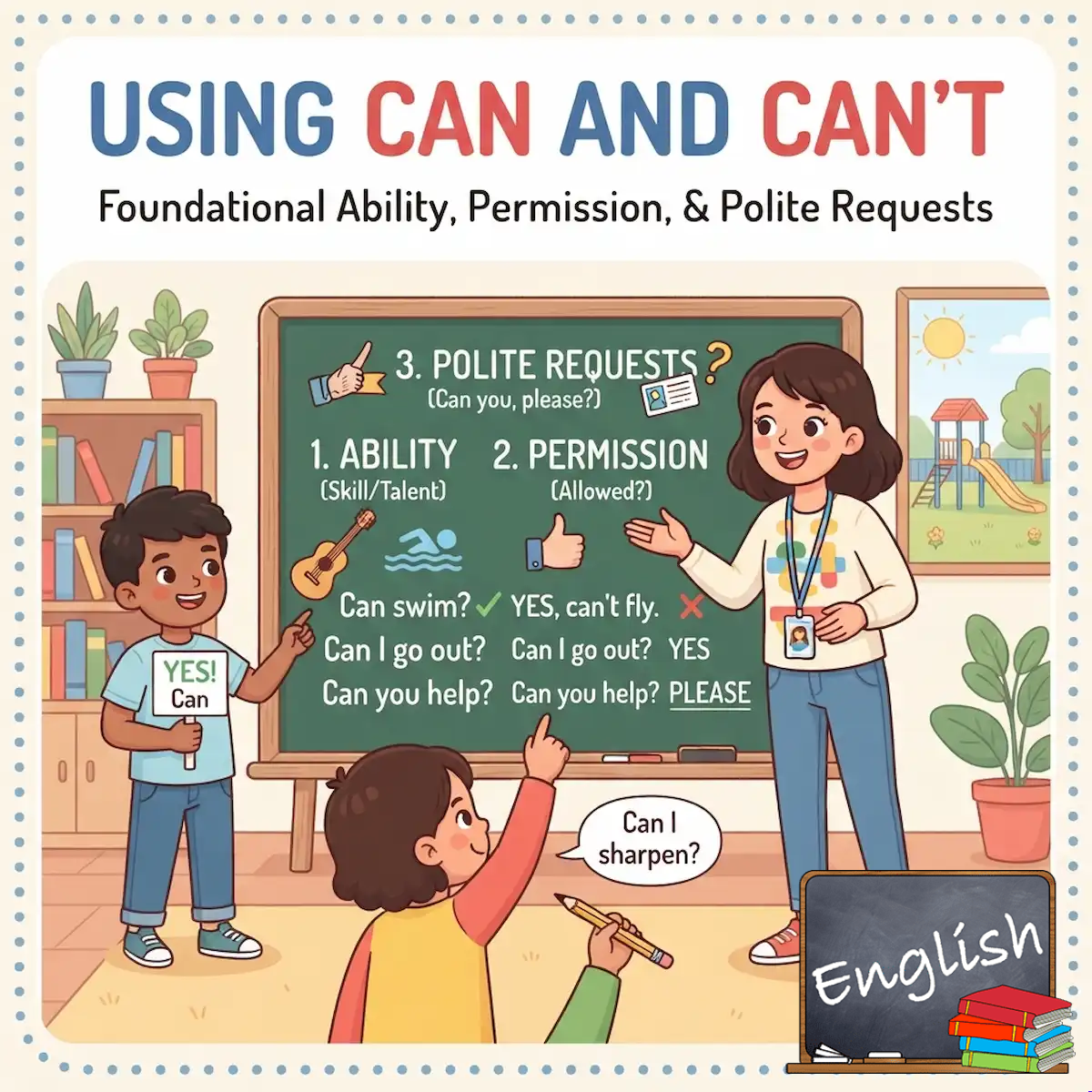
- What is the main difference between can and can’t in English? You use the modal verb can to show that someone has the skill, ability, or permission to do something, whereas can’t (the contraction of cannot) shows that someone does not have the ability or is not allowed to do something.
- Do you add an -s to the main verb after can or can’t? No, you never change the main verb after can and can’t. Whether you are talking about I, you, he, she, it, we, or they, the main verb always stays in its simple base form without to, -s, -ed, or -ing (for example, “She can swim,” not “She can swims”).
- How do you ask a polite request using can? You place the word can at the very beginning of the question before the subject, followed by the base verb and the word please at the end or middle (for example, “Can you help me with my homework, please?”).
- What is the full, uncontracted spelling of can’t? The full form of can’t is spelled as one single word, cannot, rather than two separate words.
How to Use Can and Can’t for Ability, Permission, and Requests
When you first start learning English, one of the most useful tools you can put into your vocabulary backpack is the pair of small words can and can’t. In my primary classroom, I watch students light up the very first week they learn these two words. Suddenly, instead of pointing at a water bottle or looking confused when they do not understand a worksheet, they have the power to say, “Can I drink some water?” or “I can’t read this word.”
Learning how to use can and can’t gives you immediate independence in real life. You need these words to talk about your talents, ask a teacher or boss for permission, order food at a cafe, and ask strangers for directions. Even better, the grammar rules for can and can’t are some of the easiest in the entire English language because the verbs never change their endings.
Let’s walk through everything you need to know about using can and can’t for ability, permission, and polite requests, complete with clear charts, everyday examples, and common mistakes to watch out for.
What Are Can and Can’t in English Grammar?
In English grammar, can is a special helping verb called a modal verb. Unlike regular action verbs such as walk, eat, or study, a modal verb does not describe an action by itself. Instead, it sits right in front of a main action verb to change its meaning. It tells the listener how you feel about the action—specifically, whether the action is possible, allowed, or requested.
When you want to make the negative form, you join the words can and not together. In formal writing, you write this as one single word: cannot. In everyday speaking, text messages, and friendly writing, native speakers almost always shorten cannot to the contraction can’t. Notice the little apostrophe (‘) between the n and the t. That apostrophe takes the place of the missing letters n and o.
According to the British Council LearnEnglish Grammar Guide, modal verbs like can behave differently from normal verbs because they do not take an -s in the third person singular, and they do not use helping verbs like do or does to make questions or negatives.
Quick Overview Chart: Positive, Negative, and Question Forms
| Sentence Type | Word Order Formula | Simple Example | Meaning |
|---|---|---|---|
| Positive Statement | Subject + can + base verb | I can ride a bicycle. | You have the skill to ride. |
| Negative Statement | Subject + can’t + base verb | He can’t drive a car. | He does not have the skill to drive. |
| Yes/No Question | Can + subject + base verb? | Can they speak English? | Asking if they have the skill. |
| Information Question | Question word + can + subject + base verb? | What can you cook? | Asking which dishes you know how to make. |
The Golden Grammar Rules for Using Can and Can’t
Before we look at all the different ways to use can and can’t in conversation, you only need to memorize three simple rules. Once you know these three rules, you will never make a grammar mistake with sentence structure.
Rule 1: Never Change the Modal Verb
With normal English verbs, you have to change the spelling depending on who is doing the action. For example, you say “I play,” but you must say “She plays.” With can and can’t, every single subject uses the exact same word.
- I can / I can’t
- You can / You can’t
- He can / He can’t
- She can / She can’t
- It can / It can’t
- We can / We can’t
- They can / They can’t
Rule 2: Always Use the Base Form of the Main Verb
The main verb that comes after can and can’t must always be in its pure, base form (also called the bare infinitive). Never add to, -s, -ed, or -ing to the main verb.
- Correct: Maria can dance very well.
- Incorrect: Maria can to dance very well.
- Incorrect: Maria can dances very well.
- Incorrect: Maria can dancing very well.
Rule 3: Never Use Do, Does, or Don’t in Questions or Negatives
Many beginner students try to say, “Do you can help me?” or “I don’t can swim.” Because can is already a helping verb, it does all the heavy lifting by itself. To make a question, simply move can to the front of the sentence. To make a negative, simply use can’t.
- Correct: Can you open the window?
- Incorrect: Do you can open the window?
- Correct: We can’t hear the music.
- Incorrect: We don’t can hear the music.
How Do You Use Can and Can’t for Foundational Ability?
The very first way primary students learn to use can and can’t is to talk about ability. Ability means having the physical skill, mental knowledge, or talent to do something. It answers the question: “What do you know how to do?”
When you talk about your hobbies, sports, languages, or daily skills, you use can for things you are able to do and can’t for things you are unable to do. In my classroom, we often play a game called “Two Truths and a Lie” using ability sentences. One student might say, “I can whistle a song, I can stand on my head, and I can’t eat spicy food.” It is a fun way to practice talking about real-life skills.
Examples of General Skills and Talents
- I can swim across the swimming pool, but I can’t dive into the deep water.
- My grandmother can bake delicious chocolate cake without looking at a recipe.
- Our puppy is very young, so he can’t catch a ball yet.
- David can play the guitar and the piano, but he can’t sing.
- Penguins are birds, so they have wings, yet they can’t fly in the sky.
- Can your little sister tie her own shoes? Yes, she can!
Examples of Situational Ability (Right Now)
Sometimes, you normally have the skill to do something, but something in your environment stops you right now. You also use can and can’t for these temporary situations.
- It is too dark in this room, so I can’t see my keys on the table.
- Speak louder, please! There is too much traffic outside, and I can’t hear you.
- My leg hurts today, so I can’t walk to the bus stop.
- Look out the window! You can see the mountains clearly because there are no clouds today.
- I forgot my wallet at home, so I can’t buy lunch right now.
Ability Examples Chart: Everyday Topics
| Topic Category | What Someone Can Do (Positive) | What Someone Can’t Do (Negative) |
|---|---|---|
| Languages | She can read and write in three languages. | I can’t understand fast French movies. |
| Sports & Movement | They can run five kilometers without stopping. | He can’t ride a skateboard without falling. |
| Kitchen & Cooking | We can make fresh pasta from scratch. | My brother can’t even boil water without burning it. |
| Technology | You can fix almost any computer problem. | Grandpa can’t send photos on his new phone. |
| School Subjects | Leo can solve hard math problems quickly. | I can’t spell long English words easily. |
How Do You Use Can and Can’t for Permission?
The second major way we use can and can’t is to talk about permission. Permission is all about rules, laws, and what another person allows you to do. When you ask for permission, you are asking, “Is it okay if I do this?” When someone gives or refuses permission, they use can or can’t to tell you what the rules are.
In a primary school classroom, asking for permission happens every ten minutes. Students raise their hands and ask, “Can I sharpen my pencil?” or “Can I go to the restroom?” As a teacher, I answer, “Yes, you can,” or “No, you can’t go right now because we are taking a spelling test.”
According to the Cambridge Dictionary Grammar Reference on Can, using can to ask for and give permission is standard in everyday spoken English, especially when talking to friends, family members, classmates, or teachers you know well.
Asking for Permission (Questions)
When you want permission to do something yourself, start your question with Can I or Can we.
- Can I borrow your red pen for a minute?
- Can I sit in this empty chair next to you?
- Can we play soccer outside after we finish our homework?
- Can I use my phone in the library?
- Mom, can I have an apple before dinner?
Giving and Refusing Permission (Statements and Rules)
Signs in public places, school rules, and parents often use can and can’t to explain what is allowed and what is forbidden.
- Giving Permission: You can park your bicycle next to the front gate.
- Giving Permission: Students can use a dictionary during the reading lesson.
- Giving Permission: You can take two free cookies from the tray.
- Refusing Permission: You can’t bring food or drinks into the computer lab.
- Refusing Permission: Visitors can’t take photographs inside the museum.
- Refusing Permission: We can’t stay up late on school nights.
Permission Scenarios Chart: School, Home, and Public Places
| Location | Asking for Permission | Giving Permission | Refusing Permission |
|---|---|---|---|
| Classroom | Can I open the door? | Yes, you can open it. | No, you can’t leave the room yet. |
| Home | Can we watch a movie tonight? | You can watch one after dinner. | You can’t watch TV until your room is clean. |
| Library | Can I take this book home? | You can borrow it for two weeks. | You can’t talk loudly in the quiet zone. |
| Public Park | Can my dog run off the leash? | Dogs can play inside the fenced area. | You can’t walk on the fresh grass. |
| Restaurant | Can we sit near the window? | Certainly, you can take table four. | Sorry, you can’t bring outside snacks here. |
How Do You Use Can and Can’t for Polite Requests?
The third essential use of can is making polite requests. A request is when you ask another person to do a favor or help you with something. Notice the difference between permission and a request:
- Permission: Can I do something? (You want to do the action.)
- Request: Can you do something? (You want the other person to do the action for you.)
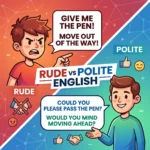
When you make a request with Can you, it is very important to add the magic word please. Without the word please, “Can you close the door?” can sometimes sound a little bit bossy or impatient. When you add please, your request immediately sounds warm, friendly, and polite.
Where to Put “Please” in a Request
You have two natural places to put the word please in a polite request:
- At the very end of the question (most common): Can you pass me the salt, please?
- Right before the main verb: Can you please pass me the salt?
Both positions are completely natural and polite. Never put please at the very beginning before Can if you want to sound like a fluent speaker (avoid saying “Please can you…”).
Everyday Examples of Polite Requests
- Can you help me carry these heavy grocery bags, please?
- Can you repeat that word slowly, please? I didn’t catch it.
- Can you hold the elevator door for a second, please?
- Can you turn down the television a little bit, please?
- Can you spell your last name for me, please?
- Can you send me the notes from yesterday’s class, please?
How to Respond Politely to Requests
When someone asks you a polite request using can, it sounds robotic to only say “Yes” or “No.” Here are natural ways beginner students can reply:
Saying Yes (Accepting a Request):
- Yes, of course!
- Sure, no problem.
- Happy to help!
- Yes, I can do that right now.
Saying No (Refusing a Request Politely):
- I’m sorry, I can’t right now. I’m busy.
- Sorry, I can’t help with that because I don’t know the answer.
- I wish I could, but I can’t leave my desk at the moment.
Can vs. Could vs. May: Which One Should Beginners Use?
As you keep studying English, you will notice that native speakers also use could and may for permission and requests. Many beginners get confused about which word to choose. The good news is that can is always understood, while could and may simply add extra levels of formal politeness.
The Merriam-Webster Dictionary Usage Note on Can and May explains that although traditional teachers once insisted on using may for permission, educated speakers routinely use can for both ability and permission in modern English. However, knowing how to upgrade from can to could or may is a great skill when talking to a principal, a police officer, or a stranger.
Politeness Comparison Chart
| Situation | Casual / Everyday (With Friends & Family) | Polite / Neutral (With Teachers & Classmates) | Very Polite / Formal (With Strangers & Bosses) |
|---|---|---|---|
| Asking for Help | Can you pass the water? | Can you pass the water, please? | Could you pass the water, please? |
| Asking to Borrow | Can I use your charger? | Can I borrow your charger, please? | May I borrow your charger, please? |
| Asking for Directions | Can you tell me where the station is? | Can you help me find the station, please? | Could you tell me how to get to the station, please? |
| Ordering Food | Can I get a coffee? | Can I have a coffee, please? | May I please have a cup of coffee? |
If you are ever unsure which word to pick, use can plus please. It is polite, friendly, and works in almost every daily situation.
Pronunciation Secrets: How to Hear the Difference Between Can and Can’t
One of the biggest challenges for beginner English students is not writing can and can’t—it is hearing the difference when native speakers talk fast! In fast conversation, Americans and British speakers often drop the final t sound in can’t. So how do native speakers tell them apart? The secret is not the t at the end; it is the vowel sound and the stress in the middle!
1. How to Pronounce “Can” (Weak vs. Strong)
In a normal positive sentence, can is NOT stressed. Native speakers rush over it quickly and pronounce the vowel like a tiny, lazy “uh” sound (linguists call this the schwa sound, /kən/). The stress goes on the main action verb instead.
- Sentence: “I can SWIM.”
- How it sounds: “I k’n SWIM.” (Short, fast, quiet can; loud, long SWIM.)
When can stands alone at the end of a short answer or at the start of a question, it uses a clearer short a sound (like the a in cat):
- “Yes, I CAN.” (/kæn/)
2. How to Pronounce “Can’t” (Always Strong!)
In a negative sentence, can’t is ALWAYS stressed because the negative meaning is super important. Native speakers say it loudly and clearly, stretching out the vowel sound.
- In American English: It rhymes with ant or plant (/kænt/). You pull the corners of your mouth wide and hold the vowel longer. Even if the final t is soft, your tongue stops the air sharply at the roof of your mouth.
- In British English: It rhymes with father or car (/kɑːnt/). You open your mouth wide and make a deep, long “ah” sound.
Pronunciation Practice Chart
| Written Sentence | Which Word Gets the Stress? | American Pronunciation Tip | British Pronunciation Tip |
|---|---|---|---|
| I can cook. | COOK | “I k’n COOK” (fast, weak can) | “I k’n COOK” (fast, weak can) |
| I can’t cook. | CAN’T and COOK | “I KANT COOK” (long, tight a) | “I KAHNT COOK” (long, open ah) |
| She can drive. | DRIVE | “She k’n DRIVE“ | “She k’n DRIVE“ |
| She can’t drive. | CAN’T and DRIVE | “She KANT DRIVE“ | “She KAHNT DRIVE“ |
Try saying those four pairs out loud right now. Notice how in “I can cook,” your voice bounces quickly over can and lands hard on cook. In “I can’t cook,” your voice hits can’t just as hard as cook.
Spelling Rules: Can’t vs. Cannot vs. Can Not
Beginners frequently ask how to spell the negative form of can when they are not using a contraction. Unlike almost every other English verb pair—such as do not, will not, or should not—we do NOT write can and not as two separate words in standard English.
According to the Oxford Learner’s Dictionaries Entry for Cannot, cannot is always written as a single closed word in both British and American English.
- Informal / Everyday Writing: Use can’t (with an apostrophe).
- Example: Sorry, I can’t come to your birthday party on Saturday.
- Formal / School Essay Writing: Use cannot (one word, no space).
- Example: Students cannot use mobile phones during the final examination.
- Incorrect Spelling: Avoid writing can not as two words. (The only rare exception is a phrase like “not only… but also,” such as “You can not only read the book, you can also listen to it.”)
Common Mistakes Beginners Make with Can and Can’t
In my years of teaching primary and beginner ESL students, I see the same five grammar and spelling mistakes happen over and over again. Review this checklist to make sure you avoid them in your own speaking and writing.
Mistake 1: Adding “to” After Can or Can’t
- Wrong: I can to play basketball after school.
- Right: I can play basketball after school.
- Why: Never put the word to between can and the main verb.
Mistake 2: Adding “-s” for He, She, or It
- Wrong: My father cans fix broken bicycles.
- Wrong: My father can fixes broken bicycles.
- Right: My father can fix broken bicycles.
- Why: Neither can nor the main verb ever takes an -s ending.
Mistake 3: Forgetting the Apostrophe in Can’t
- Wrong: I cant find my pencil case anywhere.
- Right: I can’t find my pencil case anywhere.
- Why: Without the apostrophe, cant is a completely different, rare English word that means insincere talk. Always put the apostrophe between n and t.
Mistake 4: Using “Can’t” for Past Ability
- Wrong: Yesterday I am sick, so I can’t go to school.
- Right: Yesterday I was sick, so I couldn’t go to school.
- Why: Remember that can and can’t are only for the present (right now) and future plans. When you talk about yesterday or last year, change can to could and can’t to couldn’t.
Mistake 5: Using “Don’t Can”
- Wrong: They don’t can speak Spanish.
- Right: They can’t speak Spanish.
- Why: Never mix do/does/don’t/doesn’t with can or can’t.
Short Answers: How to Reply Naturally to “Can” Questions
When someone asks you a yes-or-no question starting with Can, you do not need to repeat the entire long sentence. In natural English, we use a short answer made of three words:
- Yes + subject pronoun + can.
- No + subject pronoun + can’t.
Notice that we always replace names with pronouns (he, she, it, we, they) in short answers, and we never use a contraction in a positive short answer.
| Question | Positive Short Answer | Negative Short Answer |
|---|---|---|
| Can you swim? | Yes, I can. | No, I can’t. |
| Can your mom drive? | Yes, she can. | No, she can’t. |
| Can Tom and Sara come today? | Yes, they can. | No, they can’t. |
| Can your dog do tricks? | Yes, it can. (or Yes, he/she can.) | No, it can’t. |
| Can we start the game now? | Yes, we can. | No, we can’t. |
Practice Exercises: Test Your Skills!
Grab a piece of paper or read these sentences out loud to test what you have learned. Try to solve each one before checking the answers right below.
Part 1: Fill in the Blank with Can or Can’t
- Fish live in the ocean, so they ________ breathe underwater.
- A baby is only two months old, so she ________ walk or talk yet.
- ________ you help me spell the word “elephant,” please?
- We don’t have any flour or eggs, so we ________ bake a cake today.
- Excuse me, teacher. ________ I go to the nurse’s office? My head hurts.
- Birds have wings, so most birds ________ fly high in the sky.
Part 2: Fix the Grammar Mistake in Each Sentence
- He can plays soccer very fast.
- Do you can speak Japanese?
- I can’t to open this jar of pickles.
- She can nots come to the park with us.
Answer Key
- can (Fish have gills, so they have the ability to breathe underwater.)
- can’t (A two-month-old baby does not have the ability to walk or talk.)
- Can (A polite request asking someone for help.)
- can’t (Without ingredients, you lack the situational ability to bake.)
- Can (Asking a teacher for permission.)
- can (General ability of birds.)
- Correction: He can play soccer very fast. (Remove the -s from plays.)
- Correction: Can you speak Japanese? (Remove Do and put Can first.)
- Correction: I can’t open this jar of pickles. (Remove the word to.)
- Correction: She can’t (or cannot) come to the park with us. (Use the proper negative spelling.)
Practice Makes Perfect
Here is a PDF worksheet you can download to practice can and can’t – the answers are on a separate page
Fun Classroom and Home Activities to Master Can and Can’t
If you want to make these two words stick in your memory forever, try practicing them in real life rather than only reading grammar charts:
- Make an “I Can” Poster: Take a blank sheet of paper and draw a line down the middle. On the left side, write five things you are proud you can do right now (for example, “I can count to 100 in English” or “I can ride a bike”). On the right side, write three things you can’t do yet—and add the word yet to the end! Saying “I can’t swim yet” reminds your brain that you are still learning and growing.
- Play Animal Guessing Riddles: Think of an animal and describe it to a friend or family member using three clues with can and can’t. For example: “I can jump very high. I can carry my baby in a pocket. I can’t walk backward. What am I?” (Answer: A kangaroo!)
- Practice Polite Cafe Ordering: The next time you order a drink or snack, practice asking politely: “Hello! Can I have a bottle of water, please?”
Mastering how to use can and can’t opens the door to real communication in English. Keep practicing your pronunciation, remember to add please to your requests, and celebrate every new skill you can do in English!
Additional Helpful Information
- Study about modal verbs – English Modal Verbs: ‘May,’ ‘Might,’ ‘Could’: English Possibility