
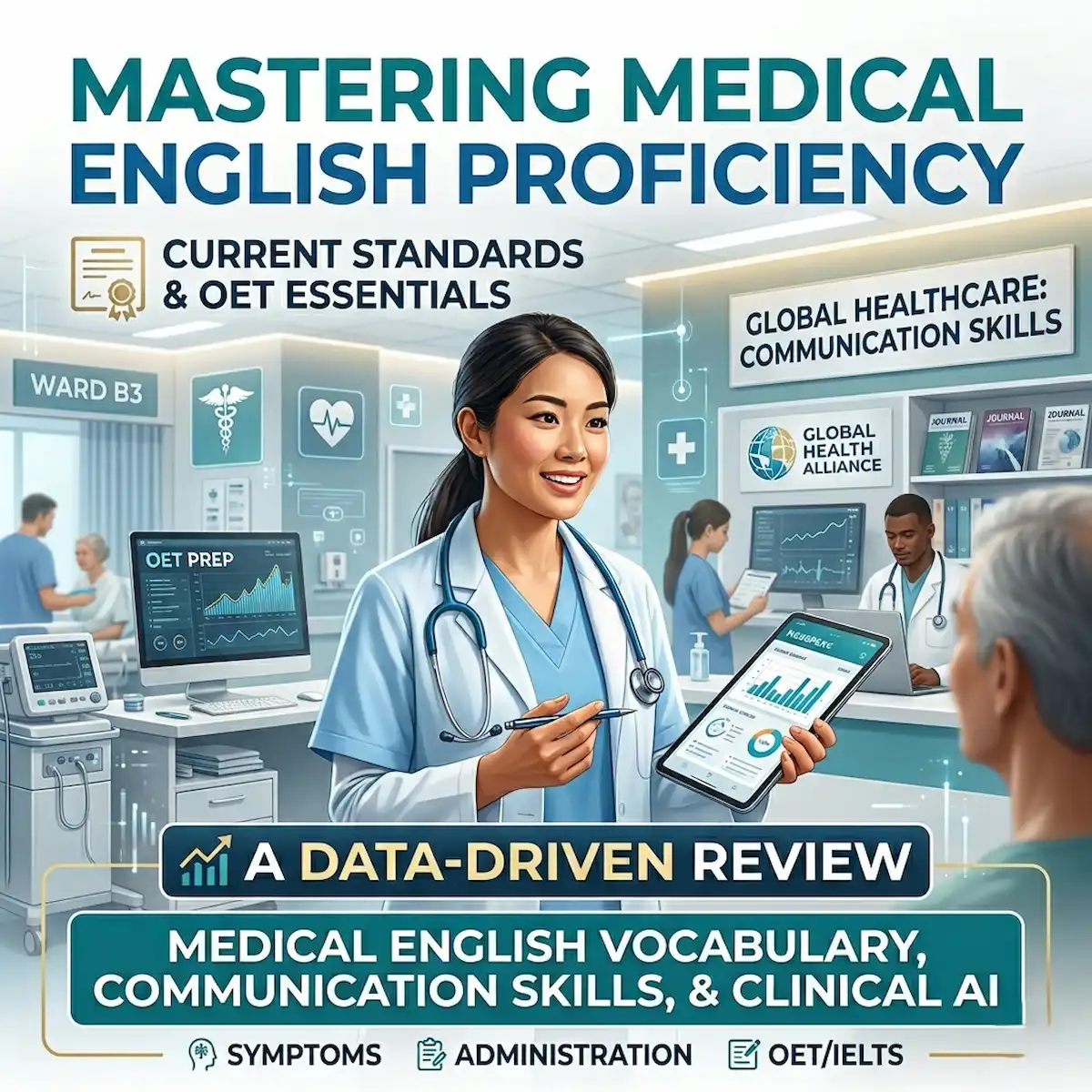
Why is Medical English Training Critical?
Medical English proficiency: is defined as the specialized linguistic competence required by healthcare professionals to perform clinical duties, ensure patient safety, and execute hospital administration accurately within English-speaking medical environments or international research contexts globally.
The healthcare landscape has shifted. In 2026, we are no longer just dealing with “bedside manner”; we are dealing with high-stakes digital integration. I’ve seen firsthand how a slight nuance in describing a “dull ache” versus a “gnawing pain” can change a triage priority. The global healthcare services market reached $9,338.49 billion in 2026, and with it, the demand for standardized communication has hit an all-time high.
The Problem: Non-native English-speaking (NNES) clinicians face a “fluency ceiling” where general English skills fail to translate into clinical accuracy, leading to a reported 75.3% increase in perceived stress during patient interactions.
The Solution: Targeted Medical English Proficiency focusing on the Occupational English Test (OET) and Common European Framework of Reference (CEFR) B2/C1 levels.
Comparison of Medical English Proficiency Assessment Standards (2026)
| Feature | OET (Medicine/Nursing) | IELTS Academic | TOEFL iBT (2026 Adaptive) |
| Context | Clinical scenarios only | General academic/science | General academic |
| Industry Favor | 92% of UK/AU Boards | General University Entry | Emerging US Healthcare |
| 2026 Pass Rate | ~65% (First attempt) | ~55% (First attempt) | ~58% (First attempt) |
| Key Skill | Patient Consultation | Data Description | Multi-source Synthesis |
| Retake Policy | Partial sub-test retake | One Skill Retake (OSR) | Full retake required |
How Does Vocabulary Impact Patient Safety?
Symptom descriptor vocabulary: is defined as the set of specific adjectives and nouns used by patients and clinicians to characterize physical sensations, duration, and intensity of illness to facilitate accurate diagnostic reasoning and treatment.
I once worked with a resident who struggled with the term “intermittent.” They recorded a patient’s chest pain as “constant,” which triggered a far more aggressive (and unnecessary) cardiac intervention than the patient’s actual “on-and-off” symptoms required. This isn’t just about big words; it’s about the right ones.
Key Vocabulary Domains in 2026
- Symptom Modifiers: Differentiating between idiopathic, acute, and chronic presentations.
- Administrative Terminology: Understanding prior authorization, ICD-11 coding, and discharge disposition.
- Digital Health English: Communicating via synchronous telehealth and interpreting automated EHR flags.
Is Hospital Administration Vocabulary Evolving?
Hospital administration vocabulary: is defined as the technical lexicon used to manage the operational, financial, and regulatory frameworks of a healthcare facility, including patient flow, resource allocation, and compliance with international health standards.
As the Healthcare Language Market nears a $2.2 billion valuation in 2026, the administrative side of medicine has become its own dialect. We are seeing a massive push toward “Human-AI Collaborative Documentation.”
Use Cases for Admin English:
- Case Management: Coordinating with insurance providers using precise “medical necessity” justifications.
- Risk Management: Writing incident reports that distinguish between a “sentinel event” and a “near miss.”
- Global Collaboration: Participating in international clinical trials where ISO 11615 standards for medicinal product identification are mandatory.
What are the Modern Use Cases for Medical English?
Clinical communication use cases: are defined as the specific professional scenarios—such as handover, informed consent, and breaking bad news—where specialized English is applied to achieve clinical objectives and maintain ethical standards.
The 2026 clinical environment is a hybrid of physical and digital spaces. Here is how Medical English proficiency manifests:
- The Virtual Ward: NNES doctors leading “tele-rounds” must use concise, non-idiomatic English to ensure clarity over potentially unstable satellite connections in rural health hubs.
- The Multi-Disciplinary Team (MDT): Using “SBAR” (Situation, Background, Assessment, Recommendation) protocols to ensure no data is lost between a surgeon and a social worker.
- Patient Education: Translating complex jargon (e.g., “hypercholesterolemia”) into layman’s terms (“high blood fat”) to improve health literacy.
FAQ: Navigating Medical English in 2026
Q: Do I need a C1 level for all healthcare roles?
A: Most regulatory bodies, like the GMC in the UK, require a level equivalent to CEFR C1 or an OET Grade B. However, for administrative roles, B2 is often sufficient.
Q: Is the IELTS One Skill Retake accepted for healthcare visas?
A: As of January 2026, most major boards (NMC, AHPRA) accept the One Skill Retake, but you must check specific Home Office guidelines for visa compliance.
Q: Why is OET preferred over IELTS for doctors?
A: OET test materials are 100% medical. You won’t be asked to write about “global warming”; you’ll be asked to write a referral letter for a patient with Type 2 Diabetes.
Industry Insider Knowledge: The “Silent Error”
In my experience training clinicians, the most dangerous error isn’t a lack of vocabulary—it’s over-politeness. In many cultures, challenging a senior consultant is taboo. In English-speaking medical cultures, using “graded assertiveness” (the PACE model: Probe, Alert, Challenge, Emergency) is a required linguistic skill. If you can’t say, “Doctor, I am concerned that the dose is too high,” your Medical English proficiency is incomplete, regardless of your test score.
Additional Helpful Information
- Important professional vocabulary – 50 Essential Business English Words For The Office
- Learn more about technical English – Technical English: Architectural Syntax for High-Precision Global Operations