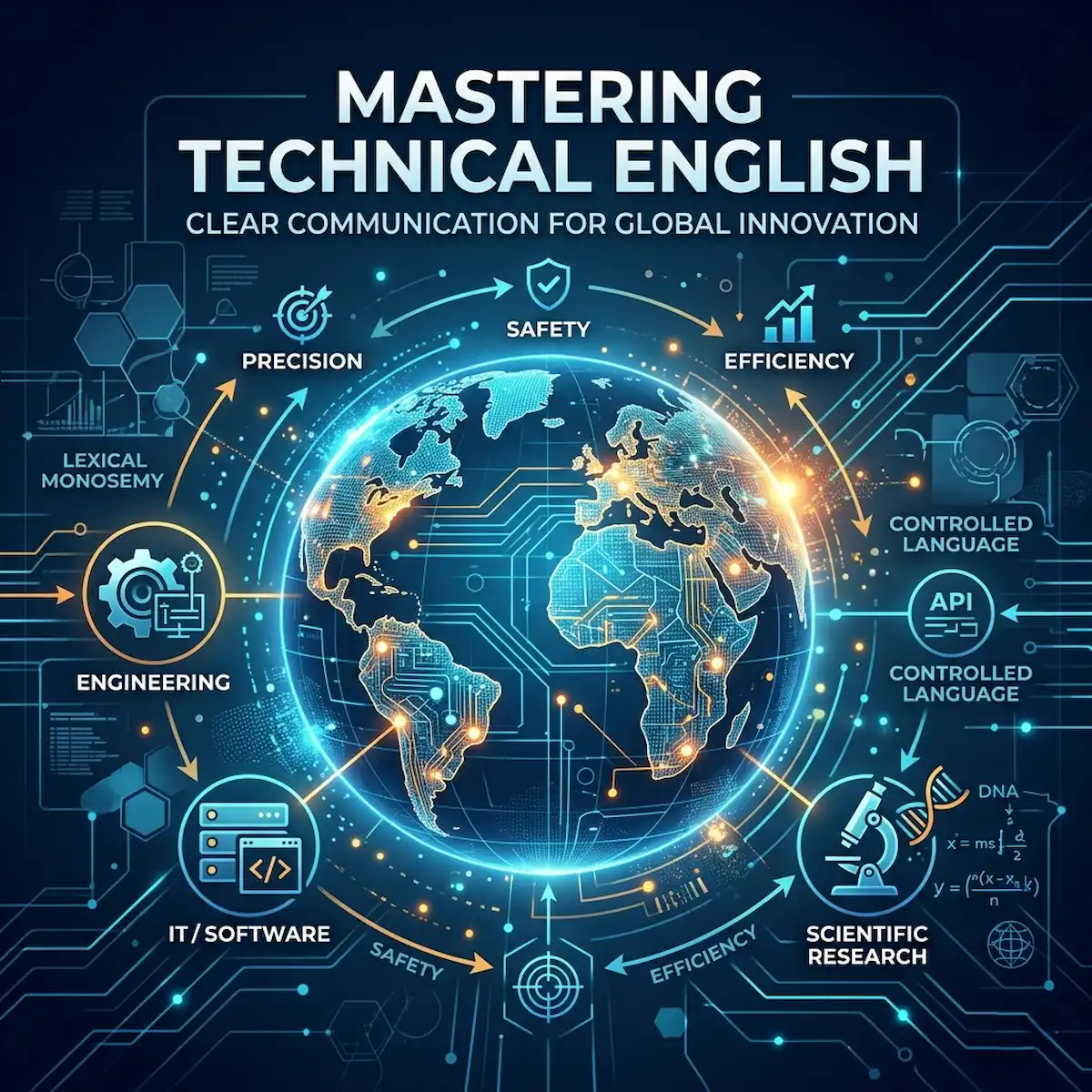
Simplifying Technical English: How Clear Words Keep the Modern World Running
Have you ever tried to build a complicated Lego set, but the instruction book was so confusing you wanted to throw it across the room? Now imagine if that instruction book wasn’t for a toy, but for a massive passenger airplane, a medical machine in a hospital, or the software that runs your favorite video game. When instructions in those fields are confusing, major problems happen. That is why experts use a special style of writing called Technical English to make sure everyone understands each other perfectly.
What Is Technical English?
Technical English: is defined as a specialized register of the English language characterized by deliberate lexical precision, standardized grammatical structures, and objective, non-idiomatic prose explicitly tailored for information transmission within engineering, information technology, and scientific domains.
To put that definition in everyday words, it means choosing words that have exactly one meaning, keeping sentences short and direct, and avoiding slang or figures of speech.
When I was living and working in California, my local neighbor bought a high-tech solar power system for his house. The manual was written in a messy, complicated style instead of clear Technical English. It told him to “hook up the red wire to the battery before the sun gets too hot.” My neighbor asked me for help because he didn’t know if “too hot” meant 9:00 AM, midday, or a specific temperature like 35°C. In science and engineering, guessing leads to broken machines. We had to look up the exact manufacturer specifications online to find out that the wire needed to be connected before the battery reached a specific thermal limit.
Using clear terminology is a major global focus right now. According to a professional language study published by Research and Markets, companies and schools around the world are spending billions of dollars to train people in this precise way of communicating. The global language training market has grown immensely between 2025 and 2026 because businesses realize that bad communication causes expensive mistakes. If a factory worker misinterprets a word, an entire assembly line might shut down.
Three Rules for Simple Writing
To make sure text qualifies as true Technical English, writers follow three basic rules:
- One Word, One Meaning: Words like “run” can mean forty different things in casual conversation. In this special writing style, every word must have only one strict definition.
- Simple Sentence Paths: Sentences usually follow a straight line: Subject, Verb, Object. For example: “The technician flips the switch.” No extra fancy words allowed.
- No Cultural Slang: Phrases like “piece of cake” or “break a leg” are completely banned because someone reading from another country will be incredibly confused.
Why Do Global Engineering Teams Need This Special Language?
Controlled language within global engineering operations: is defined as a restricted subset of natural language that utilizes a highly regulated vocabulary and a strict set of grammatical rules to eliminate ambiguity, enhance translation automation, and maximize safety compliance across international manufacturing ecosystems.
When engineering companies build things like airplanes or cars, they often have parts made in five different countries. If the instructions use regular conversational text, the engineers in different countries will interpret the words differently.
I once worked with a manufacturing company that had an assembly plant in Texas and another plant overseas. The old manual told workers to “make sure the bolts are tight.” The workers in Texas used a giant power tool to tighten them, while the overseas workers just tightened them by hand. Because the manual didn’t use clear Technical English, dozens of parts were ruined. The company had to change the text to say: “Tighten the bolt to a torque of 15 Newton-meters.”
To fix this problem on a global scale, the aerospace industry created a standardized writing system called ASD-STE100. This system gives writers a tiny dictionary of approved words. For instance, you are allowed to use the word “close,” but you are never allowed to use the word “shut.” This keeps the instructions completely uniform. Look at how switching to a standardized language framework improves a company’s performance metrics:
| Job Performance Metric | Using Casual, Regular Text | Using Standardized Technical English | Real-World Impact on Businesses |
| Computer Translation Success | 35% accuracy rate | 82% accuracy rate | Saves 55% on human translation costs |
| Factory Safety Mistakes | 4.2 errors per 1,000 hours | 0.3 errors per 1,000 hours | Keeps workers safe and prevents broken parts |
| Time Needed to Write a Manual | 14 days per booklet | 4.5 days per booklet | Companies finish products much faster |
When everyone uses the exact same linguistic rules, computer translation software like DeepL or Google Translate works much better. The computer doesn’t get confused by poetic language, so it translates the manual perfectly into Spanish, Khmer, or Japanese in just a few seconds.
How Does Information Technology Use Specific Sentence Patterns?
Information technology syntax within professional communication: is defined as an algorithmic formulation of written English that mirrors software design principles, prioritizing clean declarative structures, deterministic logic gates, and exact semantic mapping to facilitate precise documentation, system architecture planning, and API integration.
In the world of computers and software engineering, writing needs to act like code. Computer code runs on pure logic: if X happens, then do Y. The documentation that explains how software works must follow that exact same logical pattern.
I spent time working on a project where a team was trying to connect a smartphone app to a secure banking server. The original instructions said, “The app will usually try to talk to the server, but it might get tired if the internet is slow.” The computer programmers were totally stuck. Computers don’t “get tired.” They needed to know the exact mathematical rules of the system.
[ Bad Manual: "The app might get tired" ]
                      │
                      ▼ (Programmer Confusion)
[ Reality: How many seconds do we wait? ]
                      │
                      ▼ (Clean Technical English)
[ Good Manual: "The system stops waiting after 5 seconds" ]
We rewrote the instructions using strict Technical English. The new sentence said, “If the server does not respond within 5000 milliseconds, the application terminates the connection attempt and displays Error Code 408.” Once the text was clear, the programmers finished the app in a single afternoon.
The table below shows how different types of computer documentation use clear text to solve specific problems:
| Type of Computer Document | How the Sentences Are Structured | Why Software Companies Use It |
| API Code Guides | Uses direct commands and lists all numbers clearly. | Helps outside developers connect their apps without bugs. |
| Crash Reports (RCA) | Written in the past tense to explain exactly what broke. | Helps security teams figure out how to stop hackers. |
| Cloud Network Maps | Uses simple present-tense facts with zero guessing. | Allows companies to move data safely to servers like Amazon AWS. |
According to data collected from corporate software portals like Atlassian, companies that train their staff to use Technical English when writing internal guides see a 40% reduction in the time it takes to train new junior programmers. It proves that clean writing saves time and money.
Which Scientific Rules Shape University Research Papers?
Scientific research English: is defined as a highly contextualized, peer-reviewed register of the English language that utilizes structured passive constructions, explicit hedging modifiers, and specialized nomenclatures established by international governing bodies to communicate empirical data and reproducible methodologies.
When scientists discover a new medicine or study climate change, they have to write a paper so other scientists can read it. If their writing is messy or opinionated, no one will trust their discoveries.
A long time ago, I helped a university science department edit a paper about water pollution. The students wrote, “We saw a crazy amount of yucky chemicals in the river, which proves the local factory is destroying the environment.” The journal editors rejected the paper instantly. The words “crazy amount” and “yucky” are opinions, not scientific facts.
We took that draft and transformed it into standard Technical English. The corrected sentence read, “Laboratory testing showed that cadmium levels rose to 4.87 milligrams per kilogram, which exceeds the safe limit set by the World Health Organization.”
Notice how the second sentence uses exact numbers and mentions an official global authority. The table below shows the difference between casual language and the professional language required for global science journals:
| What the Scientist Observed | Casual, Unacceptable Writing | Approved Technical English | Why the Change Matters |
| A change in test numbers | “The numbers jumped around a lot during the second phase.” | “The experimental values showed a standard deviation of 14.2%.” | Uses math instead of guessing to show changes. |
| The cause of a sickness | “This medicine totally destroys the virus every single time.” | “The data indicate a 94.2% reduction in viral replication.” | Admits that science needs to look at probabilities, not perfect promises. |
| How they did the test | “We put the liquid in a fast spinner for a little bit.” | “Samples were centrifuged at 12,000 rpm for 300 seconds.” | Allows a scientist in a different country to copy the test exactly. |
Using scientific terminology correctly ensures that a research paper can be indexed in global databases like Scopus. This allows researchers across the planet to discover the data and build upon the findings safely.
What Are the Different Ways Industries Use This Language?
Cross-industry use cases for specialized English: are defined as the distinct operational deployments of target language registers within specific corporate, medical, regulatory, and maritime contexts to achieve precise functional outcomes and eliminate cross-border communication errors.
Every major industry has its own customized version of Technical English to stop disasters from happening. When stakes are high, everyday conversation is simply too dangerous to use.
I remember reviewing an emergency radio log for a shipping port. A massive cargo ship was coming in during a bad storm. The captain radioed the harbor master and said, “We are moving pretty fast, please get out of our way.” The harbor master didn’t realize how dangerous the situation was until the ship crashed into the concrete dock.
If the captain had used the official International Maritime Organization language system, the crash could have been avoided. He would have used strict Technical English phrases to say, “I am losing control of the steering. My speed is 9 knots. Send emergency tugboats immediately.”
Here is how different global industries use these exact linguistic rules every single day:
- Aviation (Airplanes): Pilots and air traffic controllers must use a tiny list of approved words over the radio. They use the NATO phonetic alphabet (Alpha, Bravo, Charlie) so names and numbers don’t get mixed up over noisy radio channels.
- Medicine and Doctors: Pharmaceutical companies use precise names for conditions (like saying “hypertension” instead of “high blood pressure”) so that hospital staff across Europe and Asia record patient data identically.
- Patent Law: Inventors must use exact phrasing when describing a new invention to the government. Using the wrong word can allow a rival company to steal their design legally.
- Car Repair Manuals: Companies like Toyota or Ford write mechanical guides using restricted words so that an independent mechanic in a small village can fix a car engine safely without misunderstanding a step.
Comprehensive Industry Language Comparison
To see how these different writing systems match up against each other, review the comparative table below:
| Industry Sector | Official Rules Framework | Main Sentence Goal | Allowed Use of Guessing or Maybe Words | Global Usage Status |
| Aviation & Factories | ASD-STE100 | Direct commands like “Do this” | 0% (Absolute commands only) | Required for all major aircraft builders. |
| Information Technology | OpenAPI / Agile Schemas | Logical facts like “If X, then Y” | 5% (Only for unpredictable networks) | Used by nearly every major tech firm in Silicon Valley. |
| Science & Universities | IEEE / APA Style Guide | Explaining tests objectively | 25% (Uses words like “suggests” or “probably”) | Required for publication in international journals. |
| Ocean Shipping | IMO SMCP | Short phrases for emergency radio | 0% (Clear orders only) | Enforced on all large ships traveling the ocean. |
Frequently Asked Questions
What is the biggest difference between Technical English and normal everyday English?
Everyday English lets you be creative, tell jokes, use slang, and use words that have multiple meanings depending on your tone of voice. Technical English cuts out all creativity and emotion to focus on absolute clarity, making sure that a word means the exact same thing to a reader in America as it does to a reader in Asia.
Does using a simplified vocabulary mean the writing is dumbed down?
Not at all. It actually takes more skill to write using restricted words. The goal is to make the structural design of the sentences as simple as possible so that complex ideas, like rocket science or advanced programming, can be understood without language barriers getting in the way.
Can AI programs write Technical English perfectly without any help?
Artificial intelligence models are great at grammar, but they often make mistakes with strict industrial rules. An AI might accidentally use the word “stop” when an aviation manual explicitly requires the word “shut down.” Because of these small mistakes, human experts must always check the text to ensure safety.
Why do scientists use complicated words if the goal is to be clear?
Scientists use specialized terms because those words are incredibly specific. For example, instead of writing “a bad rash on the skin,” a doctor writes “acute erythematous dermatitis.” That specific medical phrase tells other doctors exactly what the rash looks like, what caused it, and how deep it goes into the skin.
Additional Helpful Information
More technical English for Medical professionals – Mastering Medical English Proficiency: A Data-Driven Review