What Is Classroom Language?
Hello there, young adventurer! Step inside our colorful room, hang up your backpack, and take a comfortable seat. Have you ever stood inside a busy room and felt like everyone was speaking a secret code? When your teacher claps their hands, says a few quick words, and suddenly every student pulls out a bright red notebook at the exact same moment, it can feel like magic. But guess what? It is not magic at all. It is just the incredible power of classroom language! This special way of speaking is a set of friendly words, clear signs, and easy phrases that help us work, play, create, and learn together without any confusion.
Learning these key phrases makes you feel like an absolute superstar from the very morning bell to the final checkout line. When you understand what your teacher is asking, and when you know exactly how to use helpful classroom language for what you need, school becomes an exciting playground of discovery. Instead of worrying about what to do next, you can focus on building giant block towers, painting beautiful pictures, and solving fascinating math puzzles. Let us dive deep into this ultimate guide to help you master the wonderful world of functional speech step by step!
Teacher Kay’s Secret Tip
When I see a student smile and confidently ask a question using their new speech tools, my teacher heart skips a beat with joy! Do not worry about making mistakes when practicing your new skills. Every single mistake is just a little stepping stone that helps your brain grow bigger and stronger. Your teacher is always there to help you practice daily interaction every single day.
Why Does Our Daily Routine Communication Matter So Much?
Think of our daily communication routines as the simple rules of a fantastic board game. If nobody knew how to roll the dice or move their tokens, the game would be a messy muddle. In the exact same way, clear classroom language keeps our days smooth, safe, clean, and happy. It helps us transition from a noisy reading circle to a quiet writing time without anyone getting lost or upset along the way. Experts at institutions like the Cambridge Assessment English show that children who learn practical school expressions early build confidence much faster and enjoy their lessons a lot more.
When we practice this special communication style, we are not just memorizing words for a test. We are learning how to be awesome team players. Understanding your classroom language gives you the power to share your bright ideas, tell your friends when you like their drawings, and politely ask for help when a project gets tricky. Let us explore the primary phrases you will hear and use every single day in school.
The Magic Action Phrases: Listening and Following Directions
Your teacher uses action commands to guide the whole group safely through the day’s activities. These words tell your body and mind exactly what to do so that everyone stays perfectly in step. Let us look at the most common actions you will hear during your morning routines and core lessons that make up our essential classroom language.
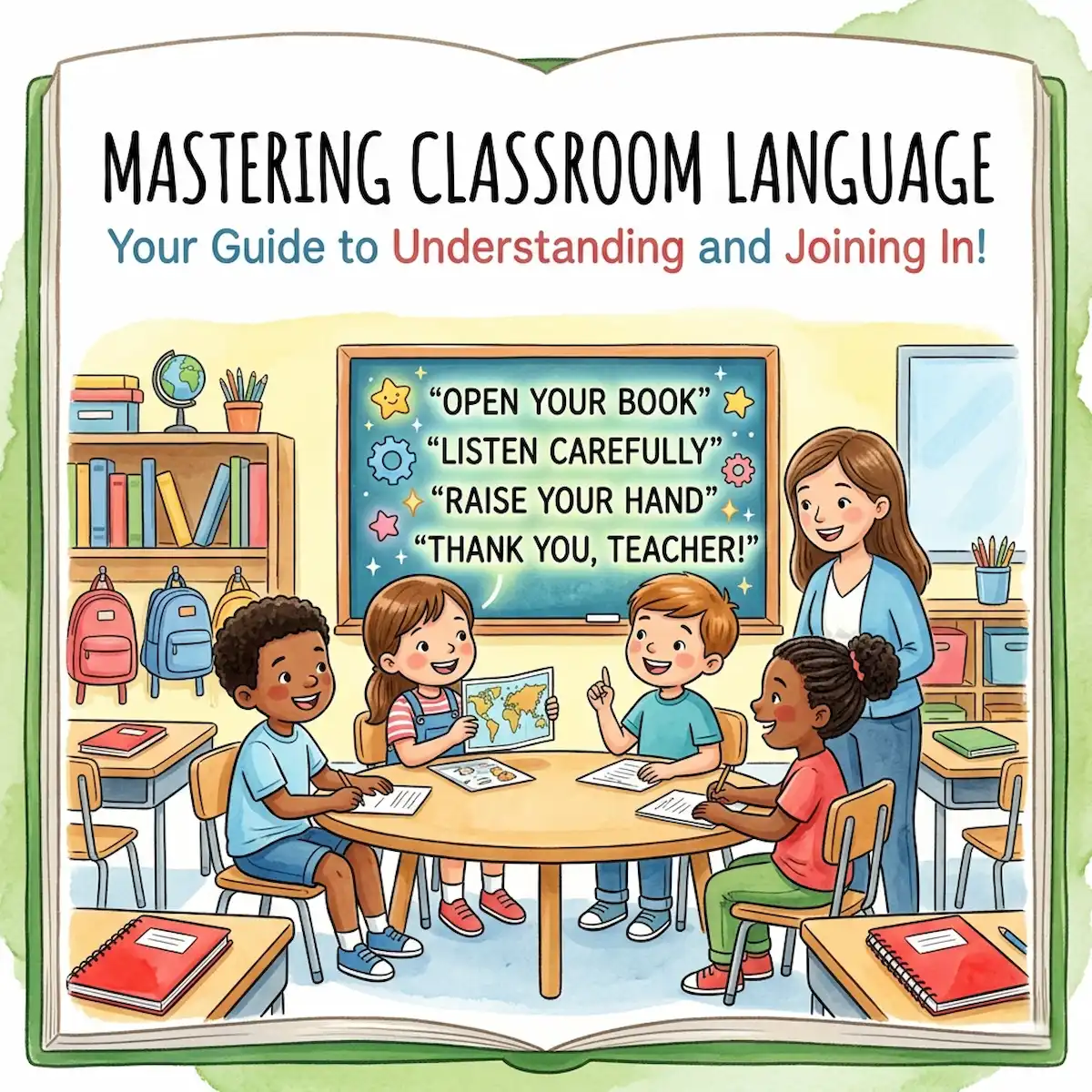
1. “Listen carefully”
When you hear “Listen carefully,” it is time to turn on your super-hearing ears! This part of our school talk means the teacher is about to share something incredibly important, like the rules of a brand-new game or a fascinating story about wild animals. To show you understand this command, look directly at the speaker, keep your hands still in your lap, and let your mind focus on the words being said.
2. “Open your book” and “Close your book”
Books are like magic windows to new worlds. When it is time to read or look at pictures, your teacher will use normal school phrases and say, “Open your book to page ten.” When we finish our work, you will hear the matching instructional phrase, “Close your book quietly and place it in the center of your desk.” Turning pages gently shows that you respect your learning tools and keep them beautiful for next time.
3. “Raise your hand”
Imagine if thirty excited children all shouted out their favorite color at the exact same moment! It would sound like a giant thunderstorm of noise, and nobody would be able to understand a single word. Using the smart rule of “Raise your hand” ensures that every single voice has a chance to be heard one by one. It is the polite way to participate in our daily classroom language conversations, showing everyone that you have an idea to share.
In the Classroom:
- Teacher Kay: Who can tell me what animal lives in the cold Arctic snow?
- Leo (Quietly raising his right hand high): Waits patiently with a smile using good manners
- Teacher Kay: Yes, Leo! Thank you for raising your hand. Please share your answer.
- Leo: It is a big, white polar bear!
The Big Classroom Language Chart of Teacher Commands
To help you remember all these fantastic instructions, I made a handy master chart of classroom language just for you! You can read through these phrases with a classmate, a parent, or practice them in front of a mirror at home to perfect your school communication skills.
| What the Teacher Says | What Your Body and Mind Should Do | Why It Helps Our Classroom Family |
| “Stand up, please.” | Rise quickly and quietly on your feet next to your desk. | Prepares us for a fun stretching song, a brain break, or lining up for lunch. |
| “Sit down, please.” | Gently tuck your chair in and sit safely on your bottom. | Keeps our bodies comfortable and ready to focus on the whiteboard. |
| “Look at the board.” | Turn your eyes and head toward the front display screen. | Helps you see spelling words, colorful pictures, or math examples. |
| “Be quiet, please.” | Put a soft finger over your lips and stop talking immediately. | Creates a calm space so friends can think clearly during a test or silent reading. |
| “Line up.” | Walk calmly to form a straight, neat line by the main exit door. | Allows us to walk safely through the school hallways without bumping into anyone. |
| “Clean up your desk.” | Put crayons in boxes, scraps in the trash, and books away. | Teaches us to care for our shared materials and keeps our room organized. |
Let’s Play: Simon Says Commands!
You can practice your skills by playing an active game with your friends or family. One person acts as the Leader (Simon). The Leader says: “Simon says, open your book!” Everyone must quickly open a book. But look out! If the Leader says: “Close your book!” without saying “Simon says” first, do not do the action! This classic game trains your brain to listen closely to all classroom language patterns.
Your Turn to Speak: The Polite Asking Phrases
Using our shared classroom language is not just about listening to your teacher; it is also about using your own voice confidently! Asking for permission politely shows that you respect your classmates, your environment, and yourself. When you practice active classroom language dialogue, it proves that you are growing up and taking great care of your daily needs. Let us learn the essential questions you can use to build your personal dialogue skills.
1. “May I go to the bathroom?”
This is perhaps the most crucial phrase of all! When nature calls, you do not need to feel nervous or embarrassed. Simply raise your hand, look at your teacher, and ask this exact phrase clearly. Your teacher will smile, nod, and give you a hall pass because they know you are using proper classroom language protocols. For helpful articles on how routines create comfortable learning spaces for young children, look at resources provided by the National Association for the Education of Young Children (NAEYC).
2. “May I drink some water?”
Working hard makes our bodies thirsty! If you keep a reusable water bottle at your desk or need to visit the cooling water fountain down the hall, this polite phrase is an excellent classroom language pattern that keeps you hydrated and ready to learn.
3. “Can you help me, please?”
Never be afraid to say these words. This is an important piece of speech because school is a place built for learning things we do not know yet! If a math problem looks like a giant knot, or if your scissors are stuck, ask for help using your friendly phrases. It is a sign of bravery, not weakness.
The Student Conversation Companion Box
Keep these five gold star student questions handy whenever you feel stuck during an activity:
- “What page are we on?” (Use this if you get lost during a reading lesson)
- “May I borrow a pencil?” (Perfect expression for when your pencil tip breaks unexpectedly)
- “How do you spell this word?” (Great tool for creative writing times)
- “Can I share with my friend?” (Use this when working in pairs on an art project)
- “Thank you, teacher!” (The sweetest words that make everyone smile)
Fun Interactive Dialogue Practice for Young Learners
Let us practice how these everyday conversations look in real life. Read through this dialogue with a reading partner, taking turns playing the roles of the helpful teacher and the eager student to build your confidence with classroom language rules.
A Morning Art Lesson Dialogue:
- Teacher Kay: Alright, class, it is time for our morning English drawing project!
- Maya (Raising hand): May I borrow a green crayon, please? I want to color my leaf.
- Teacher Kay: Of course you may, Maya. Here is a bright green one from our supply basket.
- Maya: Thank you, teacher!
- Teacher Kay: You are very welcome. Now, everyone, please look at the board to see our next step.
Did you notice how smooth and friendly that conversation was? Because Maya used her polite communication skills, the teacher knew exactly what she needed, and the rest of the children could keep drawing their projects without a single interruption. Learning typical classroom language makes the whole day run beautifully.
The Golden Rules of School Interaction
Beyond the exact words we speak, how we use our bodies and expressions matters a whole lot too. We call this non-verbal communication, and it works hand-in-hand with our functional classroom language lessons. Organizations like the TES Education Network highlight that positive body language improves social connections between students tremendously. Here are three simple guidelines to keep in mind alongside your regular speaking practice:
- Use a Kind, Clear Voice: Speak loud enough so your teacher can hear you across the table, but avoid shouting. A soft, steady voice works perfectly with your daily school habits.
- Make Friendly Eye Contact: Looking at your teacher or classmate when speaking helps show them that you value their words and respect their presence.
- Keep a Smiling, Patient Attitude: Sometimes, the teacher might be busy helping another friend. If you have your hand raised to speak, wait calmly. Your teacher sees you and will help you just as soon as they can!
The Math of Classroom Communication and Dialogue Flow
Did you know that we can even look at our talking turns using simple numbers? Let us look at a basic equation for how conversation time is shared fairly in our study groups. Imagine a small reading group where the teacher speaks for half the time, and four students share the remaining time equally. We can write the time balance like this:
{Total Lesson Time} = T \quad\vert\quad \text{Teacher Talk Time} = 0.50 \times T$$
{Remaining Time for Students} = 0.50 \times T$$
If there are $n = 4$ students in the group, each student gets an equal share of active speaking practice:
{Individual Student Speaking Time} = \frac{0.50 \times T}{n}$$
Using our shared classroom language quickly and correctly means we do not waste any of that precious time $T$ on confusion. It leaves maximum space for fun stories, deep learning, and interactive speaking games!
Helpful Tips for Parents and Educators at Home
If you are a parent reading along with your child, you can reinforce these school habits right at your kitchen table! Try practicing these simple routines and incorporating classroom language ideas into home activities like dinner or board game nights:
- Encourage your child to use polite structures like “May I please have the salt?” or “May I be excused?” to build confidence with permission requests.
- Play a silly listening game where you give three funny instructions in a row using your best voice, like: “Touch your nose, spin around once, and open your notebook!” This builds auditory working memory.
- Create a colorful reward chart with stickers for using positive, respectful expressions throughout the week.
Wrapping Up Your Communication Adventure
You have done an absolutely brilliant job exploring this guide to school phrases today! By practicing these foundational words every day, you are unlocking a magical door to a successful school experience. When you master your daily classroom language habits, you will make more friends, understand your lessons easily, and see your confidence soar high like a colorful kite.
Remember, our room is a bright community where everyone is learning together. Keep using your voice, keep listening with your whole heart, and always remember to let polite speech guide your interactions. Your teacher is so proud of you for learning this essential classroom language tool. Have a wonderful, joyful school day ahead!
Practice Makes Perfect
Here is a PDF worksheet you can download to practice using classroom language, the answers are on a separate page.
Additional Helpful Information
- More about classroom interaction – English Classroom Interaction: A Guide to Simple Yes/No Questions
- Learn more about speaking English like a native – Speak English Like a Native
Authoritative Academic Sources & References
- Cambridge Assessment English Guides: Functional Language Frameworks for Young Learners (cambridgeenglish.org)
- National Association for the Education of Young Children (NAEYC): Building Classroom Routines and Communication (naeyc.org)
- TES Global Education Network: Interactive Teaching Methods and Primary Student Engagement Strategies (tes.com)