The Auditory Foundation of Early Reading
Teaching children how to read often feels like a race to get letters on a page. Parents ask when their four-year-old will write their name, and curricula push flashcards of the alphabet before children can even comfortably distinguish whether a cat meows or a dog barks. But spending years in primary classrooms revealed a hard truth: trying to teach a child to map letters to sounds when their auditory discrimination is still muddy is like building a house on wet sand.
Before a child ever looks at a printed letter, their ears need a rigorous workout. This foundational phase—focusing purely on the sound structure of spoken language—is where true reading magic begins. Whether you are working with kindergarteners, first-graders, or absolute beginner English language learners, mastering phonemic awareness for beginners by stepping back from the alphabet and diving into oral sound play changes everything.
1. What Is Phonemic Awareness (And Why It Isn’t Phonics)
It is common to hear people use “phonemic awareness” and “phonics” interchangeably, but they are entirely different beasts in the literacy world.
Phonics requires the eyes. It is the visual-auditory bridge where children look at a printed letter (A) and link it to its sound (/æ/). On the other hand, phonemic awareness is strictly an auditory and oral exercise performed entirely in the dark, metaphorically speaking. It is the ability to notice, think about, and manipulate individual sounds—phonemes—in spoken words.
When introducing phonemic awareness for beginners, children do not need pencils, workbooks, or alphabet charts. They only need their ears, their voices, and a teacher willing to play with sound. According to research from Reading Rockets, strong phonemic skills are among the single best predictors of long-term reading success. Without it, decoding words later on becomes an exhausting guessing game rather than an automatic cognitive process. Integrating phonemic awareness for beginners early on prevents these future reading struggles entirely.
2. The Sound Ladder: A Step-by-Step Developmental Progression
You cannot jump straight into isolating the middle vowel sound of a word without first laying down broader listening foundations. Think of oral sound mastery as a ladder with distinct rungs. Skipping rungs leads to frustration.
| Rung Level | Core Skill Focus | Example Activity | Student Objective |
| Level 1 | Environmental Sounds | Sound scavenger hunt | Identify non-speech sounds in the room (door creaking, clapping). |
| Level 2 | Rhyme & Rhythm | Oral rhyming circles | Hear and produce rhyming word pairs (cat, hat, bat). |
| Level 3 | Syllable Blapping | Clapping syllable beats | Segment words into beats (din-o-saur = 3 claps). |
| Level 4 | Phoneme Isolation | Beginning, middle, end hunts | Isolate individual sounds in simple three-letter words. |
When structuring phonemic awareness for beginners, starting at Level 1 ensures that children learn how to tune in. If a child cannot distinguish a bird chirp from a car horn outside the window, expecting them to separate the /m/ sound from the /æ/ sound in the word “map” is a bridge too far. Careful sequencing is the secret weapon of any solid phonemic awareness for beginners curriculum.
3. Deep Dive Into Sound Isolation: Beginning, Middle, and Ending Sounds
Once children are comfortable with environmental sounds and rhyming, the core work of sound isolation begins. This means zooming in on a single phoneme within a spoken word.
For absolute beginners, starting with continuous sounds—sounds you can stretch out endlessly without distorting them, like /m/, /s/, /f/, /v/, /z/, /l/, /r/—makes the task much easier than stop sounds like /p/, /b/, /t/, /d.
The Anatomy of Sound Isolation
- Beginning Sounds (Onsets): The very first sound a mouth makes when uttering a word. For example, asking a child what sound they hear at the very front of the word “moon” guides them straight to /m/.
- Middle Sounds (Medial Vowels): Often the trickiest part for young learners, especially absolute beginner English students. The middle sound anchors the word’s identity, such as the short /æ/ in “cat”.
- Ending Sounds (Codas): The final puff or hum as the word trails off. Hearing the /t/ at the end of “cat” requires sharp auditory closure.
Any robust lesson plan centered on phonemic awareness for beginners must cycle through these three distinct positions. Here is a quick reference chart of common CVC (Consonant-Vowel-Consonant) words broken down by their individual phonemes to help guide your daily oral warm-ups:
| Target Word | Beginning Phoneme | Middle Phoneme | Ending Phoneme | Total Phonemes |
| Sun | /s/ | /ʌ/ | /n/ | 3 |
| Pig | /p/ | /ɪ/ | /g/ | 3 |
| Dog | /d/ | /ɒ/ | /g/ | 3 |
| Map | /m/ | /æ/ | /p/ | 3 |
| Fish | /f/ | /ɪ/ | /ʃ/ | 3 |
Applying phonemic awareness for beginners through these clean, three-sound structures prevents cognitive overload. The Florida Center for Reading Research (FCRR) provides excellent, free student-center activities that emphasize this exact oral breakdown.
4. Classroom-Tested Practice Activities (No Letters Required!)
Keeping absolute beginner English students engaged requires games that feel like play rather than drills. Because these activities rely entirely on listening and speaking, they are naturally inclusive for students with varied vocabulary levels.
Activity 1: “I Spy” Sound Games
Forget traditional “I Spy with my little eye something red.” Instead, shift the focus entirely to the ear with “I Spy with my little ear.”
- How to play: Gather three common classroom objects or picture cards—say, a cup, a sock, and a pen. Say aloud: “I spy something that starts with the sound /s/. What is it?”
- Why it works: It forces the student to scan their mental lexicon, match the target phoneme, and point to or name the correct object without ever seeing a letter.
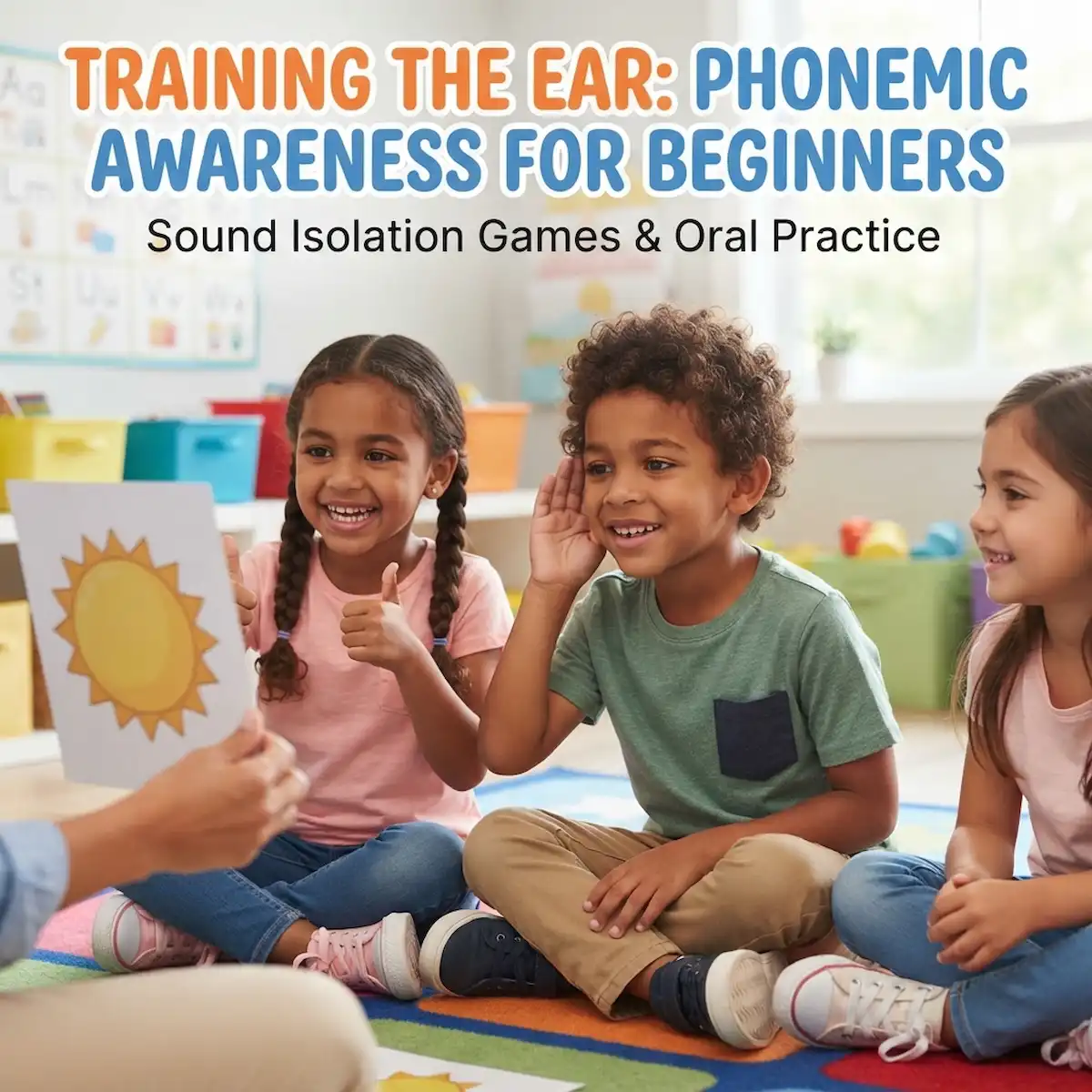
Activity 2: Thumb-Up / Thumb-Down Sound Matching
This is a high-engagement, kinetic game that works wonderfully for whole-group instruction or small-group intervention.
- How to play: Tell students you are going to say two words. If they start with the exact same beginning sound, give a big thumbs up. If they start with different sounds, give a thumbs down.
- Example rounds:
- “Sun… Sock” (Thumbs Up)
- “Map… Door” (Thumbs Down)
- “Fish… Fan” (Thumbs Up)
- Why it works: It gives children immediate physical feedback and allows teachers to visually scan the room to see who is grasping the concept instantly.
Activity 3: Oral Rhyming Circles
Rhyme is the stepping stone to phoneme manipulation.
- How to play: Sit in a circle on the rug. Toss a soft ball or beanbag to a student and say a foundational anchor word like “cat.” The student must catch the ball, say a rhyming word (“bat”), and toss it to the next peer who must find another rhyme (“hat”). If they stall out for more than three seconds, the group works together to rescue them.
- Why it works: It builds auditory memory and rhythm while fostering a low-stakes, joyful community atmosphere.
Implementing phonemic awareness for beginners using these tactile, game-based strategies builds robust cognitive pathways that make later spelling and decoding feel entirely natural. Every successful phonemic awareness for beginners session relies heavily on this type of low-pressure, high-interactivity approach.
5. Supporting Absolute Beginner English Language Learners (ELLs)
Teaching sound isolation to students who are also learning English as an additional language comes with unique hurdles. Certain phonemes present in English may not exist in a student’s native tongue, leading to auditory blind spots. For instance, the distinction between /b/ and /v/ or short vowel sounds like /ɪ/ and /e/ can be nearly imperceptible to a child whose home language lacks those phonemic contrasts.
To support ELLs effectively during phonemic awareness for beginners exercises:
- Exaggerate Mouth Placement: Show children what your lips, teeth, and tongue are doing. When teaching /m/, press your lips firmly together and hum. Visual mouth cues help bridge the gap when auditory distinction is tough.
- Use Real Objects and Pictures: Tie abstract sounds to concrete, highly visual objects. Hearing the sound /k/ in the context of a tangible toy cat makes the acoustic signal stick much faster.
- Keep Vocabulary Accessible: Do not test sound isolation using complex vocabulary words the child doesn’t understand. Stick to high-frequency, concrete nouns (dog, sun, pen, cup, hat).
For broader insights on supporting diverse learners with early literacy frameworks, the International Literacy Association (ILA) offers wonderful professional resources.
6. Troubleshooting Common Roadblocks
Even with the best games and charts, you will run into moments where students struggle. Here is how to navigate the most common classroom roadblocks:
- Roadblock 1: The student keeps looking at your mouth or hands for letters.
- Solution: Gently cup your hand over your mouth or turn around slightly so they rely solely on your voice. Remind them: “Close your eyes, let’s just listen with our superpower ears.”
- Roadblock 2: The student confuses the beginning sound with the ending sound.
- Solution: Use physical anchors. Have students tap their left shoulder for the beginning sound, their tummy for the middle sound, and their right hand for the ending sound. This kinesthetic mapping gives abstract sounds a concrete physical location.
- Roadblock 3: The student repeats the whole word instead of isolating the single sound.
- Solution: Model the elongation technique. If you ask for the first sound in “sun” and they say “sun,” stretch it out dramatically: “Sssssun. What is that very first stretching sound? Sssss…” This helps their ear catch the individual phoneme hiding inside the whole word.
7. Conclusion
Mastering sound isolation and early oral sound games is the ultimate shortcut to confident, joyful reading. By prioritizing phonemic awareness for beginners before ever introducing flashcards or alphabet worksheets, we give children the mental scaffolding they need to decode text effortlessly later on. Put away the pencils, clear off the desks, tune those ears, and let the sound games begin!
Practice Makes Perfect
Here is a PDF worksheet you can download to practive Phonemic Awareness for Beginners
Additional Helpful Information
- Study more about listening strategies – English Listening Strategies: Accents & Context