When school doors close for vacation, language progress can stall. For language learners, this gap often leads to the “summer slide”—a measurable drop in vocabulary and communication skills.
Preventing this regression does not require replicating a rigid classroom environment at home. Instead, the most effective approach matches specific, high-context English Learning Activities to the student’s exact learning level. By expanding the depth of each task, parents can naturally implement powerful English Learning Activities that keep children thinking critically.
Section 1: Foundational Literacy and Beginning Production
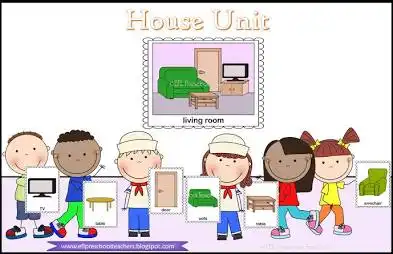
Beginning English learners retain language skills best when vocabulary is tied directly to physical movement and immediate, real-world objects. At this stage, language acquisition relies entirely on concrete, sensory-rich input rather than abstract grammar instruction. By transforming your living space into a functional linguistic map, you can anchor new words into the student’s long-term memory using physical English Learning Activities.
The Environmental Print Scavenger Hunt
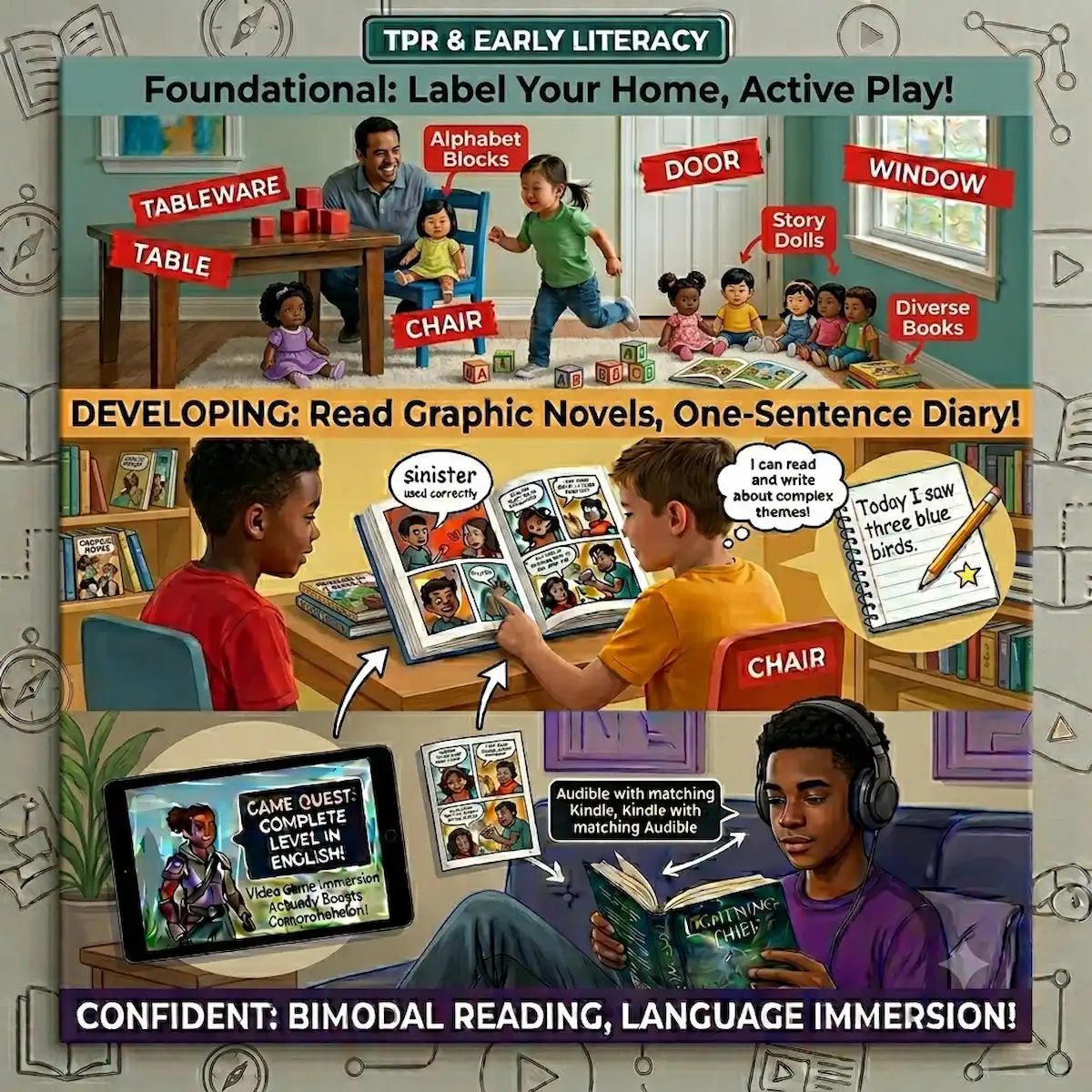
Instead of relying on dry flashcards, you can use high-visibility painter’s tape to place large, clear labels on everyday household objects. This is one of the easiest English Learning Activities to set up. Focus on high-frequency nouns and use uppercase lettering to maximize visual recognition.
- Essential Labels to Create: DOOR, CHAIR, TABLE, WINDOW, TOY, BED, CUP.
- The Execution: Call out a targeted vocabulary word clearly. The learner must physically run to the object, touch it, and repeat the word aloud. To add complexity to these kinds of English Learning Activities, you can introduce simple two-step instructions once single words are mastered (e.g., “Run to the CHAIR and then touch the WINDOW”).
- Why It Works: This activity utilizes Total Physical Response (TPR). It removes the stress of decoding text from a flat page, establishing an immediate connection between the written word, the spoken sound, and the physical item. Industry experts consistently favor these dynamic English Learning Activities over sedentary worksheets because they respect a young learner’s natural need for physical movement.
Phonics-Based Sound Detective
Modify the classic game of “I Spy” to focus entirely on isolating individual letter sounds rather than visual attributes like colors or sizes. This approach turns routine playtime into highly focused English Learning Activities that build critical phonemic awareness.
- The Procedure: Instead of saying “I spy something blue,” state: “I spy something that begins with the /t/ sound.”
- Scaffolded Examples: Guide the learner to scan the room for the physical objects labeled during your scavenger hunt. If they struggle, offer directional clues or emphasize the starting sound again: “It is near the sofa, and it starts with /t/, /t/, TABLE.”
- The Learning Benefit: This game trains the learner to isolate initial phonemes. Creative phonics games serve as essential English Learning Activities because mastering these distinct sounds is the foundational skill required before children can confidently blend letters together in a classroom setting. For more insight on incorporating phonics into home routines, explore the early childhood literacy frameworks on Edutopia.
Section 2: Developing Independent Literacy and Contextual Syntax
Developing English learners maintain their progress by engaging with highly contextual texts and practicing low-stakes daily writing. Students at this intermediate elementary stage understand basic sentence structures, but they can easily become frustrated by dense blocks of text or unfamiliar vocabulary. Introducing visual support into your holiday English Learning Activities prevents learning fatigue.
The High-Context Reading Loophole
Many caretakers worry when a student shifts away from traditional books toward graphic novels or comic books during their vacation. However, choosing graphic text over prose is a smart strategy when selecting home-based English Learning Activities.
- Recommended Material: High-quality graphic series such as Dog Man by Dav Pilkey, InvestiGators by John Patrick Green, or Amulet by Kazu Kibuishi.
- The Strategy: Allow the student to choose their own reading material. Encourage them to read through entire chapters without pausing to look up unfamiliar words. You can find excellent title recommendations and reading milestones through Scholastic’s Guide to Graphic Novels.
- The Linguistic Mechanics: Graphic novels provide immediate visual context clues. If a sentence uses an unfamiliar word, the illustration of the character’s reaction provides the meaning instantly. This preserves reading momentum, making graphic novels highly efficient English Learning Activities that build natural contextual deduction skills without the constant interruption of a dictionary.
The Single-Sentence Daily Journal
Demanding multi-paragraph writing assignments over a vacation often triggers resistance, raising the student’s affective filter—the psychological barrier that slows down language production. Swapping long compositions for focused sentence building keeps your written English Learning Activities stress-free and productive.
- The Daily Prompt: Provide a dedicated notebook. Every evening, the student must compose exactly one complete sentence describing a specific, memorable event from their day.
- Increasing the Challenge: To push their syntax development, introduce weekly constraints to these journaling English Learning Activities. For instance, require them to use an adjective on Monday, or a time transition (e.g., before, after) on Wednesday.
- Acceptable Structural Patterns:
- “Today I ate a massive piece of chocolate cake for lunch.”
- “We went to the park and saw three very noisy birds.”
- Why It Matters: This approach lowers the psychological pressure of writing. It allows the student to focus entirely on proper syntax construction, correct verb tenses, and accurate punctuation within a manageable, bite-sized format, making it one of the most sustainable daily English Learning Activities a parent can implement.
Section 3: Confident Communication and Immersive Comprehension
Confident, advanced English students boost fluency during an extended break by shifting from passive language reception to active immersion. Students at this level possess stable grammar foundations, but they require consistent exposure to idiomatic expressions, variable pronunciation, and complex vocabulary. Integrating targeted English Learning Activities into existing daily digital habits provides this exposure naturally.

Bimodal Reading (The Audio-Text Stack)
Advanced students frequently struggle with the non-phonetic spelling system of complex English words. Bimodal reading stands out among advanced English Learning Activities because it addresses this specific challenge by engaging multiple senses simultaneously.
| Reading Method | Vocabulary Retention Increase | Target Skills Addressed |
| Traditional Reading | Baseline Standard | Visual Word Recognition, Text Decoding |
| Bimodal Reading (Audio + Text) | Up to 40% Increase | Pronunciation Accuracy, Auditory Tracking, Idiomatic Flow |
- The Daily Practice: The student listens to an English-language audiobook while simultaneously reading the matching physical book or digital text.
- Target Material Suggestions: Engaging youth fiction such as The Lightning Thief by Rick Riordan or Harry Potter by J.K. Rowling, which can be easily paired using audiobooks from platforms like Audible.
- The Cognitive Process: This practice forces the brain to map the spoken sound of an advanced vocabulary word directly to its written form. It resolves confusion surrounding complex, irregular English pronunciations (such as through, choir, or colonel) while allowing the reader to enjoy more advanced narratives. These multi-sensory English Learning Activities ensure that advanced comprehension matches fluent spoken execution.
Target Language Video Game Immersion
Rather than restricting screen time during a school break, turn it into an active comprehension environment by modifying the software configuration. Utilizing digital entertainment is an exceptional way to introduce immersive English Learning Activities without causing academic resentment.
- The Configuration Rule: Change the internal system language settings of the student’s preferred video games entirely to English.
- Ideal Game Genres: Role-Playing Games (RPGs) or narrative-driven puzzle games containing detailed dialogue trees and written instructions (e.g., Animal Crossing, Minecraft, or The Legend of Zelda).
- The Operational Workflow: To navigate menus, complete missions, and progress through the game, the student must read, process, and react to English text and spoken dialogue in real-time. This leverages high intrinsic motivation to drive functional language processing, turning a standard leisure activity into one of the most rigorous English Learning Activities available at home.
By matching these specific English Learning Activities to the student’s actual proficiency level, you keep their English sharp, active, and growing—without ruining their well-deserved vacation time.
Additional Helpful Information
- Learn about role playing activities – Mastering Real-World Interactions: Role Playing Scripts for Language Learners