Breaking the Ice: Why Your First Words in English Matter
Stepping into a new language can feel a bit like walking onto a stage without a script. Years ago, when I first started teaching young ESL learners and absolute beginners, I noticed a common pattern. Students would memorize rigid textbook phrases like “How do you do?” and then freeze up when someone on the street simply smiled and said, “Hey, how’s it going?” Learn some basic English greetings and variations of them.
Language isn’t just about grammar; it’s about connection. If you are starting your journey with the English language, the absolute best place to start is with basic English greetings. These are the social keys that unlock conversations, build friendships, and help you navigate everyday situations with ease.
Let’s break down everything you need to know to greet people naturally, respond politely, and avoid common beginner mistakes.
Why Greetings Matter in English Culture
In English-speaking cultures, greetings are more than just exchanging words—they are a social ritual. Saying hello acknowledges another person’s presence and sets a friendly tone.
However, greetings change depending on who you are talking to. Saying “What’s up?” to your boss might raise an eyebrow, while saying “Good morning, Mr. Davis” to your best friend might make them laugh. Understanding the context is just as important as knowing the words themselves.
According to linguistic research published by the British Council LearnEnglish, mastering functional everyday language is the fastest way to build conversational fluency. When you feel confident in your basic English greetings, your brain relaxes, making it much easier to absorb new vocabulary later on.
Part 1: Saying Hello (Formal vs. Informal)
The first step in any interaction is choosing the right greeting. Let’s divide these into two main categories: Formal (for work, older people, or strangers) and Informal (for friends, peers, and casual settings).
Formal Greetings
Use these when you want to show respect or when you are in a professional environment.
- Good morning / Good afternoon / Good evening: These change depending on the time of day. (Note: “Good night” is only used when leaving or going to sleep, never as a greeting!).
- Hello, how are you? A classic, safe, and polite option for almost any situation.
- Pleased to meet you: Used the very first time you meet someone new.
Informal Greetings
Use these with friends, classmates, or people your own age.
- Hi / Hey: Short, friendly, and very common.
- How’s it going? A relaxed way to ask how someone is doing.
- What’s up? Very casual, often used among younger speakers or close peers.
Quick Reference Chart: Common Greetings
| Greeting | Formality Level | Best Used With |
| Good morning | Formal / Neutral | Coworkers, teachers, strangers in the AM |
| Hello | Neutral | Anyone, anywhere |
| Hi | Informal | Friends, peers, casual settings |
| How are you? | Polite / Formal | Acquaintances, service workers, professionals |
| What’s up? | Very Informal | Close friends, family |
Part 2: Natural Responses to “How Are You?”
One of the trickiest parts for beginners learning basic English greetings is the follow-up question, “How are you?” In English, this is often treated as a greeting rather than a deep medical or emotional inquiry.
When someone asks how you are, you don’t need to give a 10-minute life update. A short, polite response followed by “And you?” keeps the conversational ball rolling.
Positive Responses
- “I’m doing great, thanks!”
- “Pretty good, and you?”
- “I’m well, thank you for asking.”
Neutral Responses
- “I’m okay.”
- “Can’t complain!”
- “Just hanging in there.”
For a deeper dive into conversational etiquette and cultural nuances, the BBC Learning English platform offers fantastic audio clips showing how native speakers naturally modulate their tone during these exchanges.
Part 3: Introducing Yourself
Once you’ve mastered basic English greetings, the next logical step is introducing yourself. You can’t have a full conversation without knowing who you’re talking to!
Here are the most common patterns you will hear and use:
- Direct: “My name is Maria.” / “I am Ken.”
- Casual: “I’m Sarah.”
- Asking for a name: “What’s your name?” (Casual) or “May I ask your name?” (Formal).
After introductions are made, it is customary to say:
- “Nice to meet you.”
- “Glad to connect with you.”
Part 4: Saying Goodbye Gracefully
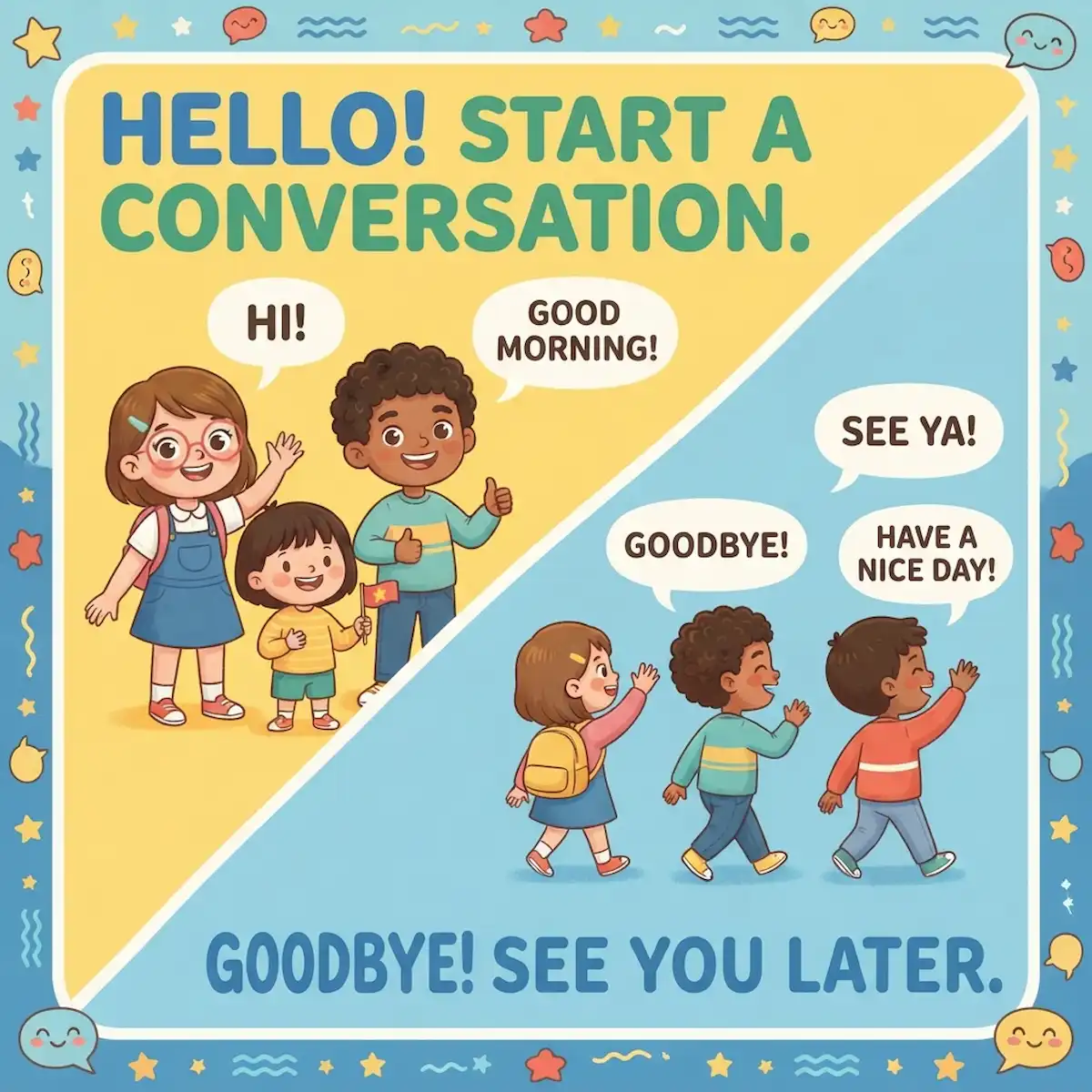
Conversations have to end, and knowing how to exit politely is just as important as knowing how to start.
Depending on how long you’ll be apart, your choice of parting words will vary:
- Short-term: “See you later,” “Catch you later,” or “See you tomorrow.”
- End of the day: “Have a good evening,” or “Good night.”
- Formal: “Goodbye, it was nice talking with you.”
The Merriam-Webster Dictionary notes that parting phrases often carry cultural warmth, signaling that the interaction was valued even as it comes to a close.
Common Mistakes Beginners Make
In my classroom, I see a few repeating mistakes when students practice basic English greetings. Keeping these in mind will help you sound much more natural:
- Translating literally: Translating phrases word-for-word from your native language often results in unnatural phrasing. Stick to established English idioms.
- Using “Good night” to say hello: Remember, “good night” means goodbye. Use “Good evening” if it’s dark outside and you are just arriving somewhere.
- Panicking over “How are you?”: Don’t overthink it. A simple “Good, thanks!” is almost always the correct answer.
Additional Helpful Content: Cultural Nuances and Body Language
Language lives in the body just as much as it lives in the mouth. When using basic English greetings, pay attention to non-verbal cues:
- Eye Contact: In many Western cultures, a brief moment of eye contact accompanied by a smile shows confidence and friendliness.
- Handshakes: In professional settings, a firm (but not crushing!) handshake is standard when meeting someone for the first time.
- Personal Space: Keep a comfortable arm’s length of space between yourself and the person you are greeting.
Practicing these physical habits alongside your vocabulary will make your interactions feel seamless and authentic.
Practice Makes Perfect
Here is a PDF worksheet you can download to practice basic English greetings – The answers are on a separate page.
Conclusion
Mastering basic English greetings is the foundation of all your future conversations. Don’t be afraid to make mistakes—every native speaker started right where you are now. Take these phrases, practice them in front of a mirror, use them with your classmates, and watch how quickly simple words can open up a whole new world.
Additional Helpful Information
- Learn more about Alphabet Letter Sound Correspondence – Alphabet Letter Sound Correspondence: Set 1 Phonics Guide for Beginners
- Study more about conversational English – Learn Common Conversational English Phrases