Present Continuous Tense for Beginners: Rules, Charts, and Easy Examples
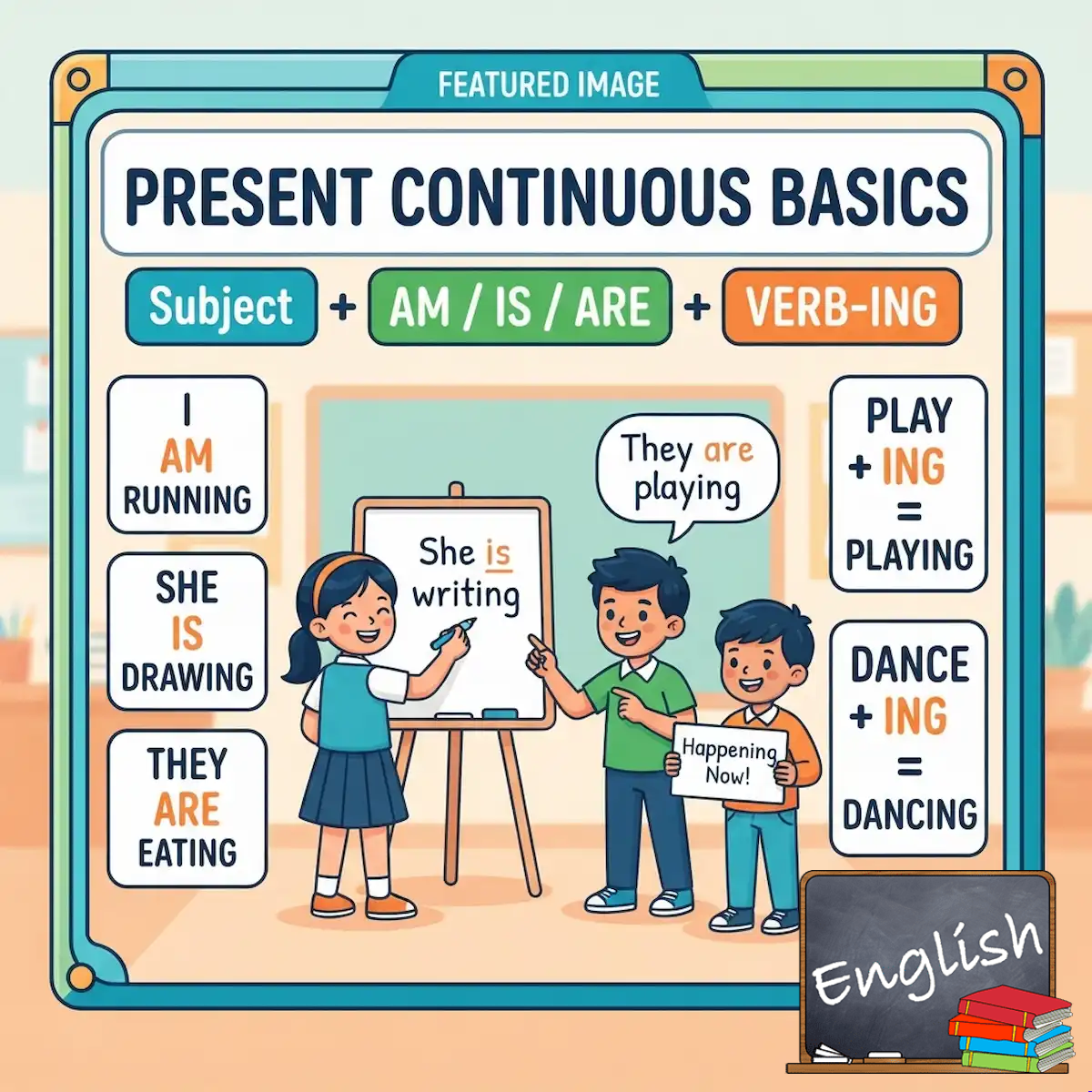
Quick Answer: The present continuous tense for beginners describes actions that are happening right now, at this exact moment. You build it using two parts: the present tense of the helping verb be (am, is, or are) plus a main verb ending in -ing (for example: I am reading, She is writing, They are playing).
Every morning in my primary school classroom, we start our English lesson with a simple five-minute game called “Freeze Frame.” I ring a small brass bell, and every student has to freeze like a statue in the middle of whatever they are doing. Then I walk around the room and ask, “What is happening right now?” One student points and says, “Leo is tying his shoe!” Another laughs and says, “Maya is holding a red pencil!” Within minutes, eight- and nine-year-olds who felt nervous about English grammar are building complete, accurate sentences without looking at a textbook.
If you are just starting your English journey, mastering the present continuous tense for beginners is one of the fastest ways to sound natural in everyday conversation. You do not need to memorize dozens of irregular past-tense verbs or complicated time clauses. Instead, you only need three tiny helping words—am, is, and are—and one simple ending: -ing.
In this guide, we will walk through everything step by step, just like we do on the classroom whiteboard. You will find clear charts, spelling tricks, everyday examples, common traps to avoid, and a short practice quiz at the end so you can test what you have learned.
What Is the Present Continuous Tense?
The present continuous tense (also called the present progressive in many American textbooks) is the verb form English speakers use to talk about an action that is in progress at the moment of speaking. The action has already started, and it has not finished yet.
Think of it like taking a live video on your phone rather than looking at a printed calendar. If you look out your window right now, you might see cars moving, birds flying, or rain falling. Because those actions are happening in front of your eyes at this exact second, you use the present continuous tense for beginners to describe them.
According to the grammar reference team at British Council LearnEnglish, we also use this tense for temporary situations happening around now—even if the person is not doing the action at the exact second they speak. For example, if a student tells me, “I am reading a great book about space,” they might not be holding the book during class, but they are in the middle of reading it this week.
Key Time Words That Signal “Happening Now”
When you see or hear certain time expressions in a sentence, they act like flashing green lights telling you to use the present continuous tense for beginners:
- Right now (I am eating lunch right now.)
- Now (She is talking on the phone now.)
- At the moment (They are studying for a test at the moment.)
- Today (We are learning new English words today.)
- This week / This month (He is staying with his grandparents this week.)
- Look! / Listen! (Look! The dog is chasing its tail! Listen! Someone is playing the piano!)
How Do You Form the Present Continuous Tense?
To build a positive sentence in the present continuous tense for beginners, follow this simple three-part formula:
Subject + am / is / are + Verb-ing
Many beginner students forget the first verb (am, is, or are) and say things like “She running” or “I eating.” In my classroom, I tell students that the helping verb be and the -ing ending are best friends—they never go to a party without each other! If you use -ing as your main action verb, you must bring am, is, or are along with it.
Master Formula Chart: Positive Sentences
Use this chart to match every subject pronoun with the right form of be and the main verb:
| Subject | Helping Verb (be) | Main Verb + -ing | Full Sentence Example | Spoken Short Form (Contraction) |
|---|---|---|---|---|
| I | am | walking | I am walking to school. | I’m walking to school. |
| You | are | listening | You are listening carefully. | You’re listening carefully. |
| He | is | drawing | He is drawing a dinosaur. | He’s drawing a dinosaur. |
| She | is | drinking | She is drinking cold water. | She’s drinking cold water. |
| It | is | raining | It is raining outside. | It’s raining outside. |
| We | are | cooking | We are cooking dinner together. | We’re cooking dinner together. |
| They | are | playing | They are playing football. | They’re playing football. |
Working with Nouns Instead of Pronouns
In real life, we do not always start sentences with he, she, or they. Often, we use people’s names, animals, or objects. Here is how to pick the right helping verb every single time:
- One person, animal, or thing (Singular Noun) → use
is- My brother is sleeping. (My brother = he)
- The cat is climbing the tree. (The cat = it)
- The bus is arriving at the station. (The bus = it)
- Two or more people, animals, or things (Plural Noun) → use
are- My parents are working in the garden. (My parents = they)
- Tom and Sara are sharing a sandwich. (Tom and Sara = they)
- The children are singing a song. (The children = they)
As noted in the Cambridge Dictionary English Grammar Today guide, native speakers use short forms (contractions) like I’m, she’s, and they’re almost all the time when speaking. Practicing both the full form and the short form will help you understand fast spoken English right away.
Spelling Rules for Adding -ing to Verbs
Adding -ing to the end of a verb looks easy at first: play becomes playing, and eat becomes eating. However, English has four small spelling changes you need to watch out for when learning the present continuous tense for beginners.
In grammar, this -ing form of a verb is officially called a present participle, as defined by Merriam-Webster. Knowing how to spell the present participle cleanly will save you from easy mistakes on school tests and emails.
The 5 Spelling Rules Chart for -ing Verbs
| Rule Name | When to Use It | Base Verb | Change You Make | Correct -ing Form |
|---|---|---|---|---|
| 1. Standard Rule | Most verbs (including verbs ending in -y, -w, or -x) | read play fix snow | Just add -ing (never drop -y) | reading playing fixing snowing |
| 2. Silent -e Rule | Verbs ending in one silent -e | make write dance smile | Drop the -e, then add -ing | making writing dancing smiling |
| 3. Double -ee Exception | Verbs ending in -ee, -oe, or -ye | see agree flee | Keep both letters and add -ing | seeing agreeing fleeing |
| 4. CVC Doubling Rule | Short 1-syllable verbs ending in Consonant + Vowel + Consonant | sit run swim stop | Double the last consonant + -ing | sitting running swimming stopping |
| 5. The -ie to -y Rule | Verbs ending in -ie | lie tie die | Change -ie to -y, then add -ing | lying tying dying |
A Teacher’s Classroom Trick for Rule #4 (Doubling Letters)
Young learners often ask me, “Why does run get two n‘s (running), while rain only gets one (raining)?”
Here is the trick we use on the board: look at the last three letters of the verb.
- In r-u-n, the last three letters are Consonant (r) + Vowel (u) + Consonant (n). That is a 1-1-1 sandwich (one syllable, one vowel, one final consonant). When you have a 1-1-1 sandwich, you double the last letter: running. Break into English
- In r-a-i-n, the last three letters are Vowel (a) + Vowel (i) + Consonant (n). There are two vowels sitting together, so you do not double the n: raining.
- Also remember: we never double the letters w, x, or y at the end of a word (snowing, boxing, staying). Break into English
How to Make Negative Sentences in the Present Continuous
Sometimes you need to say what is not happening right now. To make a negative sentence in the present continuous tense for beginners, simply put the word not right after am, is, or are.
Subject + am / is / are + not + Verb-ing
Negative Sentences Chart
| Subject | Full Negative Form | Common Short Form (Contraction) | Example Sentence |
|---|---|---|---|
| I | I am not | I’m not (never “I amn’t”) | I’m not watching TV right now. |
| You | You are not | You aren’t / You’re not | You aren’t wearing your jacket. |
| He | He is not | He isn’t / He’s not | He isn’t feeling well today. |
| She | She is not | She isn’t / She’s not | She isn’t working at the hospital today. |
| It | It is not | It isn’t / It’s not | Look outside—it isn’t snowing anymore! |
| We | We are not | We aren’t / We’re not | We aren’t taking the bus this morning. |
| They | They are not | They aren’t / They’re not | They aren’t listening to the instructions. |
Notice that for I am not, there is only one natural contraction: I’m not. For all the other subjects, you have two great choices (He isn’t or He’s not; They aren’t or They’re not), and both mean the exact same thing.
How to Ask Questions in the Present Continuous
Asking questions in the present continuous tense for beginners is wonderfully simple because you do not need any extra words like do or does. All you do is swap the places of the subject and the helping verb (am, is, or are).
Think of it like two dancers switching spots on stage:
- Statement: You are eating breakfast.
- Question: Are you eating breakfast?
Yes/No Questions and Short Answers Chart
When someone asks you a Yes/No question in the present continuous, you do not need to repeat the -ing verb in a short answer. Just use am, is, or are (and remember: never use a contraction at the end of a positive short answer—say “Yes, I am,” not “Yes, I’m”).
| Question | Positive Short Answer | Negative Short Answer |
|---|---|---|
| Am I sitting in your chair? | Yes, you are. | No, you aren’t. |
| Are you doing your homework? | Yes, I am. | No, I’m not. |
| Is he playing video games? | Yes, he is. | No, he isn’t. |
| Is she cooking dinner? | Yes, she is. | No, she isn’t. |
| Is it raining outside? | Yes, it is. | No, it isn’t. |
| Are we going the right way? | Yes, we are. | No, we aren’t. |
| Are they waiting for the train? | Yes, they are. | No, they aren’t. |
Wh- Questions (Asking for More Information)
When you want more than a “yes” or “no,” place a question word (What, Where, Who, Why, or How) right at the very beginning of the question, before am, is, or are:
- What are you reading? — I am reading a comic book.
- Where is she going? — She is going to the library.
- Who are they talking to? — They are talking to the science teacher.
- Why is the baby crying? — Because she is hungry.
- How are you feeling today? — I am feeling much better, thank you!
Everyday Examples of the Present Continuous in Action
Reading grammar rules is helpful, but seeing real sentences in familiar places helps your brain remember them naturally. Here is how the present continuous tense for beginners sounds in four places you visit every week.
1. At School (In the Classroom)
- The teacher is writing the date on the whiteboard.
- Two students are handing out blue notebooks.
- I am sharpening my pencil at the back of the room.
- We are practicing our pronunciation out loud.
- Marco isn’t looking at his book; he is staring out the window!
2. At Home (In the Kitchen and Living Room)
- Dad is chopping carrots and onions for soup.
- Grandma is watering the flowers on the balcony.
- Our puppy is sleeping under the dining table.
- My sister and I are washing the dishes together.
- Nobody is watching the television, so let’s turn it off.
3. At the Park (Outdoors)
- The sun is shining brightly today.
- Three kids are riding their bicycles along the path.
- An old man is feeding bread crumbs to the ducks.
- A woman is jogging with her headphones on.
- The wind is blowing the yellow leaves off the trees.
4. On a Phone Call or Video Chat
- “Hi, Sam! Where are you?” — “I’m walking into the supermarket right now.”
- “Can I call you back in ten minutes? We’re eating dinner.”
- “Look at the camera—the baby is waving at you!”
- “Why are you whispering?” — “Because my little brother is taking a nap.”
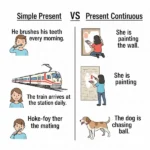
Present Continuous vs. Present Simple: What Is the Difference?
Once learners get comfortable with the present continuous tense for beginners, they often ask: “When do I say ‘I play’ and when do I say ‘I am playing’?”
This is one of the most important contrasts in beginner English. As explained in the British Council LearnEnglish Kids grammar lessons, the two tenses do two very different jobs:
- Present Simple = habits, daily routines, and facts that are always true.
- Present Continuous = actions happening right now, or temporary actions happening around today. Cambridge Dictionary – Cambridge University Press & Assessment
Side-by-Side Comparison Chart
| Feature | Present Simple (Habits & Facts) | Present Continuous (Happening Now) |
|---|---|---|
| Main Job | Things you do every day, every week, or usually. | Things happening right now at this moment. |
| Verb Form | Base verb (add -s/-es for he, she, it) | am / is / are + verb-ing |
| Signal Words | always, usually, often, every day, on Mondays | now, right now, at the moment, today, Look! |
| Example 1 | She drinks tea every morning. | She is drinking orange juice right now. |
| Example 2 | I wear a uniform to school. | Today is Saturday, so I am wearing jeans. |
| Example 3 | It rains a lot in April. | Take your umbrella—it is raining now! |
| Example 4 | They speak Spanish at home. | Shh! They are speaking to the principal. |
When you get stuck, ask yourself one quick question: “Can I point at this action happening right now?” If the answer is yes, choose the present continuous tense for beginners!
Watch Out! Verbs We Do Not Usually Use with -ing (Stative Verbs)
Even when you are talking about right now, there is a small group of English verbs that almost never take -ing. Teachers call these stative verbs (or state verbs) because they describe feelings, thoughts, senses, or ownership inside your mind—not physical actions you can watch someone do.
For example, you cannot stand across a room and watch someone “know” a math answer or “like” chocolate. Because these are states rather than moving actions, we keep them in the present simple even when we mean “right now”:
| Category | Common Stative Verbs | Incorrect (Do Not Say) | Correct (Say This Instead) |
|---|---|---|---|
| Feelings & Likes | like, love, hate, want, need, prefer | I want a glass of water. | |
| Thoughts & Mind | know, understand, remember, forget, believe | She knows the answer. | |
| Ownership | have (for possessions), own, belong | They have a big blue car. | |
| Senses | see, hear, smell, taste | I hear a strange noise. |
Teacher’s Bonus Tip on “Have”: When have means owning something (I have two cats), do not use -ing. However, when have is part of an action phrase—like having lunch, having a shower, or having fun—you can use the present continuous! (“We are having lunch right now.”)
5 Common Beginner Mistakes (and How to Fix Them)
After years of checking beginner notebooks and listening to classroom dialogues, I see the same five mistakes pop up again and again. Spotting them early will make your English sound much clearer:
- Forgetting the helping verb (
am,is,are)- Mistake:
My dog barking at the mailman. - Fix: My dog is barking at the mailman.
- Mistake:
- Using the wrong helping verb for plural nouns
- Mistake:
The students is sitting quietly. - Fix: The students are sitting quietly.
- Mistake:
- Forgetting to add
-ingafteram/is/are- Mistake:
She is cook pasta in the kitchen. - Fix: She is cooking pasta in the kitchen.
- Mistake:
- Keeping the silent
-ebefore adding-ing- Mistake:
He is writeing a letter to his cousin. - Fix: He is writing a letter to his cousin.
- Mistake:
- Using
-ingwith stative verbs likelikeorunderstand- Mistake:
I am understanding the lesson now! - Fix: I understand the lesson now!
- Mistake:
3 Fun Ways to Practice at Home (No Textbook Needed)
The best way to lock the present continuous tense for beginners into your long-term memory is to connect it to what your eyes and ears are doing in real life. Try one of these three five-minute exercises today:
- The Sports Commentator Game: Put on a short video clip of a soccer match, a cooking show, or a busy city street. Pretend you are a live TV announcer and describe everything out loud as it happens: “The player in red is running fast… Now he is passing the ball… The goalkeeper is jumping!”
- The Window Spy Routine: Stand by your window for two minutes each afternoon and say five sentences about what you see outside: “A woman is walking a brown dog. Two birds are sitting on the roof. A delivery truck is stopping across the street.”
- The Family Photo Walk: Open the photo gallery on your phone and pick five pictures of friends or family. Point to each person and describe the action frozen in the photo: “In this photo, my cousin is blowing out her birthday candles, and everyone is clapping.”
Quick Practice Quiz: Test Your Skills!
Ready to check what you have learned about the present continuous tense for beginners? Fill in the blanks with the correct form of am, is, or are plus the -ing verb in brackets. Check your answers right below!
- Listen! The birds __________ (sing) outside my bedroom window.
- I __________ (not / wear) my glasses today because I left them at home.
- __________ your brother __________ (study) for his English exam right now?
- Look at the chef! He __________ (make) fresh pizza dough.
- We __________ (sit) in the front row of the cinema.
- Why __________ they __________ (run) toward the bus stop?
- My aunt __________ (tie) a ribbon around the birthday gift.
- Be quiet, please—the baby __________ (sleep).
Answer Key
- are singing (The birds = plural, so use are + singing)
- am not wearing / ‘m not wearing (negative form with I)
- Is your brother studying (question form with singular subject your brother)
- is making / ‘s making (drop the silent -e on make before adding -ing) Break into English
- are sitting / ‘re sitting (double the -t in sit because of the 1-1-1 CVC pattern)
- are they running (question form + double the -n in run) Break into English
- is tying / ‘s tying (change -ie to -y in tie before adding -ing) Break into English
- is sleeping / ‘s sleeping (singular subject the baby + sleeping)
Practice Makes Perfect
Here is a PDF worksheet you can download to practice present continuous tense – the answers are on a separate page
Frequently Asked Questions (FAQ)
What is the basic rule for the present continuous tense for beginners?
The basic rule is am, is, or are + verb-ing. Use am with I, is with he, she, it, and singular nouns, and are with you, we, they, and plural nouns. You use this structure to describe actions happening right now or temporary situations in progress around the present time.
Why do we double the last letter in words like “running” and “swimming”?
In English spelling, when a short one-syllable verb ends in a single consonant-vowel-consonant pattern (like r-u-n or s-w-i-m), you double the final consonant before adding -ing so the short vowel sound stays clear. Verbs ending in two vowels plus a consonant (like reading) or ending in -w, -x, or -y (like playing) do not double the final letter.
Can I use the present continuous tense for future plans?
Yes! Once you master the present continuous tense for beginners for actions happening right now, you can also use the exact same am/is/are + verb-ing form to talk about fixed personal plans in the near future—for example, “I am meeting my friend at 4:00 PM tomorrow” or “We are visiting our grandparents this weekend”.
What is the difference between present continuous and present progressive?
There is no difference in meaning or grammar rules—they are two names for the exact same verb tense. British English resources like Cambridge and the British Council usually call it the present continuous, while many North American textbooks call it the present progressive.
Additional Helpful Information
- Study more about present continuous – Simple Present vs Present Continuous: Easy English Guide