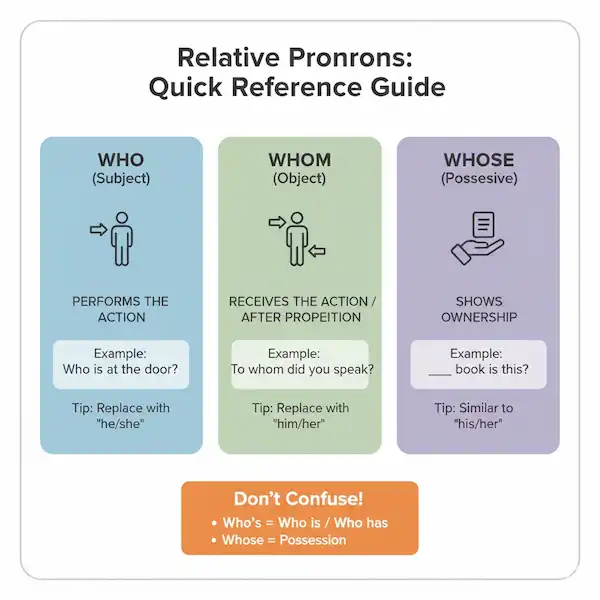
Who Whom Whose: A Comprehensive Guide to Relative Pronouns
Navigating the nuances of “who,” “whom,” and “whose” can feel like a linguistic minefield, even for seasoned writers. These relative pronouns, while seemingly similar, each play a distinct role in a sentence. Mastering their correct usage is crucial for clear, grammatically sound communication.
This article will demystify “who,” “whom,” and “whose,” providing clear explanations, ample examples, helpful charts, and additional resources to solidify your understanding. Continue reading to clear up the confusion about Who vs. Whom vs. Whose.
Who vs. Whom vs. Whose – Understanding the Basics: Subject vs. Object
The core of distinguishing between “who” and “whom” lies in understanding the difference between a subject and an object in a sentence.
- Subject: The subject of a verb is the person or thing performing the action. Think of it as the “doer” of the sentence.
- Example: She runs. (She is the subject.)
- Object: The object of a verb or a preposition is the person or thing receiving the action or being acted upon. Think of it as the “receiver.”
- Example: I saw her. (Her is the object of the verb “saw”.)
- Example: I gave the book to her. (Her is the object of the preposition “to”.)
Who: The Subject Form
“Who” acts as a subject in a sentence or clause. It refers to the person or people performing an action.
Think of it this way: If you can replace “who” with “he,” “she,” “they,” or “I,” then “who” is the correct choice.
Examples:
- Who ate the last slice of cake? (He/She ate the cake. “Who” is the subject of “ate.”)
- The student who aced the exam received a scholarship. (He/She aced the exam. “Who” is the subject of “aced.”)
- I don’t know who will be attending the meeting. (They will be attending. “Who” is the subject of “will be attending.”)
Helpful Tip: Try substituting “who” with “he” or “she” in the dependent clause. If it makes sense, “who” is correct.
Whom: The Object Form
“Whom” acts as an object in a sentence or clause. It refers to the person or people receiving an action or coming after a preposition.
Think of it this way: If you can replace “whom” with “him,” “her,” “them,” or “me,” then “whom” is the correct choice.
Examples:
- To whom should I address this letter? (I should address this letter to him/her. “Whom” is the object of the preposition “to.”)
- The committee will select the candidate whom they believe is most qualified. (They believe him/her to be most qualified. “Whom” is the object of “believe.”)
- You are speaking to whom? (You are speaking to him/her. “Whom” is the object of the preposition “to”.)
Helpful Tip: Try substituting “whom” with “him” or “her” in the dependent clause. If it makes sense, “whom” is correct.
Whose: The Possessive Form
“Whose” indicates possession or ownership. It’s the possessive form of both “who” and “which.”
Think of it this way: “Whose” is like “his,” “her,” “its,” or “their.”
Examples:
- Whose car is parked in my driveway? (His/Her car is parked here. “Whose” indicates possession of the car.)
- The author, whose latest novel topped the charts, will be signing books. (His/Her latest novel. “Whose” shows possession of the novel.)
- I found a phone. Whose is it? (Whose phone is it? “Whose” asks about ownership.)
Important Distinction: Don’t confuse “whose” with “who’s.”
- Who’s is a contraction of “who is” or “who has.”
- Whose indicates possession.
Examples:
- Who’s going to the party? (Who is going to the party?)
- Whose jacket is this? (Indicates possession.)
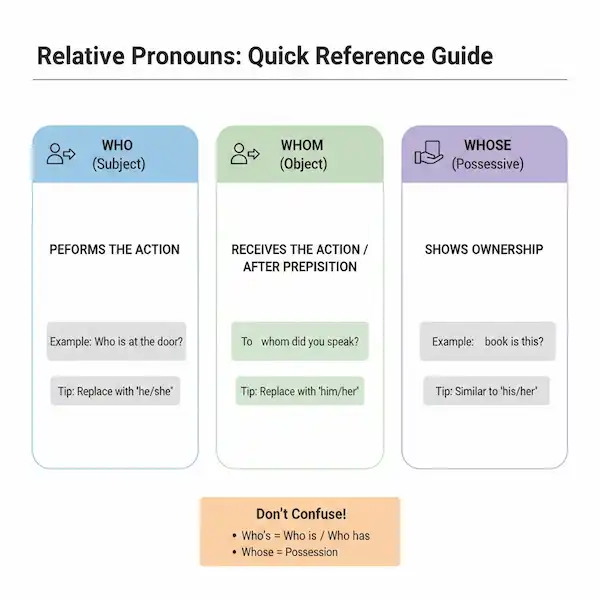
Visual Aid: Quick Reference Chart
Practical Application: Test Your Knowledge – Who vs. Whom vs. Whose
Let’s put your understanding to the test with some practice sentences. Try to determine whether “who,” “whom,” or “whose” is correct.
- He is the kind of person ______ always brightens your day.
- To ______ did you lend your book?
- The artist, ______ paintings are displayed in the gallery, is attending the opening.
- ______ do you think will win the election?
- She is speaking with the manager, ______ recommended her for the promotion.
Answers:
- He is the kind of person who always brightens your day. (He/She brightens. “Who” is the subject of “brightens.”)
- To whom did you lend your book? (You lent your book to him/her. “Whom” is the object of the preposition “to.”)
- The artist, whose paintings are displayed in the gallery, is attending the opening. (His/Her paintings. “Whose” indicates possession.)
- Who do you think will win the election? (They will win. “Who” is the subject of “will win.” The phrase “do you think” is an interjection.)
- She is speaking with the manager, who recommended her for the promotion. (He/She recommended. “Who” is the subject of “recommended.”)
Here is a PDF worksheet you can download to practice Who vs. Whom vs. Whose. The answers are on a separate page.
Common Pitfalls and Tricky Sentences about Who vs. Whom vs. Whose
Even with the rules in mind, some sentences can still be confusing. Here are a few common pitfalls and how to navigate them:
- Intervening Clauses: When an intervening clause like “do you think” or “do you believe” appears, it can obscure the subject/object relationship. Always analyze the clause where “who” or “whom” is functioning.
- Incorrect: Whom do you think is coming to dinner?
- Correct: Who do you think is coming to dinner? (They are coming. “Who” is the subject of “is coming.”)
- Formal vs. Informal Language: In very informal speech, “whom” is often replaced with “who.” While acceptable in casual conversation, it’s best to stick to the correct grammatical usage in formal writing and speech.
- The “M” Test: A quick mental trick for “who” vs. “whom” is to try replacing it with “he/him” or “she/her.”
- If “he” or “she” fits, use “who.”
- If “him” or “her” fits, use “whom.”
Example:
- (Who/Whom) did you see?
- I saw him. (So, “Whom” did you see?)
Frequently Asked Questions (FAQ) – Who vs. Whom vs. Whose
Q: Is “whom” becoming obsolete? A: While “whom” is used less frequently in everyday spoken English, especially in informal contexts, it is still grammatically correct and important to use in formal writing and speech to ensure precision and clarity.
Q: How do I know if a pronoun is functioning as a subject or an object? A: To determine this, isolate the clause containing the pronoun and identify the verb. If the pronoun is performing the action of that verb, it’s a subject. If it’s receiving the action or follows a preposition, it’s an object.
Q: Can “whose” refer to inanimate objects? A: Yes, “whose” can refer to inanimate objects, although it’s sometimes considered more formal. For example: “The house, whose roof was damaged, needed repairs.” In less formal contexts, you might rephrase it as “The house with the damaged roof.”
Q: What about relative clauses starting with prepositions (e.g., “for whom,” “with whom”)? A: When a relative pronoun follows a preposition, it will always be the object form, “whom.”
- Example: This is the colleague for whom I bought the gift.
- Example: The person with whom I spoke was very helpful.
Conclusion – Who vs. Whom vs. Whose
Mastering “who,” “whom,” and “whose” is a significant step towards achieving grammatical precision in your writing and speaking. By consistently applying the subject/object distinction and understanding the possessive nature of “whose,” you can eliminate common errors and enhance the clarity of your communication. Keep practicing, and these once-tricky pronouns will become second nature!
Additional Helpful Links for Who vs. Whom vs. Whose
- Confused about Affect vs Effect? – Affect vs Effect: The Definitive Guide to Using Them Correctly
- Understand the difference between Further and Farther – Farther vs Further: Mastering the Distance Distinction
External Links for Authoritative Sources
- Purdue OWL – Pronouns: https://owl.purdue.edu/owl/general_writing/grammar/pronouns/index.html
- Grammarly – Who vs. Whom: https://www.grammarly.com/blog/who-vs-whom/
- Merriam-Webster – Who, Whom, Whose, and Who’s: https://www.merriam-webster.com/grammar/who-whom-whose-whos-usage