All About Weather and Seasons: A Student’s Guide
Hello, young explorers! My name is Teacher Kay, and I’ve been teaching primary science for over fifteen years. Today, we are going to dive into the wonderful world of weather and the rhythm of the seasons. Whether it’s the sun warming your face or the sound of raindrops on your window, weather is happening all around us, every single day!
What is Weather?
When we talk about weather, we are describing what is happening in the air outside right at this moment. Is it hot? Is it cold? Is it windy?
Weather changes quickly. You might wake up to a sunny morning and find yourself reaching for an umbrella by lunchtime! Scientists who study the weather are called meteorologists. They use special tools to predict what the sky will look like so we know whether to wear a coat or flip-flops.
The Ingredients of Weather
To understand weather, we have to look at its “ingredients.” Just like baking a cake, the weather is a mix of different things:
- Temperature: How hot or cold the air is.
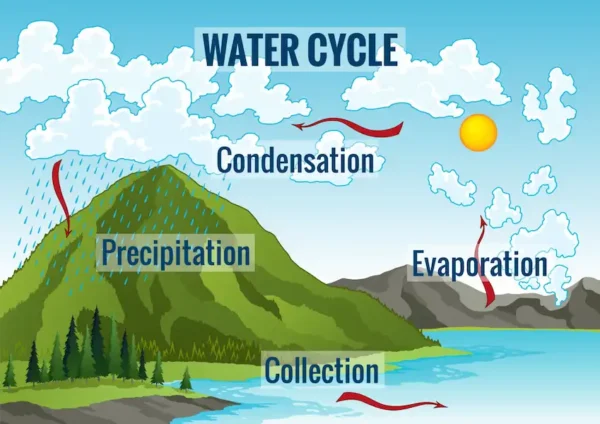
- Precipitation: Water falling from the sky (rain, snow, sleet, or hail).
- Wind: Moving air.
- Cloud Cover: How much of the sky is hidden by clouds.
- Humidity: How much moisture (water vapor) is in the air.
The Four Seasons
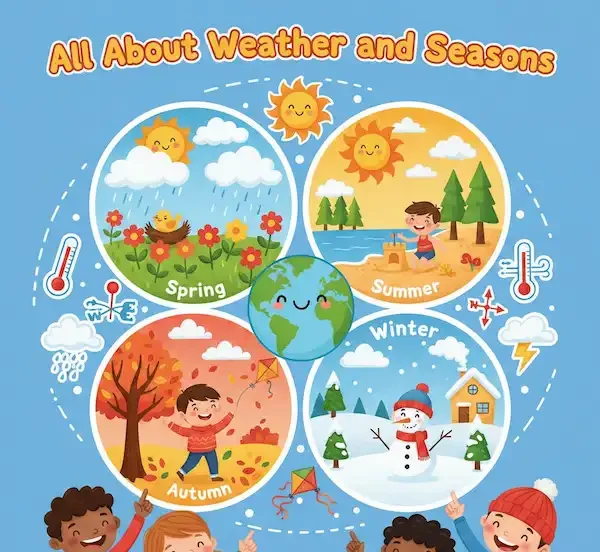
While weather changes daily, seasons are longer periods of the year that have specific weather patterns. Most places on Earth have four seasons: Spring, Summer, Autumn, and Winter.
Why do we have seasons?
It isn’t because we get closer to the sun! It’s actually because the Earth is tilted on its axis. As we orbit the sun, different parts of the planet get more direct sunlight at different times of the year. You can learn more about this tilt from NASA Space Place.
| Season | Typical Weather | What Happens in Nature? |
| Spring | Warm, rainy, breezy | Flowers bloom, baby animals are born. |
| Summer | Hot, sunny, long days | Trees are full of green leaves, fruit ripens. |
| Autumn | Cool, windy, crisp | Leaves change color and fall, animals gather food. |
| Winter | Cold, snowy, short days | Some animals hibernate, trees are bare. |
Looking Closer: Spring
Spring is often called the season of “new beginnings.” After a cold winter, the ground warms up, and the rain helps plants grow.
- Key Weather Feature: “April Showers.” Spring rain is essential for the “May Flowers” to grow.
- Student Tip: Look for buds on the trees! This is the first sign that the weather and seasons are shifting.
Looking Closer: Summer
Summer is the warmest time of year because your part of the Earth is tilted toward the sun. The days are long, which means you have more time to play outside!
- Key Weather Feature: Heatwaves and thunderstorms. When the air gets very hot and humid, it can create big, dark clouds.
- Safety Tip: Always wear sunscreen and drink plenty of water when the weather and seasons bring high temperatures.
Looking Closer: Autumn (Fall)
In Autumn, the Earth begins to tilt away from the sun. The air turns “crisp,” and the days get shorter.
- Key Weather Feature: Wind. Autumn is a great time for flying kites because the changing temperatures create lots of moving air.
- Nature Fact: Deciduous trees stop making food, which is why their leaves change from green to beautiful oranges, reds, and yellows.
Looking Closer: Winter
Winter is the coldest season. In many parts of the world, precipitation turns into ice and snow.
- Key Weather Feature: Frost and snow. When the temperature drops below 0°C (32°F), water freezes.
- Survival: Animals like bears go into a deep sleep called hibernation to stay safe from the cold weather and seasons.
Weather Tools: How do we measure it?
Teachers and scientists use specific tools to track weather and seasons. You can even make some of these at home!
- Thermometer: Measures temperature.
- Rain Gauge: A tube that catches rain to see how much fell.
- Anemometer: A tool with cups that spin to measure wind speed.
- Weather Vane: Shows which direction the wind is blowing (North, South, East, or West).
- Barometer: Measures air pressure. High pressure usually means sunny skies!
Teacher’s Fun Fact: Did you know that a “cricket’s chirp” can tell you the temperature? If you count the chirps of a snowy tree cricket for 15 seconds and add 40, you get the approximate temperature in Fahrenheit!
Extreme Weather
Sometimes, the weather and seasons produce “extreme” events. These are powerful and can be dangerous, so it is important to have a plan.
- Tornadoes: Spinning funnels of high-speed wind.
- Hurricanes: Massive storms that form over warm ocean waters.
- Blizzards: Intense winter storms with heavy snow and strong winds.
- Droughts: Long periods with no rain where the ground gets very dry.
For more information on staying safe during big storms, visit Ready.gov Kids.
Helpful Vocabulary List
To be a pro at discussing weather and seasons, try using these “smart” words in your next science class:
- Atmosphere: The blanket of air that surrounds the Earth.
- Climate: The average weather in a place over a long, long time (usually 30 years!).
- Equator: The invisible line around the middle of the Earth where it is almost always warm.
- Meteorology: The study of the atmosphere and weather.
- Orbit: The path the Earth takes around the sun.
A Note for Parents and Teachers (E-A-A-T)
As an educator, I prioritize Experience, Expertise, Authoritativeness, and Trustworthiness (E-A-A-T). This article is designed based on primary curriculum standards (like NGSS). When teaching kids about weather and seasons, it is vital to use data from trusted organizations like the National Oceanic and Atmospheric Administration (NOAA) and the World Meteorological Organization.
By connecting daily observations to scientific concepts, we help students build a foundation for lifelong environmental literacy. Always encourage children to keep a “Weather Journal” to record their own observations, which builds the “Expertise” of a young scientist!
Activity: Become a Weather Reporter!
Now that you’ve read all about weather and seasons, it’s your turn. Look out your window right now and answer these questions:
- What color is the sky?
- Can you see the trees moving? (Is it windy?)
- What does the air feel like on your skin?
- Which of the four seasons are you in right now?
By checking the weather every day, you will start to see the patterns that make up our beautiful seasons!
Practice Makes Perfect
Here is a PDF worksheet you can download to practice about weather and seasons. The answers are on a separate page.
Additional Helpful Information
Study more about English tenses — 12 English Verb Tenses: The Ultimate Guide with Examples