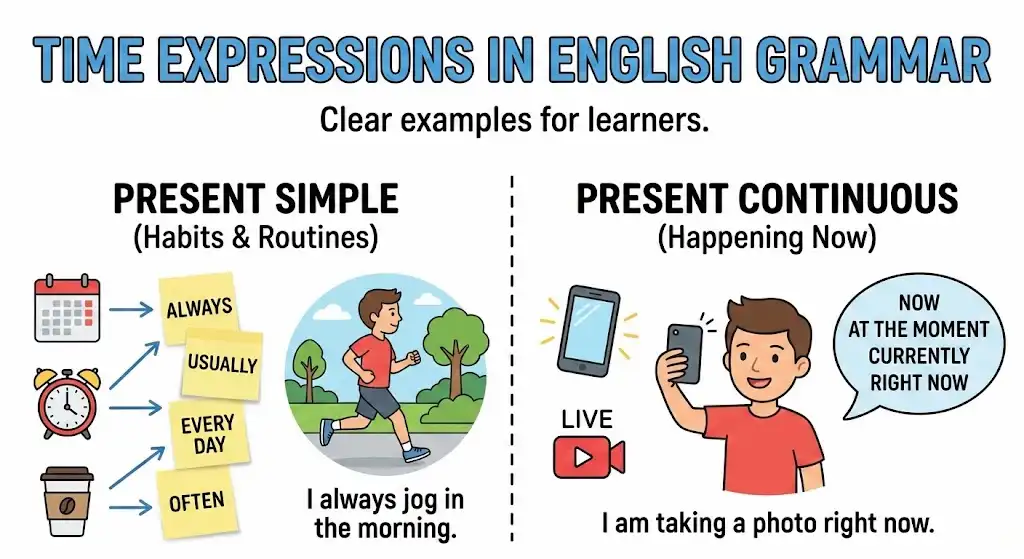
Introduction to Present Tense Time Expressions
When you learn English, knowing the right words for “when” something happens is very important. These words are called present tense time expressions. They help your listener understand if you are talking about a habit that happens every day or an action that is happening right this second.
Many students find English grammar a bit difficult because the rules for the Present Simple and the Present Continuous are different. However, once you learn the specific present tense time expressions that go with each tense, speaking becomes much easier. In this article, we will look at how to use these words correctly so you can sound more natural and confident.
Why Do Time Expressions Matter?
Imagine you say, “I eat chocolate.” Your friend might ask, “Now? Or every day?”
If you say, “I always eat chocolate,” your friend knows it is a habit. If you say, “I am eating chocolate now,” your friend knows you have a snack in your hand. The present tense time expressions give the “clue” to the meaning of your sentence.
Understanding the Present Simple
We use the Present Simple for things that are true all the time, for habits, and for routines. Because these things happen again and again, we use adverbs of frequency. These are a specific type of present tense time expressions that tell us “how often” something occurs.
Common Adverbs of Frequency
Here is a list of the most common adverbs used with the Present Simple:
- Always (100% of the time)
- Usually (about 80-90% of the time)
- Often (about 60-70% of the time)
- Sometimes (about 50% of the time)
- Rarely / Seldom (about 10-20% of the time)
- Never (0% of the time)
Where to Put These Words in a Sentence
The rules for where to put these present tense time expressions are quite simple:
- Before the main verb: “I often play soccer on Saturdays.”
- After the verb ‘to be’: “She is always happy in the morning.”
Frequency Phrases
Sometimes, we use phrases instead of just one word. These present tense time expressions usually go at the very end of the sentence.
| Frequency Phrase | Example Sentence |
| Every day / week / month | I go to the gym every day. |
| Once a week | She calls her mother once a week. |
| Twice a month | They clean the windows twice a month. |
| On Mondays / On weekends | We visit our grandparents on weekends. |
Understanding the Present Continuous
The Present Continuous is for actions that are happening at this exact moment or around the current time. These present tense time expressions show that the action is temporary and not a permanent habit.
Common Expressions for the Present Continuous
When you want to show that something is happening right now, you should use these present tense time expressions:
- Now: “I am writing an email now.”
- At the moment: “He is sleeping at the moment.”
- Right now: “We are studying English right now.”
- Currently: “The company is currently hiring new workers.”
- Today / This week: “I am working from home today.”
Why “Today” Can Be Tricky
Sometimes students think “today” is for the Present Simple. But in English, if you are doing something special just for one day, we use the Present Continuous.
- Habit: “I usually drink tea, but today I am drinking coffee.”
In this sentence, you see two different present tense time expressions working together to show a change in routine.
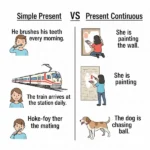
Present Simple vs. Present Continuous: The Comparison
To choose the right present tense time expressions, ask yourself: “Is this a habit or a one-time action?”
| Aspect | Present Simple | Present Continuous |
| Meaning | Habits, routines, facts | Actions happening now or temporary |
| Key Words | Always, usually, every day | Now, currently, at the moment |
| Example | He usually walks to work. | He is walking to work now. |
Using the wrong present tense time expressions can change your meaning. For example, if you say “I am always eating breakfast,” it can sound like you never stop eating! But if you say “I always eat breakfast,” it sounds like a healthy morning routine.
Expert Tips for Intermediate Students
As a long-time English educator, I have seen many students struggle with the word “always.” Here is a professional tip: while we usually use “always” for the Present Simple, we can use it with the Present Continuous to complain about a bad habit.
- Example: “You are always losing your keys!”
This is a more advanced way to use present tense time expressions to show emotion. However, for your general exams and daily speaking, sticking to the standard rules is the best way to ensure clarity.
Common Mistakes to Avoid
- Wrong Word Order: Avoid saying “I go often.” Instead, use the correct present tense time expressions order: “I often go.”
- Using “Now” with Simple Tense: Avoid “I eat now.” Instead, say “I am eating now.”
- Forgetting “to be”: When using present tense time expressions for the continuous tense, don’t forget the ‘am/is/are’. Say “I am working currently,” not “I working currently.”
Practical Examples in a Story
Let’s look at how a person uses different present tense time expressions in a normal day.
“My name is Sarah. I usually wake up at 7:00 AM. I always have a cup of coffee before I start my work. Every morning, I check my emails. However, at the moment, I am not checking emails because I am talking to you! Currently, I am sitting in a cafe. I sometimes come here when I want a change of scenery. Today, I am working on a big project, so I am staying here until 5:00 PM.”
In Sarah’s story, you can see how present tense time expressions help tell a clear story by separating her normal life from what she is doing right now.
Summary of Present Tense Time Expressions
Mastering present tense time expressions is a major step toward becoming a fluent English speaker. Remember that words like “always,” “often,” and “usually” describe your general life and habits. On the other hand, words like “now,” “currently,” and “at the moment” describe the specific actions of your day.
By practicing these present tense time expressions daily, you will find it much easier to describe your world to others. Keep a journal and try to use at least three different present tense time expressions every day to describe what you do.
Exercises: Test Your Knowledge
Try to fill in the blanks using the correct present tense time expressions from the list: (now, usually, every Tuesday, at the moment, never).
- I __________ go to the cinema because I don’t like movies.
- She is busy __________. She is fixing her car.
- We have a guitar lesson __________.
- They __________ eat dinner at 6:00 PM.
- Look! It is raining __________!
Answers: 1. never, 2. at the moment, 3. every Tuesday, 4. usually, 5. now.
Here is a PDF worksheet you can download to practice Present Tense Time Expressions, the answers are on a separate page.
Additional Helpful Information
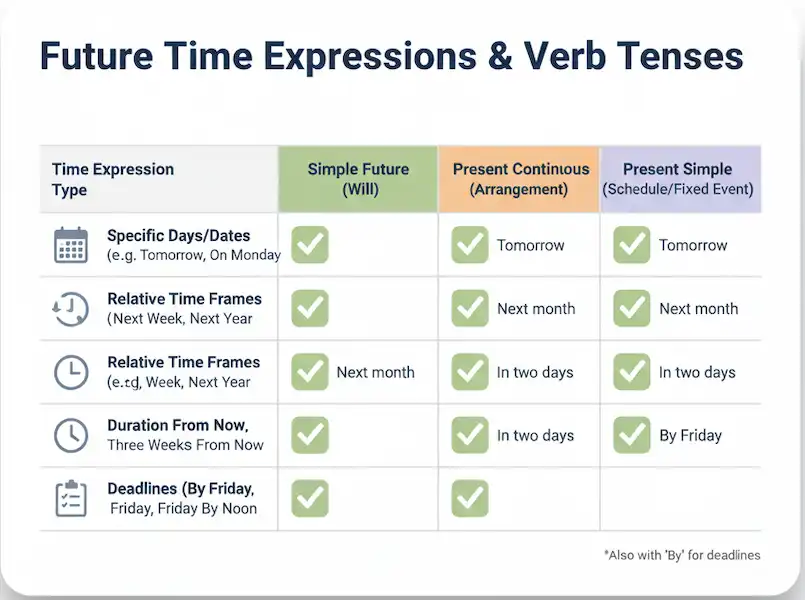
Study about time expressions for future tense – Time Expressions Future Tense
Authoritative Resources for Further Study
To improve your understanding of present tense time expressions, it is helpful to visit websites managed by English language experts. Here are some of the best places to continue your learning:
- British Council – Present Simple
- Cambridge Dictionary – Adverbs of Frequency
- Oxford Learner’s Dictionaries – Present Continuous