Introduction to Past Tense Time Clauses
Have you ever tried to tell a story in English and felt confused about the order of events? Maybe you wanted to say you were cooking dinner when a friend called, or that you finished your homework before you went to bed. To tell these stories correctly, you need to use past tense time clauses.
A “time clause” is a part of a sentence that starts with a word like when, while, before, or after.1 These words are like glue. They join two actions together and tell the reader which action happened first or if they happened at the same time. Learning how to use past tense time clauses will help you speak more naturally and write better essays.
In this guide, we will look at how to use these words with the Simple Past and the Past Continuous. We will use simple words and many charts to help you understand easily.
Review: Simple Past vs. Past Continuous
Before we dive into past tense time clauses, let’s quickly remember what our two main tenses do.
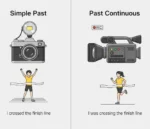
| Tense | What it does | Example |
| Simple Past | Shows a completed action. | I walked to the park. |
| Past Continuous | Shows an action that was “in progress” (continuing). | I was walking to the park. |
When we use past tense time clauses, we often mix these two tenses to show how one action related to another.
Using “When” and “While”
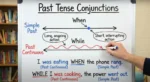
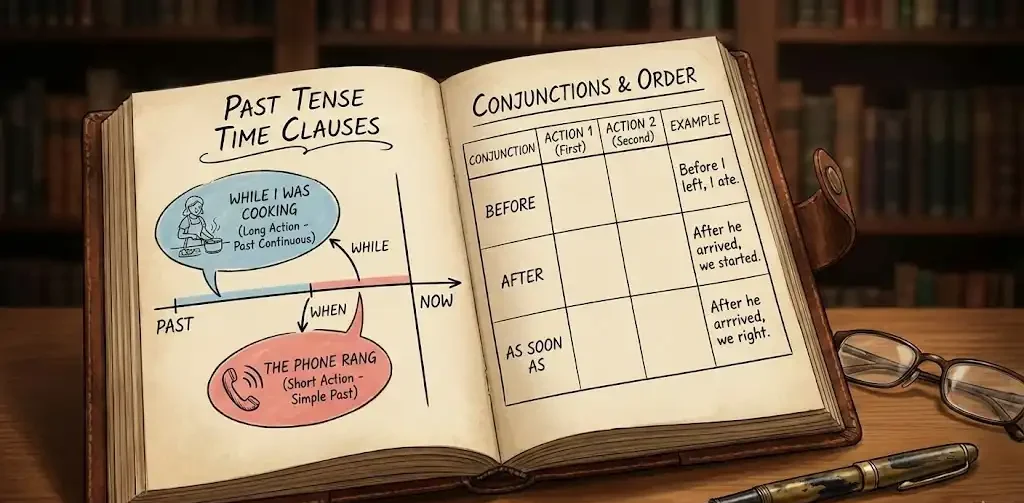
The words when and while are the most common words used in past tense time clauses. They help us describe actions that were happening at the same time or actions that were interrupted.
1. Using “While” for Long Actions
We usually use while with the Past Continuous. This is because while describes a long action or a “background” activity.
- Example: While I was eating lunch, the mailman arrived.
- Meaning: The long action (eating) was happening first. During that time, a short action (mailman arriving) happened.
2. Using “When” for Short Actions
We usually use when with the Simple Past. This word often points to the specific moment something happened or interrupted another action.
- Example: I was sleeping when the alarm rang.
- Meaning: I was in the middle of a long action (sleeping), and the short action (alarm ringing) stopped or interrupted it.
Comparing When and While
| Word | Usually followed by… | Example Sentence |
| While | Past Continuous (was/were + -ing) | While she was studying, the lights went out. |
| When | Simple Past (verb + -ed / irregular) | She was studying when the lights went out. |
Notice that the meaning of the two sentences in the chart is exactly the same! You can choose which word to use based on which part of the sentence you want to emphasize. Just remember the rule: While likes the “-ing” form, and when likes the simple form.
Using “Before” and “After”
Sometimes, we don’t want to show an interruption. Instead, we want to show a clear sequence—what happened first and what happened second. This is where before and after become very useful in past tense time clauses.
1. Using “Before”
The word before shows that the action in the main part of the sentence happened first.
- Example: I washed my hands before I ate dinner.
- Sequence: 1. Washed hands -> 2. Ate dinner.
2. Using “After”
The word after shows that the action in the time clause happened first.
- Example: After I finished my work, I watched a movie.
- Sequence: 1. Finished work -> 2. Watched a movie.
The Grammar Secret for Before and After
In these past tense time clauses, we almost always use the Simple Past for both actions because we are just listing things that happened one after another.
Sentence Structure and Punctuation
One thing that confuses many students is where to put the comma. In past tense time clauses, the order of the sentence can change.
Rule A: The Time Clause Starts the Sentence
If you start your sentence with When, While, Before, or After, you must use a comma.
- While I was cooking*,** I burned my finger.*
- Before I left*,** I locked the door.*
Rule B: The Time Clause Ends the Sentence
If the time word is in the middle of the sentence, you do not need a comma.
- I burned my finger while I was cooking.
- I locked the door before I left.
Story Time: Seeing it All Together
Let’s look at a short story that uses many past tense time clauses. Read the story and look for the keywords.
Last night was very busy. While I was walking home, it started to rain. I didn’t have an umbrella, so I ran fast. When I finally reached my house, I was very wet. After I took a hot shower, I felt much better. I cooked some soup for dinner. Before I ate the soup, I called my mom to say hello. While we were talking on the phone, I told her about the rain. It was a long day!
In this story, the past tense time clauses help the reader understand exactly when things happened. Without these words, the story would just be a list of boring facts.
Common Mistakes to Avoid
Even intermediate students make mistakes with past tense time clauses. Here are three things to watch out for:
- Using “will” in the past: Never use will or would inside the time clause itself.
- Wrong: After I will finish…
- Right: After I finished…
- Forgetting the -ing: If you use while, make sure you use the was/were + verb + ing form.
- Wrong: While I cooked… (Though sometimes used in casual speech, “While I was cooking” is better for students).
- The Double Comma: Only use one comma if the time word starts the sentence. Never put a comma before when or while if they are in the middle of the sentence.
Summary Chart for Quick Reference
| Conjunction | Best Tense to Use | Purpose |
| While | Past Continuous | For long background actions. |
| When | Simple Past | For short interruptions or events. |
| Before | Simple Past | To show the second action in a line. |
| After | Simple Past | To show the first action in a line. |
Extra Helpful Content: “As Soon As”
If you want to sound even more advanced with your past tense time clauses, you can use the phrase “as soon as.” This is very similar to after, but it means that the second action happened immediately after the first.
- Example: As soon as the bell rang, the students left the classroom.
- Meaning: There was no waiting. The bell rang, and boom—they left!
Using “as soon as” adds excitement and speed to your storytelling. It follows the same punctuation rules as when and while.
Practice Makes Perfect
Here is a PDF worksheet you can download to practice Past Tense Time Clauses, the answers are on a separate page.
Conclusion and Expert Resources
Mastering past tense time clauses is a huge step in your English journey. It allows you to move from simple sentences to complex, interesting stories. Remember to practice using while for long actions and when for short ones. Always check your commas when you start a sentence with a time word.
Additional Helpful Information
- Study about Present Tense Time Expressions – Present Tense Time Expressions: A Simple Guide for Students
- Learn more about changing facts to a story – Past Tense Conjunctions: A Guide to Linking Simple Past and Past Continuous
To learn more from authoritative sources, we highly recommend visiting these pages:
The best way to learn past tense time clauses is to use them! Try writing five sentences about your morning using these new words.