Welcome to Your Grammar Journey!
Hello everyone! My name is Teacher Kay, and I have been a secondary school English teacher for over twelve years. I know that English grammar can sometimes feel like a big puzzle. One of the most common questions my students ask is: “How do I talk about two things happening at the same time in the past?”
To answer that, we need to look at past tense conjunctions. These are special “joining words” that act like glue. They help us connect the Simple Past and the Past Continuous so our stories make sense. Whether you are writing an essay or telling a friend about your weekend, using these words correctly will make your English sound much more natural.
In this article, we will look at how to use when, while, before, and after. We will use simple words and plenty of charts to make sure you feel confident.
Quick Review: Simple Past vs. Past Continuous
Before we use past tense conjunctions, let’s quickly remember what our two main tenses do.
| Tense | What it describes | Example |
| Simple Past | A completed action at a specific time. | I ate lunch. |
| Past Continuous | An action that was in progress (continuing). | I was eating lunch. |
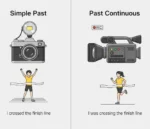
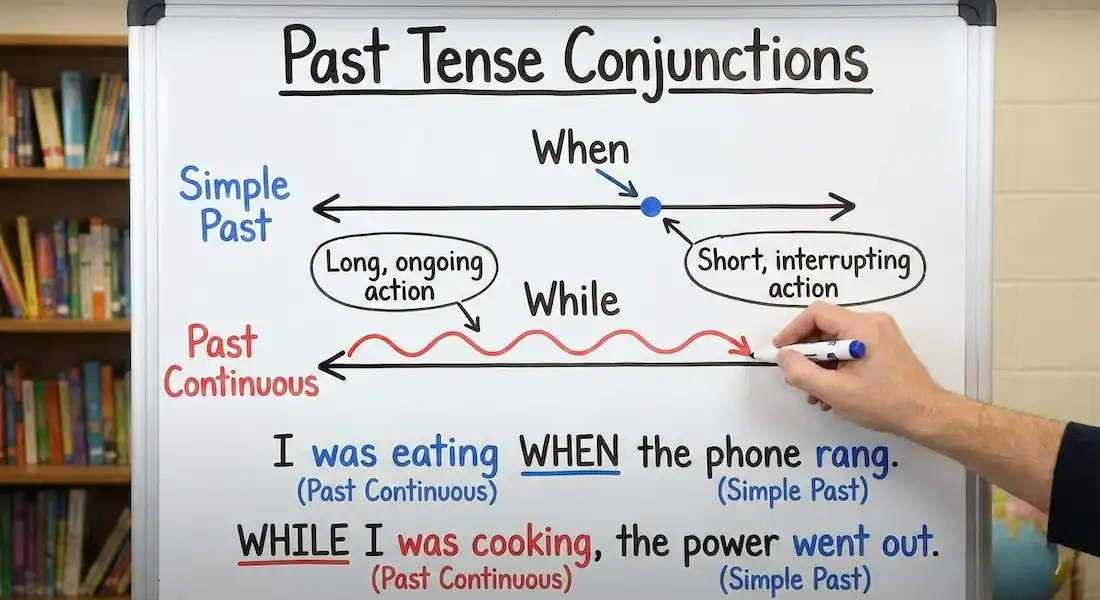
Think of the Simple Past as a “dot” on a timeline and the Past Continuous as a “line.” When we combine them, we show how these dots and lines interact.
1. Using “When” and “While”
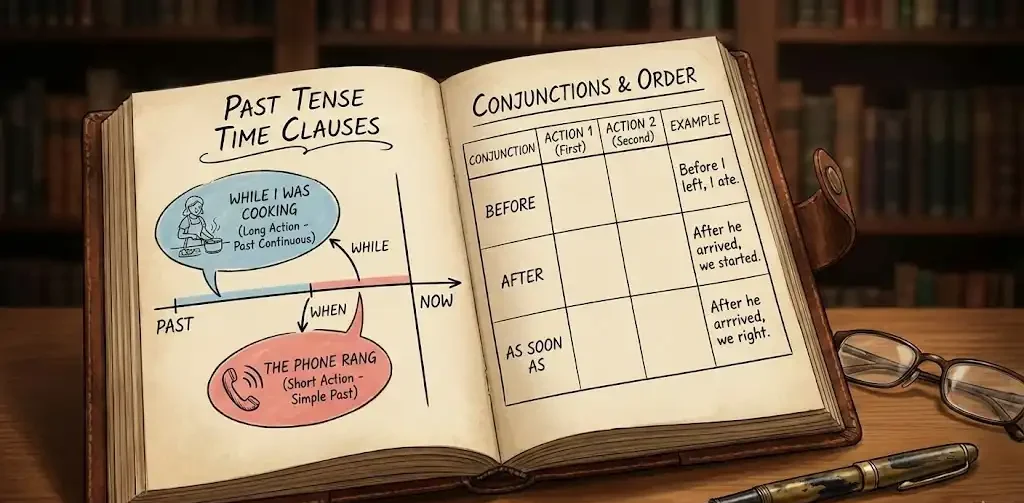
These are the most common past tense conjunctions used to show actions happening at the same time.
The Rule for “While”
We usually use while before the Past Continuous. This is because while describes a period of time or a “long” action.
- Example: I fell asleep while I was watching a movie.
- Structure: [Simple Past] + while + [Past Continuous]
The Rule for “When”
We usually use when before the Simple Past. This is because when often introduces a “short” action that interrupts a longer one.
- Example: I was walking to school when it started to rain.
- Structure: [Past Continuous] + when + [Simple Past]
Comparing When and While
You can often say the same thing using different past tense conjunctions, but you must change the verb form.
| Using “While” | Using “When” |
| While I was cooking, the phone rang. | I was cooking when the phone rang. |
| The power went out while they were studying. | They were studying when the power went out. |
According to the British Council LearnEnglish website, we use these structures to provide the “background” of a story. The Past Continuous is the background, and the Simple Past is the event that happens.
2. Using “Before” and “After”
While when and while focus on overlapping actions, before and after help us show the sequence of events. These past tense conjunctions tell the reader which action happened first and which happened second.
Using “Before”
Before means that the second action happened after the first one. We usually use the Simple Past with before.
- Example: I brushed my teeth before I went to bed.
- Teacher’s Tip: In this sentence, brushing teeth is Action 1, and going to bed is Action 2.
Using “After”
After means that the first action was finished before the second one started.
- Example: After I finished my homework, I played video games.
- Teacher’s Tip: Here, finishing homework is Action 1, and playing games is Action 2.
For more detailed rules on time clauses, you can visit the Cambridge Dictionary Grammar Guide.
Why are Past Tense Conjunctions Important?
You might wonder why we don’t just use short, simple sentences like “I was walking. It rained.” While those sentences are correct, they don’t show the relationship between the ideas.
Using past tense conjunctions helps you:
- Show Cause and Effect: Did the rain start because I went outside? Or did it just happen at the same time?
- Create Flow: Your writing becomes smoother and easier to read.
- Express Complexity: You can explain more detailed stories about your life.
As a teacher, I always tell my students that past tense conjunctions are the difference between a list of facts and a real story.
Common Mistakes to Avoid
Even intermediate students make mistakes with past tense conjunctions. Here are three things to watch out for:
1. Using “While” with a Short Action
- Wrong: While the bell rang, I stood up.
- Right: When the bell rang, I stood up.
- Explanation: A bell ringing is a short “pop” of an action, so we use when.
2. Forgetting the Comma
When you start a sentence with past tense conjunctions, you usually need a comma after the first clause.
- Example: While I was eating lunch, the cat jumped on the table. (Correct)
- Example: I was eating lunch while the cat was jumping on the table. (No comma needed)
3. Mixing Up the Tenses
Make sure your “long” action is in the Continuous (-ing) form.
- Wrong: When I was walk home, I saw a dog.
- Right: When I was walking home, I saw a dog.
Practice Chart: Choose the Right Conjunction
Try to fill these in your head as you read!
| Sentence | Correct Conjunction | Why? |
| I was reading ____ the lights went out. | When | It’s a short interruption. |
| ____ she was sleeping, her mom arrived. | While | It’s a long background action. |
| He washed his hands ____ he ate dinner. | Before | It shows the order of events. |
| ____ they watched the movie, they felt sad. | After | It shows the reaction to the event. |
Using these past tense conjunctions correctly takes practice. I recommend checking out resources like Oxford Learner’s Dictionaries to see more sentence examples in different contexts.
Helpful Tips for Intermediate Learners
As you continue to study past tense conjunctions, keep a small notebook. Every time you read a book or watch a movie in English, look for these words. Ask yourself:
- Is this a long action or a short action?
- Which action happened first?
- Can I rewrite this sentence using a different conjunction?
By practicing this way, using past tense conjunctions will become a habit. You won’t have to think about the rules anymore; the right words will just come to you!
In my classroom, we often play a game called “What happened next?” One student starts a sentence with a background action (Past Continuous) and another student must finish it using past tense conjunctions and a Simple Past action.
- Student A: “I was running in the park…”
- Student B: “…when I saw a giant squirrel!”
Final Thoughts from Your Teacher
Learning how to link sentences is a huge step in your English journey. By mastering past tense conjunctions, you are moving from basic English to a much more advanced level. Remember, it is okay to make mistakes! Every mistake is a chance to learn something new.
If you are ever confused, come back to this guide and look at the charts. Use while for the long “ing” actions, when for the short interruptions, and before or after to keep your story in the right order.
Practice Makes Perfect
Here is a PDF worksheet you can download to practice past tense conjunctions, the answers are on a separate page.
Keep practicing, stay curious, and enjoy your English studies! You are doing a great job.
Additional Helpful Information
Learn more about using Used to and more – A Simple English Grammar Guide to Used To, Be Used To, and Get Used To