All About Ordinal Numbers: A Fun Guide for Primary Students!
Hello, superstars! My name is Mr. G, and I’ve been teaching primary school for over ten years. One thing I’ve noticed is that while everyone loves counting (1, 2, 3!), we sometimes forget the special words we use when we want to talk about order or position.
In this guide, we are going to explore ordinal numbers. By the time you finish reading, you’ll be an expert at describing who won a race, which floor you live on, and when your birthday is!
What are Ordinal Numbers?
Most of the time, we use “Cardinal Numbers.” These are the regular numbers we use to count how many things are in a group. For example, “I have three apples.”
However, when we want to talk about where something is in a line, we use ordinal numbers. Think of the word “Ordinal”—it sounds like the word “Order.” These numbers tell us the position of something.
The Difference: Cardinal vs. Ordinal
| Cardinal Number (How many?) | Ordinal Number (What position?) |
| One (1) | First (1st) |
| Two (2) | Second (2nd) |
| Three (3) | Third (3rd) |
| Ten (10) | Tenth (10th) |
The Big Three: 1st, 2nd, and 3rd
The first three ordinal numbers are a little bit tricky because they don’t sound like the regular numbers at all.
- First (1st): We use this for the winner or the very beginning.
- Second (2nd): This comes right after the first.
- Third (3rd): This is the number three position.
Teacher’s Tip: Notice the little letters at the end? We call these “suffixes.” For 1st, we use the last two letters of “first.” For 2nd, we use “second.” For 3rd, we use “third.”
How to Make Ordinal Numbers (The “th” Rule)
The good news is that after the number three, most ordinal numbers are much easier to remember. We usually just add the letters “th” to the end of the cardinal number!
The Top Ten List
Let’s look at how we write the first ten ordinal numbers. This chart is great for your notebook!
| Number | Ordinal Word | Short Form |
| 1 | First | 1st |
| 2 | Second | 2nd |
| 3 | Third | 3rd |
| 4 | Fourth | 4th |
| 5 | Fifth | 5th |
| 6 | Sixth | 6th |
| 7 | Seventh | 7th |
| 8 | Eighth | 8th |
| 9 | Ninth | 9th |
| 10 | Tenth | 10th |
Watch Out! Did you notice that “five” becomes “fifth” (not fiveth) and “nine” becomes “ninth” (we drop the ‘e’)? Spelling can be sneaky! You can practice these spelling rules on sites like Oxford Owl, which has great resources for primary spelling.
Using Ordinal Numbers in Real Life
We use ordinal numbers every single day without even realizing it. Here are some places you will see them:
1. Sports and Racing
When athletes run a race, we don’t say they got “number one.” We say they came in first place! Gold, silver, and bronze medals are given to the 1st, 2nd, and 3rd finishers.
2. Dates and Birthdays
When we say the date, we use ordinal numbers.
- “My birthday is on the twenty-second of June.”
- “Today is the fourth of March.”
3. Floors in a Building
If you enter a tall apartment building, you use the lift (elevator) to go to the tenth floor.
4. Steps in a Recipe
When you are baking cookies, you follow instructions in order:
- First, preheat the oven.
- Second, mix the butter and sugar.
- Third, add the flour.
Going Beyond Ten: The Teen Numbers
Between 11 and 19, ordinal numbers follow the “th” rule very strictly.
- 11th: Eleventh
- 12th: Twelfth (Notice the ‘f’ replaces the ‘v’!)
- 13th: Thirteenth
- 14th: Fourteenth
- 15th: Fifteenth
- 16th: Sixteenth
- 17th: Seventeenth
- 18th: Eighteenth
- 19th: Nineteenth
Even though 11, 12, and 13 end in 1, 2, and 3, we do not say “eleventh-first.” We just say eleventh. The “st, nd, rd” endings only come back once we get to 21! For more help with these larger numbers, BBC Bitesize offers excellent math visuals for primary students.
Big Ordinal Numbers (20 to 100)
When we get to the “ty” numbers (20, 30, 40), the ‘y’ changes to an ‘ie’ before we add the ‘th’.
- 20: Twenty $\→ Twentieth
- 30: Thirty $\→ Thirtieth
If the number has two parts, like 21, only the second number becomes an ordinal.
- 21st: Twenty-first
- 32nd: Thirty-second
- 43rd: Forty-third
- 54th: Fifty-fourth
Why Is This Important? (E-E-A-T Section)
As a teacher, I want you to know that learning ordinal numbers isn’t just for math class—it’s a vital part of English Literacy. Understanding “sequence” (the order of things) helps you become a better reader and writer.
When you read a story, you need to know what happened first, second, and last. This is called “chronological order.” If you want to learn more about how teachers use these standards to help you learn, you can check out the National Curriculum for mathematics and English.
Expert Advice: If you are struggling to remember the suffixes, just look at the last digit of the number.
- Ends in 1? Use st (except 11).
- Ends in 2? Use nd (except 12).
- Ends in 3? Use rd (except 13).
- Everything else? Use th.
Fun Activity: The Stuffed Animal Race!
Do you want to practice ordinal numbers at home? It’s easy!
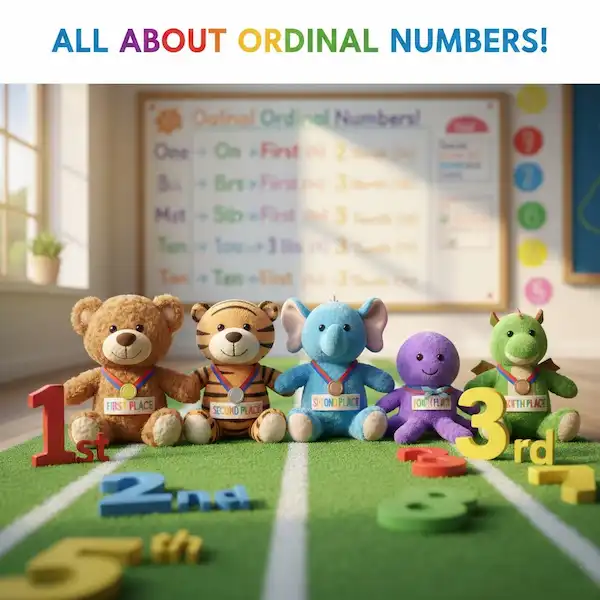
- Gather five of your favorite toys.
- Line them up as if they are waiting for a bus.
- Label them! Who is first? Who is fifth?
- Switch them around and label them again.
If you enjoy games, Maths is Fun has some great interactive charts that show ordinal numbers up to 100!
Summary Table: Quick Reference
| Type | Examples |
| Small Numbers | 1st, 2nd, 3rd, 4th, 5th |
| The Teens | 11th, 12th, 13th, 14th |
| The Tens | 20th, 30th, 40th, 50th |
| The Compound Numbers | 21st, 32nd, 43rd, 54th |
Practice Makes Perfect
Here is a PDF worksheet that you can download to practice ordinal numbers. The answers are on a separate page.
Final Thoughts from Teacher Kay
Ordinal numbers are the “glue” that holds our schedules and stories together. Whether you are talking about the first time you rode a bike or the third scoop of ice cream on your cone, these numbers help people understand exactly what you mean.
Keep practicing, and don’t be afraid to make mistakes with the spelling—even adults sometimes forget the ‘f’ in “twelfth”! You are doing a fantastic job.
Additional Helpful Information
Study more about numbers and counting – Numbers and Counting 1-100 Easily – Learn English Numbers