Fun with Prepositions! Where is it?
Hi everyone! 👋 I’m Teacher Kay, and I’m so excited to learn with you today! We’re going on a super fun adventure to discover where things are. Have you ever wondered if your toy car is under the bed or next to your books? Or maybe where your cat is hiding? Today, we’re going to learn some special words that help us tell exactly where things are. These words are called prepositions of place for kids!
What are prepositions of place for kids?
Think of prepositions as little helper words that tell us about the position or location of something. They help us answer the question “WHERE?”. Imagine you have a yummy cookie. Is it on the plate, in the jar, or under the napkin? The words “on,” “in,” and “under” are all prepositions of place! Today, we’ll focus on four super important ones: Under, Next to, Behind, and In front of.
Are you ready to become a super detective of places? Let’s go!
1. UNDER – Like a Secret Hiding Spot!
When something is under something else, it’s usually below it, covered by it, or underneath it. Think of it like a cozy hiding spot!
Let’s look at some examples!
- The ball is under the table.Imagine a table. Now, imagine a ball right on the floor, beneath the table. That’s under!
- My shoes are under my bed.Do you ever kick your shoes off and they slide right under your bed? Mine do too!
- The cat is under the blanket.Sometimes my cat loves to snuggle and hide under a warm blanket. Can you imagine that?
- The book is under the pillow.Maybe you’re reading in bed and you put your book under your pillow before you fall asleep.
Let’s see an example!
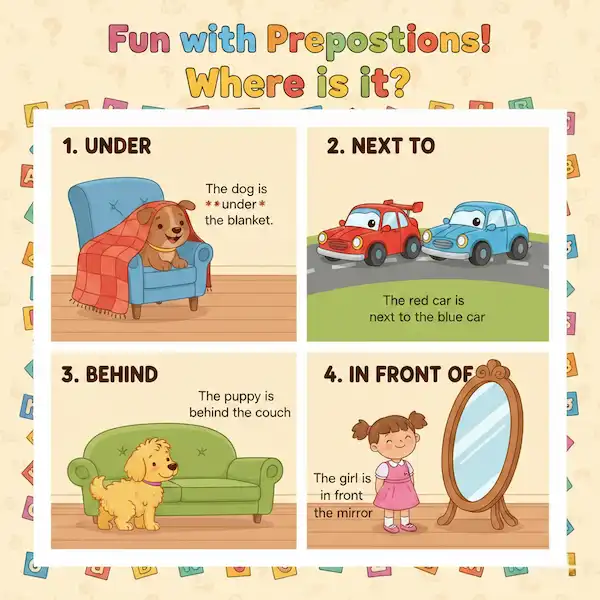
The small dog loves to nap under the big chair.
Think of other things that might be under something else. Maybe a secret treasure chest under a pirate ship? Or a tiny mouse under a mushroom? Learning prepositions of place for kids is all about imagining!
Activity Time!
Look around your room right now. Can you find anything that is under something else?
- Is your rug under your desk?
- Is your pencil under your book?
- Is your foot under your chair?
Share what you find with a grown-up! This is a great way to practice prepositions of place for kids.
Chart for “Under”:
| Object 1 | Preposition | Object 2 | Meaning |
| Ball | Under | Table | The ball is below the table. |
| Shoes | Under | Bed | The shoes are beneath the bed. |
| Cat | Under | Blanket | The cat is covered by the blanket. |
| Book | Under | Pillow | The book is in a lower position than the pillow. |
Authoritative External Link for further learning: To understand more about prepositions and how they work, check out this simple explanation from the British Council for young learners: https://learnenglishkids.britishcouncil.org/grammar-practice/prepositions-place-and-time
2. NEXT TO – Friends Side-by-Side!
When something is next to something else, it means it’s beside it, very close to it, or right at its side. Think of two friends standing side-by-side!
Let’s look at some examples!
- The lamp is next to the bed.Imagine your bedside table. A lamp is usually right there, next to your bed.
- My backpack is next to the door.When you come home from school, where do you put your backpack? Maybe next to the front door?
- The pencil is next to the notebook.When you’re ready to write, your pencil is usually right beside your notebook, isn’t it?
- The dog is next to its owner.Dogs love to be close to their humans! They often sit or walk next to them.
Let’s see an example!
The red car is parked next to the blue car.
It’s like they are good friends, side by side! Learning prepositions of place for kids helps us talk about these friendly positions.
Activity Time!
Let’s play “Where’s my friend?”!
Pick two toys.
Put one toy next to the other toy.
Say, “The [first toy] is next to the [second toy].”
For example, “The teddy bear is next to the robot.”
You’re doing great with your prepositions of place for kids practice!
Chart for “Next to”:
| Object 1 | Preposition | Object 2 | Meaning |
| Lamp | Next to | Bed | The lamp is beside the bed. |
| Backpack | Next to | Door | The backpack is at the side of the door. |
| Pencil | Next to | Notebook | The pencil is close to the notebook. |
| Dog | Next to | Owner | The dog is by the owner’s side. |
3. BEHIND – A Little Bit Hidden!
When something is behind something else, it’s at the back of it, often out of sight, or partially hidden by it. It’s like playing hide-and-seek!
Let’s look at some examples!
- The sun is behind the clouds.Sometimes on a cloudy day, the sun is still there, but it’s hidden behind the clouds.
- The boy is behind the tree.If you’re playing hide-and-seek in the park, a tree is a great place to hide behind!
- My secret candy is behind the books.Shhh! Don’t tell anyone! I sometimes hide my treats behind my books on the shelf.
- The car is behind the bus.When you’re in traffic, one car follows another, so it’s behind it.
Let’s see an example!
The playful puppy is hiding behind the couch.
Can you imagine trying to find the puppy? You’d have to look behind the couch! This is a fun prepositions of place for kids concept.
Activity Time!
Let’s play “Guess what’s behind!”
Ask a grown-up to hide a small toy behind something bigger (like a book, a cushion, or a mug).
Then you have to guess, “Is the [toy] behind the [object]?”
When you find it, say, “Yes! The [toy] is behind the [object]!”
This is a super way to learn prepositions of place for kids.
Chart for “Behind”:
| Object 1 | Preposition | Object 2 | Meaning |
| Sun | Behind | Clouds | The sun is at the back of the clouds. |
| Boy | Behind | Tree | The boy is concealed by the tree. |
| Candy | Behind | Books | The candy is hidden by the books. |
| Car | Behind | Bus | The car is in the rear position of the bus. |
Authoritative External Link for further learning: For more practice and interactive games involving prepositions, try these resources from Cambridge English: https://www.cambridgeenglish.org/learning-english/activities-for-learners/a2-pre-a1-movers-activity-prepositions-of-place/
4. IN FRONT OF – Right in the View!
When something is in front of something else, it’s at the forward part of it, facing it, or positioned before it. It’s the opposite of behind!
Let’s look at some examples!
- The teacher stands in front of the class.Miss Lily (that’s me!) is usually standing in front of you when we’re learning together.
- The car is in front of the house.When a car is parked on the driveway, it’s in front of the house.
- The TV is in front of the sofa.When you’re watching your favorite cartoon, the TV is usually in front of where you sit.
- The children are in front of the stage.At a school play, the audience (that’s you!) sits in front of the stage to watch the actors.
Let’s see an example!
The little girl is standing in front of the big mirror.
She can see herself reflected! This helps us understand prepositions of place for kids.
Activity Time!
Let’s play “Line Up!”
Grab three of your favorite toys.
Put them in a line.
Then, say where each toy is!
For example:
“The bear is in front of the robot.”
“The robot is in front of the car.”
You’re becoming a preposition pro! Practicing prepositions of place for kids is fun!
Chart for “In front of”:
| Object 1 | Preposition | Object 2 | Meaning |
| Teacher | In front of | Class | The teacher is at the forward part of the class. |
| Car | In front of | House | The car is positioned before the house. |
| TV | In front of | Sofa | The TV is facing the sofa. |
| Children | In front of | Stage | The children are in the viewing area of the stage. |
Why are prepositions of place for kids so important?
Learning these words helps us describe the world around us much better! When you can say “My book is under my bed” instead of just “My book is somewhere,” it makes it easier for others to understand you and find things. It’s like giving super clear directions! Imagine trying to find a hidden treasure without knowing if it’s behind the big rock or next to the small bush!
These little words are super powerful for clear communication. And the more you practice, the easier they will become! Understanding prepositions of place for kids is a big step in becoming a great English speaker.
Let’s Review Our Prepositions of Place for Kids!
Remember our four special words?
- UNDER: Below something, like a hidden spot.
- NEXT TO: Beside something, like friends standing together.
- BEHIND: At the back of something, often a bit hidden.
- IN FRONT OF: At the front of something, right in view.
Challenge Time!
Can you describe this picture using our four prepositions?
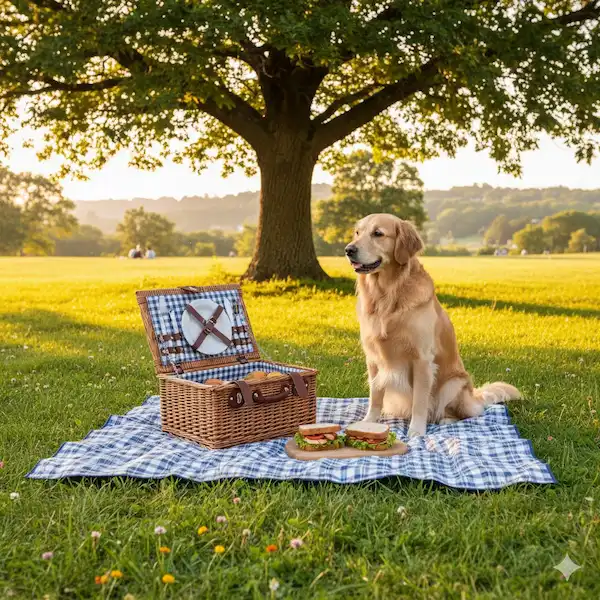
You can do it! This is great practice for your prepositions of place for kids.
More Fun Activities to Practice Prepositions!
- “Simon Says” with Prepositions:Have a grown-up or a friend give commands using our prepositions.”Simon Says, put your hand under your chin.””Simon Says, stand next to the door.””Simon Says, hide behind the sofa.””Simon Says, put your toy in front of you.”
- Drawing Game:Ask a grown-up to draw a simple scene (e.g., a house, a tree, a car). Then you describe where things are using the prepositions.”The car is in front of the house.””The cat is under the tree.”Then, switch! You draw, and the grown-up describes!
- Treasure Hunt!Hide a small toy somewhere and give clues using the prepositions.”Your treasure is next to the big blue book.””Now look behind the curtain.””Then check under the red cushion.””Finally, it’s in front of the small box!”This makes practicing prepositions of place for kids an exciting game!
Here is a PDF worksheet you can download to practice prepositions of place. The answers are on a separate page.
Important Tips for Parents and Teachers (EAAT Content)
As a primary level teacher, I know how crucial foundational grammar is for young learners. Prepositions, while seemingly small, are building blocks for more complex sentence structures and clearer communication.
- Real-World Integration: The most effective way for children to grasp prepositions of place for kids is through real-world, hands-on experiences. Encourage them to use the words actively when describing their environment, playing, or setting up toys.
- Visual Reinforcement: Always pair the preposition with a visual cue or action. As seen in the examples above, showing the physical placement while saying the word helps create a strong mental connection. Images and simple drawings are invaluable.
- Repetition and Play: Young children thrive on repetition and learn best through play. Incorporate preposition practice into games, stories, and daily routines. The “Simon Says” game is particularly effective.
- Sentence Structure: Guide them in forming simple sentences. Start with “The [noun] is [preposition] the [noun].” This helps them understand the role of the preposition within a sentence.
- Gradual Introduction: While we focused on four today, there are many prepositions. Introduce them gradually to avoid overwhelming the child. Once these four are understood, you can move on to others like “on,” “in,” “above,” “below,” etc.
- Authoritative Sources: Referencing reputable sources like the British Council or Cambridge English (as linked above) ensures that the teaching methodology aligns with established language learning principles. These sites often provide excellent resources specifically designed for young English language learners. These are great for understanding the importance of prepositions of place for kids.
- Feedback and Encouragement: Positive reinforcement is key. Celebrate their attempts and successes. Gently correct errors by rephrasing the sentence correctly, rather than just saying “no.” For instance, if a child says “The ball is on the table” when it’s under, you can say, “Ah, close! The ball is actually under the table. Can you say ‘under’?”
Understanding prepositions of place for kids is not just about memorizing words; it’s about developing spatial awareness and the ability to articulate that understanding. These skills are fundamental for academic success across subjects and for navigating the world confidently.
Conclusion
Wow! We’ve learned so much about where things are today! You are all amazing preposition detectives. Remember, practice makes perfect, so keep using “under,” “next to,” “behind,” and “in front of” every day. Look around you, describe what you see, and ask your grown-ups to help you find things using these fun words.
Additional Helpful Information
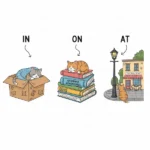
Learn basic prepositions of place – Learn English Prepositions of Place – ‘In,’ ‘On,’ and ‘At’