
What Is Active Voice?
When we talk or write in English, we usually want to show who is doing an action. The active voice is the most common way to do this. In an active sentence, the subject (the person or thing) performs the action.
Imagine a soccer game. If you say, “Leo kicked the ball,” you are using the active voice. Leo is the subject, and he is the one doing the “kicking.” This makes your writing feel alive and easy to understand.
Why Should You Use It?
Most teachers and professional writers prefer the active voice. According to the Purdue Online Writing Lab (OWL), active sentences are usually shorter and more direct than passive ones.
Using active voice helps you:
- Be Clear: The reader knows exactly who did what.
- Be Fast: Active sentences use fewer words.
- Be Strong: Your writing sounds more confident.
The Recipe for Active Voice
Building a sentence in active voice is like following a simple recipe. You need three main parts:
| Part | What it is | Example |
| Subject | The “doer” (person or thing) | The chef |
| Verb | The action | cooked |
| Object | The “receiver” (person or thing) | the meal |
Complete Sentence: The chef cooked the meal.
How it compares to Passive Voice
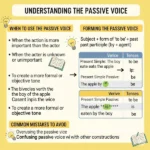
In passive voice, the object moves to the front, and the sentence becomes slower.
- Active: The cat chased the mouse. (Fast and clear)
- Passive: The mouse was chased by the cat. (Slower and more complex)
The University of Wisconsin-Madison suggests that while passive voice isn’t “wrong,” using active voice makes your meaning much sharper.
Active Voice in Different Tenses
Intermediate students often worry that active voice only works in the simple past or present. That is not true! You can use active voice in every tense.
1. Present Tense
We use this for habits or facts.
- Example: Sarah writes a blog every day.
- Example: The sun warms the earth.
2. Past Tense
We use this for things that already happened.
- Example: The team won the trophy last night.
- Example: I bought a new book yesterday.
3. Future Tense
We use this for plans.
- Example: We will visit London next summer.
- Example: My brother is going to bake a cake.
4. Continuous Tense
We use this for actions happening right now.
- Example: The students are learning about active voice.
- Example: She is painting a picture of the sea.
10 Examples of Active Voice
To help you practice, look at these common sentences. Notice how the “doer” is always at the start.
- The gardener waters the flowers.
- My father repaired the old car.
- The company hired five new workers.
- Scientists discovered a new planet.
- The dog barked at the mailman.
- The teacher explained the difficult lesson.
- Heavy rain flooded the streets.
- The chef prepared a delicious soup.
- I finished my homework early.
- The hurricane damaged many houses.
When Is Active Voice Better?
As an intermediate learner, you might wonder when you should choose active voice. Here is a helpful guide:
- Storytelling: Use active voice to show action. “The hero jumped over the wall” sounds more exciting than “The wall was jumped over by the hero.”
- Business Emails: It sounds professional and responsible. Instead of saying “The mistake was made,” say “I made a mistake.” This shows honesty.
- Science and Facts: While science papers sometimes use passive voice, many modern journals, like Nature, now encourage authors to use active voice to make the research easier to read.
Comparison Table: Active vs. Passive
Use this table to see how the same idea changes when you switch voices.
| Active Voice (Strong) | Passive Voice (Weak) |
| The boy flew the kite. | The kite was flown by the boy. |
| The storm broke the window. | The window was broken by the storm. |
| My mom made these cookies. | These cookies were made by my mom. |
| The police caught the thief. | The thief was caught by the police. |
| I cleaned the kitchen. | The kitchen was cleaned by me. |
Tips to Improve Your Writing
If you want to master active voice, try these three steps:
1. Find the “Be” Verbs
Look for words like am, is, are, was, were, be, being, and been. If you see these words followed by another verb (like “was eaten”), you are probably using passive voice. Try to rewrite it to be active.
2. Identify the Doer
Ask yourself: “Who is doing the action?” If that person is at the end of the sentence or missing, move them to the front.
- Change: “The song was sung by Maria” $\rightarrow$ “Maria sang the song.”
3. Keep it Simple
Don’t use big words if small ones work. Active voice is all about simplicity.
Common Mistakes to Avoid
Even intermediate students make mistakes with active voice. Here are things to watch out for:
- Forgetting the Object: An active sentence usually needs someone to receive the action. “The boy kicked” is active, but “The boy kicked the ball” is a complete thought.
- Using Too Many Passive Sentences: Sometimes students think passive voice sounds “fancier” or more “academic.” Actually, it often makes your writing harder to read. Stick to active voice 80% of the time.
- Tense Confusion: Make sure your active verb matches the time of the action.
- Wrong: Yesterday, I eat an apple.
- Right: Yesterday, I ate an apple (Active Voice – Past Tense).
Summary Checklist
Before you finish your next essay or email, use this checklist to ensure you are using active voice:
- [ ] Does my sentence start with the person or thing doing the action?
- [ ] Is my verb strong and direct?
- [ ] Did I avoid unnecessary “be” verbs (is, was)?
- [ ] Is the sentence easy to read aloud?
By using active voice, you are taking control of your English. You are making it easier for people to understand your ideas, your stories, and your feelings.
Practice Makes Perfect
Here is a PDF worksheet you can download to practice using Active Voice, the answers are on a separate page.
Additional Helpful Information
- Study about Passive voice – Passive Voice: When & How to Use It Correctly
- Learn about how to use Used To, Be Used To, and Get Used To – A Simple English Grammar Guide to Used To, Be Used To, and Get Used To