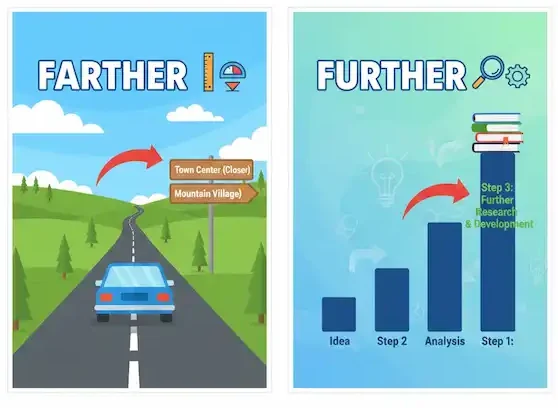
Farther vs Further: Mastering the Distance Distinction
Have you ever found yourself pausing, pen in hand or fingers hovering over the keyboard, wondering whether to use “farther” or “further”? You’re not alone! This common linguistic dilemma trips up even the most seasoned writers. But fear not, for by the end of this article, you’ll be navigating the nuances of “farther” and “further” with confidence.
While often used interchangeably, there’s a subtle yet significant distinction between these two words that, once understood, can elevate your writing and clarity.
Farther vs. Further – The Core Distinction: Physical vs. Figurative
The most widely accepted and helpful distinction lies in the type of “distance” you’re referring to:
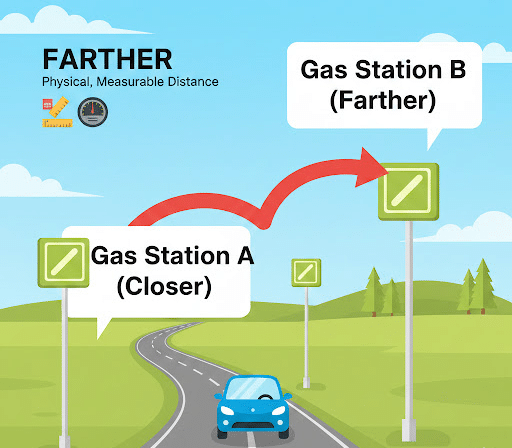
- Farther: Typically refers to physical, measurable distance. Think of something you can measure with a ruler, a odometer, or by walking.
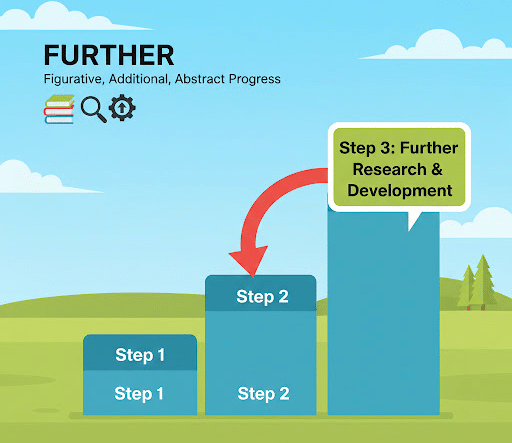
- Further: Typically refers to figurative, metaphorical, or additional extent, degree, or time. It often implies “more” or “to a greater extent.”
Let’s dive into some examples to solidify this concept.
Farther: For Tangible Journeys
When you’re talking about how many miles, kilometers, or steps something is, “farther” is your go-to word.
Examples:
- “The nearest gas station is farther down the road.” (Physical distance)
- “She can throw a baseball farther than anyone else on the team.” (Physical distance)
- “Our new house is farther from the city center than our old one.” (Physical distance)
- “How much farther do we have to walk?” (Physical distance)
- “The satellite traveled farther into space than any before it.” (Physical distance)
Here’s an illustration to help visualize “farther”:
Further: For Abstract Progress and Additional Information
“Further” is a more versatile word, encompassing ideas of “more,” “additional,” “to a greater degree,” or “to a greater extent.” It’s about progress, development, or expanding on a topic, not just physical movement.
Examples:
- “Let’s discuss this further at our next meeting.” (More discussion, additional extent)
- “She needs to do further research on the topic.” (Additional research)
- “The company decided to take further action to address the complaints.” (More action, to a greater extent)
- “He will provide further details tomorrow.” (Additional details)
- “To improve further, you need consistent practice.” (To a greater degree of improvement)
- “They pushed the boundaries of scientific understanding even further.” (To a greater extent of understanding)
Consider this image representing “further” progress:
The “F-U-R” Trick: A Helpful Mnemonic
Here’s a little trick that many find helpful:
- Think of FURther as encompassing FURthermore, which means “in addition” or “moreover.” If you can replace the word with “furthermore,” then “further” is likely the correct choice.
- “I need to do further research.” (I need to do furthermore research – sounds a bit clunky, but the idea of “in addition” is there).
While not a perfect substitution, it often helps to reinforce the “additional” or “to a greater extent” meaning of “further.”
Farther vs. Further – When “Further” Can Also Mean “Farther” (The Tricky Part!)
Here’s where it gets a little more complex. While the physical vs. figurative rule is generally reliable, some grammarians consider “further” acceptable when referring to physical distance, especially in American English.
However, “farther” cannot be used to mean “additional” or “to a greater extent.”
The Safe Bet:
- If it’s physical distance, use farther.
- If it’s figurative distance, extent, or “more,” use further.
By sticking to this rule, you’ll always be correct and precise in your language.
Charting the Differences – Farther vs. Further
This chart summarizes the key differences and provides a quick reference:
| Feature | Farther | Further |
| Primary Use | Physical, measurable distance | Figurative, additional, abstract extent/degree |
| Relates To | How far? (e.g., miles, feet) | How much more? To what extent? |
| Examples | “The car traveled farther.” | “Let’s discuss further.” |
| Can be used for | Physical distance only | Figurative extent, sometimes physical distance (less common) |
Additional Helpful Content: Synonyms & Context – Farther vs. Further
Understanding the synonyms for each word can also clarify their usage:
Farther (Synonyms for physical distance):
- More distant
- Remoter
- Beyond
Further (Synonyms for additional/greater extent):
- More
- Additional
- Supplementary
- Extra
- Moreoverre
- Additionally
- To a greater extent/degree
Context is Key: Always consider the context of your sentence. Are you literally measuring a distance, or are you talking about abstract progress or additional items?
Practice Makes Perfect
Here is a PDF worksheet you can download to practice using Farther vs. Further. The answers are on a separate page.
Frequently Asked Questions (FAQ) – Farther vs. Further
Q1: Is it ever wrong to use “further” for physical distance?
A1: While some style guides accept “further” for physical distance, “farther” is always the more precise and traditionally correct choice. Using “farther” for physical distance removes any ambiguity.
Q2: Can I use “farther” as an adverb?
A2: Yes, both “farther” and “further” can function as adverbs (e.g., “She ran farther than him.” “He looked further into the matter.”) and adjectives (e.g., “The farther shore.” “For further information.”).
Q3: Which word is more common?
A3: Generally, “further” is more common due to its broader application in figurative contexts.
Q4: Does this apply to “farthest” and “furthest” as well?
A4: Absolutely! The same distinction applies to their superlative forms:
* Farthest: Refers to the greatest physical distance (e.g., “That’s the farthest I’ve ever run.”).
* Furthest: Refers to the greatest degree, extent, or additional amount (e.g., “This is the furthest we’ve gotten on the project.”).
Conclusion – Farther vs. Further
While the distinction between “farther” and “further” can seem subtle at first, remembering the core rule – farther for physical distance, further for figurative or additional extent – will empower you to use these words with precision and confidence. It’s a small detail that can make a big difference in the clarity and sophistication of your writing.
Additional Helpful Links
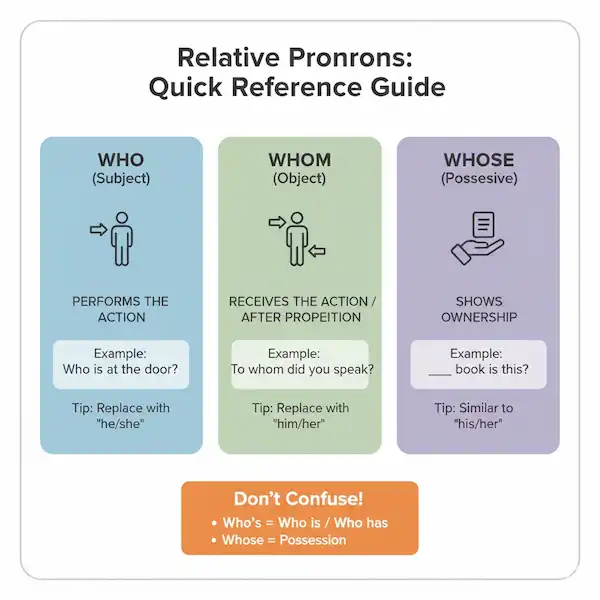
- Learn more about relative pronouns – Who Whom Whose: Mastering Relative Pronouns
External Links for Authoritative Sources: – Farther vs. Further
- Merriam-Webster: https://www.merriam-webster.com/words-at-play/farther-vs-further
- Purdue OWL (Online Writing Lab): https://owl.purdue.edu/owl/general_writing/common_errors_2/farther_vs_further.html
- Grammarly Blog: https://www.grammarly.com/blog/farther-vs-further/