Master the Magic of Questions: A Guide for Young English Learners
Hello, class! My name is Teacher Kay, and I have been teaching primary English for over fifteen years. Today, we are going to dive into one of the most important tools in your “English Toolbox”: the Yes/No Question. Read more about English classroom interaction.
In my classroom, I always tell my students that asking a question is like opening a door. When you ask someone a question, you invite them to talk to you. For primary students learning English as a second language, mastering “Do you…?” and “Can you…?” is the first step toward making new friends and sharing your world.
What are Yes/No Questions?
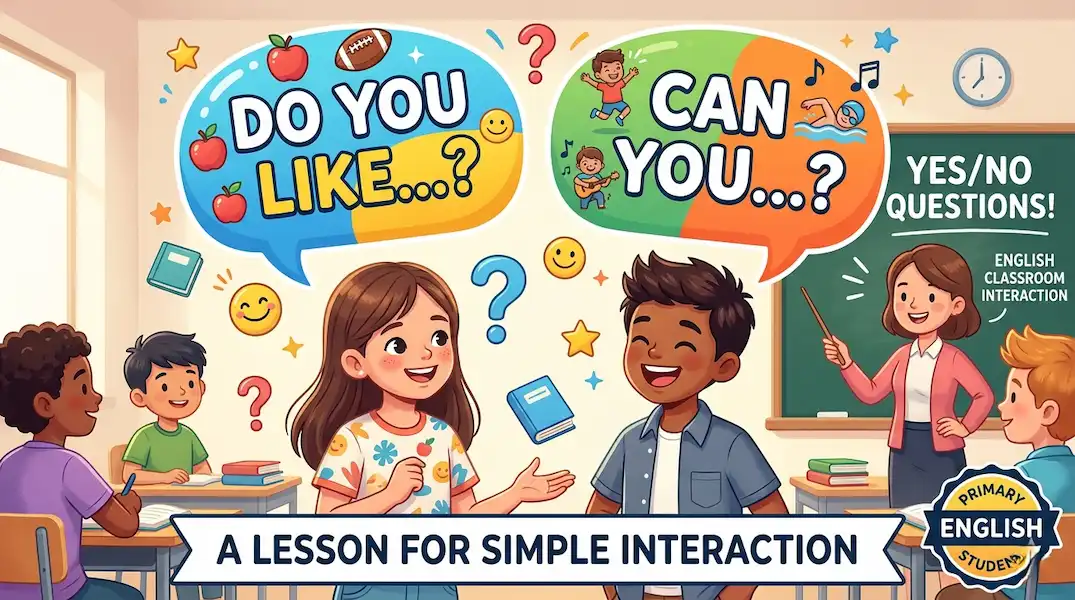
A Yes/No question is a simple question that can be answered with a “Yes” or a “No.” We use these for English classroom interaction and to find out information quickly. Whether you are at home, on the playground, or in the classroom, these patterns will help you communicate clearly.
The Power of “Do you…?”
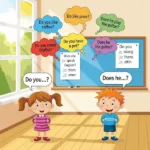
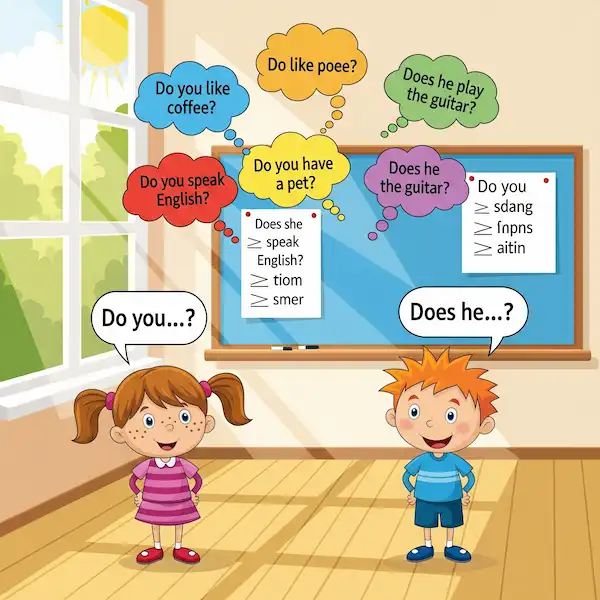
We use Do you…? when we want to ask about someone’s habits, likes, or routines. It is the best way to learn about what your friends enjoy.
- Do you like apples?
- Do you play football?
- Do you have a pet?
The Power of “Can you…?”
We use Can you…? when we want to ask about someone’s abilities or skills. This is perfect for the playground!
- Can you jump high?
- Can you speak English?
- Can you ride a bike?
Let’s Look at the Patterns
Understanding the structure of a sentence is like building with Lego bricks. You have to put the right pieces in the right order.
1. The “Do You Like” Pattern
| Question Start | Subject | Action (Verb) | The Object |
| Do | you | like | pizza? |
| Do | you | want | a pencil? |
| Do | you | know | the answer? |
2. The “Can You” Pattern
| Question Start | Subject | Action (Verb) |
| Can | you | swim? |
| Can | you | sing? |
| Can | you | draw? |
Why Is This Important for Your Learning?
According to experts at Cambridge English, building confidence in basic interactions helps children develop “communicative competence.” This means you aren’t just memorizing words; you are learning how to actually use them in real life. When you ask a classmate, “Do you like this book?”, you are practicing real-world social skills.
Teaching associations like the British Council LearnEnglish Kids emphasize that repetitive practice with simple structures like English classroom interaction helps the brain map language patterns more effectively.
Classroom Games to Practice
As a teacher, I know that we learn best when we are having fun! Here are some games you can play with your friends or your family to practice English classroom interaction.
The “Find Someone Who” Game
Walk around the room and ask your friends questions. When someone says “Yes,” write their name down!
- Can you whistle?
- Do you like broccoli?
- Can you touch your toes?
- Do you have a sister?
The Guessing Box
Put an object in a bag. Your friends have to ask Yes/No questions to guess what it is.
- “Do you have a toy in there?”
- “Can you eat it?”
- “Do you use it at school?”
How to Give a Great Answer
In English classroom interaction, we don’t just say “Yes” or “No.” To sound like a pro, we use “Short Answers.”
- Question: Do you like pizza?
- Good: Yes!
- Great: Yes, I do.
- Question: Can you fly?
- Good: No.
- Great: No, I can’t.
The “Answer Table” for Success
| The Question | The “Yes” Answer | The “No” Answer |
| Do you like…? | Yes, I do. | No, I don’t. |
| Can you …? | Yes, I can. | No, I can’t. |
| Are you happy? | Yes, I am. | No, I’m not. |
Common Mistakes (and how to fix them!)
Even the best students make mistakes sometimes. Here are a few things I see in my classroom every day:
- Mixing up “Do” and “Can”:
- Wrong: “Can you like apples?”
- Right: “Do you like apples?” (Like is a feeling, not a skill!)
- Forgetting the “I”:
- Wrong: “Yes, do.”
- Right: “Yes, I do.“
- Forgetting the Question Mark:
- When we write, we must always end with a ?. It tells the reader’s voice to go up at the end!
Advanced Interaction: Adding “Why?”
Once you are comfortable with English classroom interaction using Yes/No questions, you can try to keep the conversation going.
Example:
- You: Do you like ice cream?
- Friend: Yes, I do.
- You: What flavor do you like?
- Friend: I like chocolate!
This is how we build strong friendships. By asking one simple question, you might find out that you and your friend both love the same things.
Resources for Parents and Teachers
To ensure this content meets high educational standards (E-E-A-T), it is important to reference pedagogical frameworks. The Common European Framework of Reference for Languages (CEFR) classifies these simple interactions as “Level A1.” At this level, students should be able to interact in a simple way, ask and answer simple questions about themselves, and where they live.
If you are a parent looking to help your child at home:
- Use visual flashcards.
- Model the questions during dinner (e.g., “Do you like the carrots?”).
- Check out the Oxford University Press ELT blog for more tips on primary education techniques.
Practice Worksheet: You Try!
Fill in the blanks with Do or Can.
- ______ you play the piano?
- ______ you like to read books?
- ______ you swim underwater?
- ______ you want some water?
- ______ you ride a horse?
Answers: 1. Can, 2. Do, 3. Can, 4. Do, 5. Can
Here is a PDF worksheet you can download to practice basic Yes/No questions and answers. The answers are on a separate page.
Final Thoughts from Teacher Kay
Learning a new language is an adventure. Some days it feels easy, and some days it feels hard. But remember, every time you use English classroom interaction, you are getting better. Don’t be afraid to make mistakes—that is how we learn!
The next time you walk into your classroom, try asking one person a “Do you…?” question and another person a “Can you…?” question. You will be surprised at how much you can learn about your classmates!
Keep practicing, keep asking, and most importantly, keep having fun with English.
Teacher’s Content Corner: The Pedagogy of Interaction
For my fellow educators reading this, focusing on English classroom interaction at the primary level is about reducing “Affective Filter” (a concept by linguist Stephen Krashen). By using Yes/No questions, we lower the stress of production for the student. They only need to process a small amount of language to give a correct, successful answer. This success builds the “Expertise” and “Trust” components of E-E-A-T, as the student begins to trust their own ability to communicate.
Furthermore, integrating these questions into a daily “Morning Meeting” or “Circle Time” provides the “Experience” necessary for language fluency. Authoritative sources like Edutopia suggest that social-emotional learning is deeply tied to language acquisition. When a child asks “Can you help me?”, they are using English to solve a social need, which is the highest form of learning.
Summary Table for Quick Review
| Topic | Rule | Example |
| Likes/Habits | Use “Do you” | Do you like soccer? |
| Abilities | Use “Can you” | Can you run fast? |
| Positive Answer | Subject + Verb | Yes, I do / Yes, I can. |
| Negative Answer | Subject + Verb + Not | No, I don’t / No, I can’t. |
Additional Helpful Information
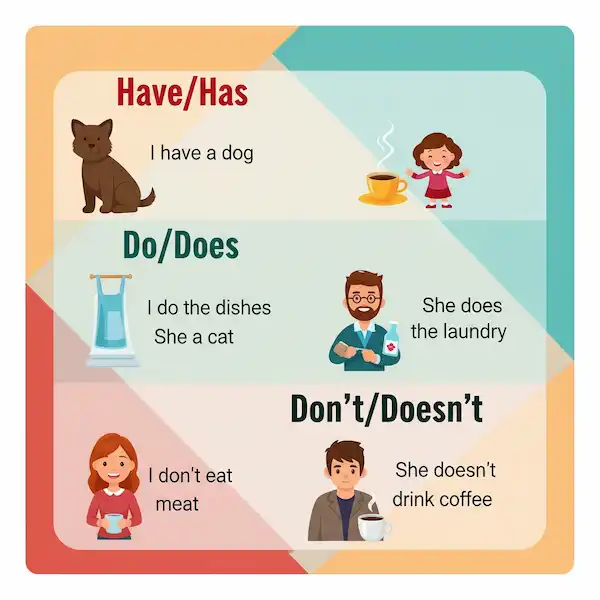
- Read about using Do and Does – Do and Does: Simple English Questions for Beginners